Canis lupus
The wolf, also known as the grey wolf or gray wolf, is a canine native to Eurasia and North America. More than thirty subspecies of Canis lupus have been recognized, including the dog and dingo, though grey wolves, as popularly understood, include only naturally occurring wild subspecies. The wolf is the largest wild extant member of the family Canidae, and is further distinguished from other Canis species by its less pointed ears and muzzle, as well as a shorter torso and a longer tail. The wolf is nonetheless related closely enough to smaller Canis species, such as the coyote and the golden jackal, to produce fertile hybrids with them. The wolf's fur is usually mottled white, brown, grey, and black, although subspecies in the arctic region may be nearly all white.

User:Mas3cf · CC BY-SA 4.0 · via Wikipedia/Commons. May be a photograph of a specimen, or an artist’s reconstruction — an interpretation of a skeleton, since colour and soft tissue are almost never preserved.
On record
Recorded, not inferred- Also called
- gray wolfPBDB
- Sits inside
- CanisPBDB
- Diet
- carnivorePBDB
- Life habit
- ground dwellingPBDB, for Canidae
- Motility
- actively mobilePBDB, for Osteichthyes
- Environment
- terrestrialPBDB, for Eutheria
Time the record covers
At least 2.5 million years on record.
The record covers at least 2.58 Mya to 11.7 ka. No occurrence read is dated outside 3.6 Mya to 0 Mya.
126 occurrences of Canis lupus on record, most of them in the Pleistocene. The Paleobiology Database records this as a living group. Bar height is expected occurrences, not a count: each fossil is spread across the span it is dated to, so a tall narrow bar means tight dating and a low wide one means loose.
When
126 occurrences- Pliocene1%
- Pleistocene89%
- Holocene10%
These are dates about fossils, not the animal: the record can only begin after it arose and end before it died out, so either end may reach further. Shares are expected occurrences: a fossil dated to a span is counted partly in each period it straddles. More on what this infers.
Found in
5 formations
- Chapala Formation2
- Cromer Forest Bed Formation2
- Floral Formation1
- Kairubak suite Formation1
- Guxiangtun Formation1
Loading coastlines…
The named rock units Canis lupus has been recovered from, largest first. Drawn where the rock is now, not where it formed. 119 occurrences have no formation on record, which is common for older literature.
Canis lupus and its relatives
PleistoceneWhere Canis lupus and its relatives were recorded in the Pleistocene.
Found in the same rock
1,284 taxa- Equus54 sites
- Microtus44 sites
- Cervus41 sites
- Vulpes vulpes38 sites
- Cervus elaphus34 sites
- Sus scrofa34 sites
- Lepus32 sites
- Bos primigenius30 sites
- Bison29 sites
- Myodes27 sites
- Equus caballus26 sites
- Panthera leo26 sites
- Capreolus capreolus24 sites
- Ursus arctos24 sites
- Panthera pardus23 sites
- Ursus23 sites
- Arvicola21 sites
- Apodemus sylvaticus19 sites
- Pliomys19 sites
- Crocuta crocuta18 sites
- Microtus arvalis18 sites
- Megaloceros17 sites
- Palaeoloxodon antiquus17 sites
- Apodemus16 sites
The Paleobiology Database records 125 sites for Canis lupus, and this reads all of them. The number is how many of those sites it was catalogued from too. The 24 sharing the most are listed.
This is not a list of everything alive at the time. It is only what has come out of the same ground as this animal and been written down.
Entered from
81 references- Mittelpleistozane Saugetierfaunen aus Mitteleuropa - der Versuch einer biostratigraphischen Zuordnung13
- I giacimenti Quaternari di vertebrati fossili nell'Italia Nord-Orientale12
- Le gisement Pleistocene moyen et superieur d'Artenac (Saint-Mary, Charent): premier bilan interdisciplinaire6
- From tortoises to elephants: the impact of elephants in the broad spectrum diet at Bolomor Cave (MIS 9–5 Spain)4
- Quaternary vertebrates from Shiriya area, Shimokita Pininsula, northeastern Japan4
- Pleistocene vertebrate faunas of Hungary3
- Polar bear fossil and archaeological records from the Pleistocene and Holocene in relation to sea ice extent and open water polynyas2
- Late Cenozoic fossil mammals from the Chapala rift basin, Jalisco, Mexico2
- The Villafranchian mammalian faunas and biochronology of Greece2
- Fossil equids (Mammalia, Equidae) from the Neogene and Pleistocene of Tadzhikistan2
- Carnivores from the Early Pleistocene hominid-bearing Trinchera Dolina 6 (Sierra de Atapuerca, Spain)2
- Vertebrates of the Last Interglaciation in Canada: A Review, with New Data2
Each of the 126 occurrences read was entered from one of these publications, ordered by how many each accounts for. This is not a search for papers mentioning the name. 69 further references are not listed. Entries link to doi.org where the Paleobiology Database holds an identifier, and to its own record where it does not. Relayed as the Paleobiology Database holds them, not checked against what they resolve to.
Media and terms
Media content3
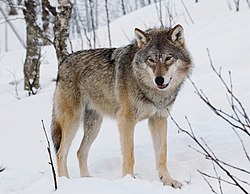
Picture of Canis lupus
- Source
- Wikipedia/Commons
- Credit
- User:Mas3cf
- Licence
- CC BY-SA 4.0
- Commercial use
- the licence allows it
CT scan
- Source
- MorphoSource
- Licence
- not stated by the source
- Commercial use
- cannot be read from the licence given — check the record
- Specimen
- Canis lupus · msu:mr:36390
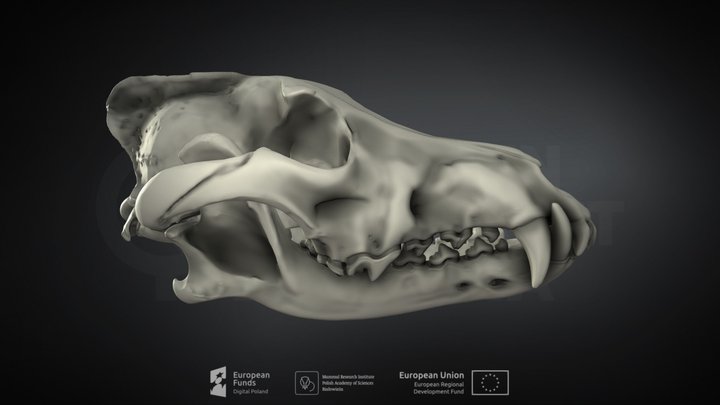
3D model
- Source
- Sketchfab
- Licence
- CC Attribution
- Commercial use
- cannot be read from the licence given — check the record
The description on this site
- Source
- Wikipedia, “Wolf”
- Licence
- CC BY-SA 4.0
This is what the site found, which is not the same as what exists.
Keep going
What may have been alongside itCanis through timeFormations of the PleistoceneThe world it lived on
Occurrence data from the Paleobiology Database, CC BY 4.0. Linnaeus 1758