Arceuthobium sp.
The genus Arceuthobium, commonly called dwarf mistletoes, is a genus of 42 species of parasitic plants that parasitize members of Pinaceae and Cupressaceae in North America, Central America, Asia, Europe, and Africa. Of the 42 species that have been recognized, 39 and 21 of these are endemic to North America and the United States, respectively. They all have very reduced shoots and leaves with the bulk of the plant living under the host's bark. Recently the number of species within the genus has been reduced to 26 as a result of more detailed genetic analysis.

Stan Shebs · CC BY-SA 3.0 · via Wikipedia/Commons. May be a photograph of a specimen, or an artist’s reconstruction — an interpretation of a skeleton, since colour and soft tissue are almost never preserved.
Time the record covers
At least 2.4 million years on record.
The record covers at least 2.58 Mya to 129 ka. No occurrence read is dated outside 5.333 Mya to 11.7 ka.
8 occurrences of Arceuthobium sp. on record. Bar height is expected occurrences, not a count: each fossil is spread across the span it is dated to, so a tall narrow bar means tight dating and a low wide one means loose.
When
8 occurrences- Pliocene75%
- Pleistocene25%
These are dates about fossils, not the animal: the record can only begin after it arose and end before it died out, so either end may reach further. Shares are expected occurrences: a fossil dated to a span is counted partly in each period it straddles. More on what this infers.
Found in the same rock
180 taxa- Pinus8 sites
- Alnus7 sites
- Betula7 sites
- Ericaceae7 sites
- Poaceae7 sites
- Quercus7 sites
- Salix7 sites
- Acer6 sites
- Asteraceae6 sites
- Cathaya6 sites
- Cistaceae6 sites
- Engelhardia6 sites
- Gleicheniaceae6 sites
- Myrica6 sites
- <Amaranthaceae/Chenopodiaceae>5 sites
- <not identified>5 sites
- Apiaceae5 sites
- Carya5 sites
- Corylus5 sites
- Cupressaceae5 sites
- Ilex aquifolium5 sites
- Juglans5 sites
- Nyssa5 sites
- Oleaceae5 sites
The Paleobiology Database records 8 sites for Arceuthobium sp., and this reads all of them. The number is how many of those sites it was catalogued from too. The 24 sharing the most are listed.
This is not a list of everything alive at the time. It is only what has come out of the same ground as this animal and been written down.
Entered from
3 references- Niche evolution versus niche conservatism and habitat loss determine persistence and extirpation in late Neogene European Fagaceae6
- Late-glacial vegetation and climate at the Manis mastodon site, Olympic Peninsula, Washington1
- The Finding of Pleistocene Material in an Asphalt Pit at Carpinteria, California1
Each of the 8 occurrences read was entered from one of these publications, ordered by how many each accounts for. This is not a search for papers mentioning the name. Each entry links to doi.org. Relayed as the Paleobiology Database holds them, not checked against what they resolve to.
Media and terms
Media content1
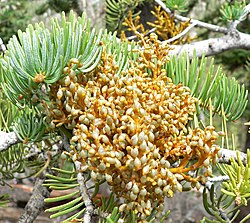
Picture of Arceuthobium sp.
- Source
- Wikipedia/Commons
- Credit
- Stan Shebs
- Licence
- CC BY-SA 3.0
- Commercial use
- the licence allows it
No 3D scan of Arceuthobium sp. was found in MorphoSource and Sketchfab.
Smithsonian Open Access was not reached for this taxon, so this list is what the others held rather than everything there is.
The description on this site
- Licence
- CC BY-SA 4.0
This is what the site found, which is not the same as what exists.
Keep going
What may have been alongside itThe world it lived on
Occurrence data from the Paleobiology Database, CC BY 4.0.