Archaeopteryx
Archaeopteryx, sometimes referred to by its German name, "Urvogel " is an extinct genus of bird-like dinosaurs. The genus name derives from the Ancient Greek ἀρχαῖος, meaning 'ancient', and πτέρυξ, meaning 'feather, wing'. Between the late 19th century and the early 21st century, Archaeopteryx was generally accepted by palaeontologists and popular reference books as the oldest known bird. Older potential avialans have since been identified, including Anchiornis, Xiaotingia, Aurornis, and Baminornis.

H. Raab ( User: Vesta ) · CC BY-SA 3.0 · via Wikipedia/Commons. May be a photograph of a specimen, or an artist’s reconstruction — an interpretation of a skeleton, since colour and soft tissue are almost never preserved.
On record
Recorded, not inferred- Sits inside
- AvialaePBDB
- Diet
- piscivore, insectivorePBDB
- Life habit
- volantPBDB
- Motility
- actively mobilePBDB, for Theropoda
- Environment
- coastalPBDB
- Length
- 0.5 mWikidata
Time the record covers
At least 19 million years on record.
The record covers at least 145.06 Mya to 125.77 Mya. No occurrence read is dated outside 149.2 Mya to 121.4 Mya.
10 occurrences of Archaeopteryx on record, most of them in the Late Jurassic. Bar height is expected occurrences, not a count: each fossil is spread across the span it is dated to, so a tall narrow bar means tight dating and a low wide one means loose.
When
10 occurrencesThese are dates about fossils, not the animal: the record can only begin after it arose and end before it died out, so either end may reach further. Shares are expected occurrences: a fossil dated to a span is counted partly in each period it straddles. More on what this infers.
Found in
5 formations
- Altmühltal Formation · Weißjura Group5
- Solnhofen Formation1
- Camarillas Formation1
- Painten Formation · Weißjura Group1
- Mörnsheim Formation · Weißjura Group1
Loading coastlines…
The named rock units Archaeopteryx has been recovered from, largest first. Drawn where the rock is now, not where it formed. 1 occurrence has no formation on record, which is common for older literature.
Archaeopteryx and its relatives
Late JurassicWhere Archaeopteryx and its relatives were recorded in the Late Jurassic.
Found in the same rock
29 taxa- Acrosaurus frischmanni1 site
- Albanerpetontidae1 site
- Ardeosaurus brevipes1 site
- Bernissartia1 site
- Caturus furcatus1 site
- Cricosaurus1 site
- Cricosaurus elegans1 site
- Cricosaurus gracilis1 site
- Dakosaurus maximus1 site
- Eobaatar pajaronensis1 site
- Geosaurus grandis1 site
- Geosaurus medius1 site
- Germanodactylus cristatus1 site
- Germanodactylus rhamphastinus1 site
- Jurapteryx recurva1 site
- Lepidotes1 site
- Lepidotus unguiculatus1 site
- Listroteuthis conica1 site
- Metriorhynchinae1 site
- Meyasaurus1 site
- Muensterella spinosa1 site
- Ornithischia1 site
- Pholidophorus radians1 site
- Pleurosaurus goldfussi1 site
The Paleobiology Database records 10 sites for Archaeopteryx, and this reads all of them. The number is how many of those sites it was catalogued from too. The 24 sharing the most are listed.
This is not a list of everything alive at the time. It is only what has come out of the same ground as this animal and been written down.
Entered from
10 references- The first specimen of Archaeopteryx from the Upper Jurassic Mörnsheim Formation of Germany1
- The oldest Archaeopteryx (Theropoda: Avialiae): a new specimen from the Kimmeridgian/Tithonian boundary of Schamhaupten, Bavaria1
- The ninth specimen of Archaeopteryx from Solnhofen1
- A new genus and species for the largest specimen of Archaeopteryx1
- Multituberculaten-Zähne aus der Unter-Kreide (Barremium) von Pié Pajarón (Prov. Cuenca, Spanien)1
- The teeth of Archaeopteryx and a reinterpretation of the Eichstätt specimen1
- Description of the Archaeopteryx specimen in the Teyler Museum, Haarlem1
- Über Brustbein, Schulter- und Beckengürtel der Archaeopteryx [On the breastbone, shoulder- and pelvic-girdle of Archaeopteryx]1
- On the fossil remains of a long-tailed bird (Archeopteryx macrurus, Ow) from the Lithographic Slate of Solenhofen1
- Beiträge zur näheren Kenntniss fossiler Reptilien [Contributions to the detailed knowledge of fossil reptiles]1
Each of the 10 occurrences read was entered from one of these publications, ordered by how many each accounts for. This is not a search for papers mentioning the name. Entries link to doi.org where the Paleobiology Database holds an identifier, and to its own record where it does not. Relayed as the Paleobiology Database holds them, not checked against what they resolve to.
Media and terms
Media content3
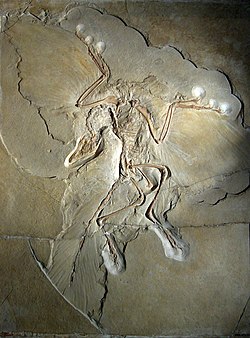
Picture of Archaeopteryx
- Source
- Wikipedia/Commons
- Credit
- H. Raab ( User: Vesta )
- Licence
- CC BY-SA 3.0
- Commercial use
- the licence allows it
CT scan
- Source
- MorphoSource
- Licence
- In Copyright
- Commercial use
- cannot be read from the licence given — check the record
- Specimen
- Archaeopteryx sp. · FMNH:PA:830
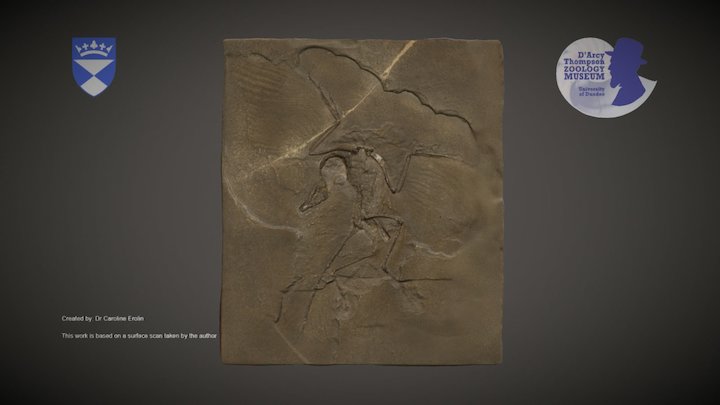
3D model
- Source
- Sketchfab
- Licence
- CC0 Public Domain
- Commercial use
- the licence allows it
The description on this site
- Licence
- CC BY-SA 4.0
This is what the site found, which is not the same as what exists.
Keep going
What may have been alongside itAvialae through timeFormations of the Late JurassicThe world it lived on
Occurrence data from the Paleobiology Database, CC BY 4.0. Meyer 1861