Asiatosuchus germanicus
Asiatosuchus is an extinct genus of crocodyloid crocodilians that lived in Eurasia during the Paleogene. Many Paleogene crocodilians from Europe and Asia have been attributed to Asiatosuchus since the genus was named in 1940. These species have a generalized crocodilian morphology typified by flat, triangular skulls. The feature that traditionally united these species under the genus Asiatosuchus is a broad connection or symphysis between the two halves of the lower jaw. Recent studies of the evolutionary relationships of early crocodilians along with closer examinations of the morphology of fossil specimens suggest that only the first named species of Asiatosuchus, A. grangeri from the Eocene of Mongolia, belongs in the genus. Most species are now regarded as nomina dubia or "dubious names", meaning that their type specimens lack the unique anatomical features necessary to justify their classification as distinct species. Other species such as "A." germanicus and "A." depressifrons are still considered valid species, but they do not form an evolutionary grouping with A. grangeri that would warrant them being placed together in the genus Asiatosuchus.

Yan-yin Wang, Corwin Sullivan, Jun Liu · CC BY 4.0 · via Wikipedia/Commons. May be a photograph of a specimen, or an artist’s reconstruction — an interpretation of a skeleton, since colour and soft tissue are almost never preserved.
On record
Recorded, not inferred- Sits inside
- AsiatosuchusPBDB
- Diet
- carnivorePBDB, for Crocodylia
- Motility
- actively mobilePBDB, for Osteichthyes
- Environment
- marinePBDB, for Mesoeucrocodylia
Time the record covers
At most 7.1 million years on record.
Every occurrence read is dated to somewhere between 48.07 Mya and 41.03 Mya, and nothing in the dating separates them, so that window is what the record shows rather than a span.
3 occurrences of Asiatosuchus germanicus on record, most of them in the Eocene. Bar height is expected occurrences, not a count: each fossil is spread across the span it is dated to, so a tall narrow bar means tight dating and a low wide one means loose.
When
3 occurrences- Eocene100%
These are dates about fossils, not the animal: the record can only begin after it arose and end before it died out, so either end may reach further. Shares are expected occurrences: a fossil dated to a span is counted partly in each period it straddles. More on what this infers.
Asiatosuchus germanicus and its relatives
EoceneWhere Asiatosuchus germanicus and its relatives were recorded in the Eocene.
Found in the same rock
77 taxa- Eurohippus parvulus3 sites
- Geochelone3 sites
- Hyrachyus3 sites
- Lophiodon remensis3 sites
- Propalaeotherium voigti3 sites
- Ailuravus picteti2 sites
- Allognathosuchus2 sites
- Amphiperca2 sites
- Borkenia germanica2 sites
- Cyclurus kehreri2 sites
- Diatryma2 sites
- Diplocynodon2 sites
- Eolacerta robusta2 sites
- Geoemyda ptychogastroides2 sites
- Lophiodon tapirotherium2 sites
- Necrosaurus2 sites
- Palaeoesox fritzschei n. sp.2 sites
- Palaeopython ceciliensis2 sites
- Palaeotherium isselanum2 sites
- Paleryx spinifer2 sites
- Propalaeotherium hassiacum2 sites
- Protoadapis2 sites
- Rhinocerolophiodon buxovillanum2 sites
- Thaumaturus2 sites
The Paleobiology Database records 3 sites for Asiatosuchus germanicus, and this reads all of them. The number is how many of those sites it was catalogued from too. The 24 sharing the most are listed.
This is not a list of everything alive at the time. It is only what has come out of the same ground as this animal and been written down.
Entered from
1 referenceEach of the 3 occurrences read was entered from one of these publications, ordered by how many each accounts for. This is not a search for papers mentioning the name. Each entry links to the Paleobiology Database's own record for the work.
Media and terms
Media content1
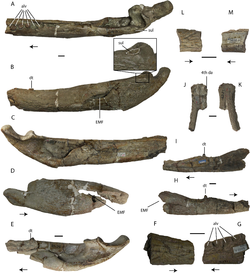
Picture of Asiatosuchus germanicus
- Source
- Wikipedia/Commons
- Credit
- Yan-yin Wang, Corwin Sullivan, Jun Liu
- Licence
- CC BY 4.0
- Commercial use
- the licence allows it
No 3D scan of Asiatosuchus germanicus was found in Smithsonian Open Access and Sketchfab.
MorphoSource was not reached for this taxon, so this list is what the others held rather than everything there is.
The description on this site
- Licence
- CC BY-SA 4.0
This is what the site found, which is not the same as what exists.
Keep going
What may have been alongside itAsiatosuchus through timeFormations of the EoceneThe world it lived on
Occurrence data from the Paleobiology Database, CC BY 4.0. Berg 1966