Asteroidea
Searched as Asteroidea indet.. The Paleobiology Database treats Asteroidea as the accepted name.
Starfish or sea stars are a class of echinoderms generally shaped like a star polygon. Starfish are also known as asteroids because they form the taxonomic class Asteroidea. About 1,900 species of starfish live on the seabed, and are found in all the world's oceans, from warm, tropical zones to frigid, polar regions. They can occur from the intertidal zone down to abyssal depths, at 6,000 m (20,000 ft) below the surface.

Top left: Klaus Rassinger (Museum Wiesbaden) Top right: Katie Ahlfeld Bottom right: Jon Zander (Digon3) Bottom left:… · CC BY-SA 4.0 · via Wikipedia/Commons. May be a photograph of a specimen, or an artist’s reconstruction — an interpretation of a skeleton, since colour and soft tissue are almost never preserved.
On record
Recorded, not inferred- Also called
- sea starPBDB
- Sits inside
- AsterozoaPBDB
- Diet
- carnivorePBDB
- Life habit
- low-level epifaunalPBDB
- Motility
- slow-movingPBDB
- Vision
- limitedPBDB
- Environment
- marinePBDB, for Echinodermata
Time the record covers
At least 462 million years on record.
The record covers at least 463.3 Mya to 774 ka. No occurrence read is dated outside 471.3 Mya to 129 ka.
139 occurrences of Asteroidea on record, most of them in the Carboniferous. The Paleobiology Database records this as a living group, and the chart stops with its fossils rather than at the present. Bar height is expected occurrences, not a count: each fossil is spread across the span it is dated to, so a tall narrow bar means tight dating and a low wide one means loose.
When
139 occurrences- Ordovician9%
- Silurian4%
- Devonian8%
- Carboniferous21%
- Permian1%
- Late Triassicunder 1%
- Early Jurassicunder 1%
- Middle Jurassic17%
- Late Jurassic11%
- Early Cretaceous4%
- Late Cretaceous11%
- Paleocene1%
- Eocene4%
- Oligocene4%
- Mioceneunder 1%
- Pliocene2%
- Pleistoceneunder 1%
These are dates about fossils, not the animal: the record can only begin after it arose and end before it died out, so either end may reach further. Shares are expected occurrences: a fossil dated to a span is counted partly in each period it straddles. More on what this infers.
Found in
64 formations
- Wewoka Formation19
- Dyer Formation · Chaffee Group4
- Geneseo Formation · Genesee Group4
- Borden Formation3
- Bobcaygeon Formation3
- Keasey Formation3
Loading coastlines…
The named rock units Asteroidea has been recovered from, largest first. Drawn where the rock is now, not where it formed. 40 further formations hold fewer occurrences each and are not listed. 34 occurrences have no formation on record, which is common for older literature.
Asteroidea and its relatives
CarboniferousWhere Asteroidea and its relatives were recorded in the Carboniferous.
Found in the same rock
3,214 taxa- Echinoidea40 sites
- Crinoidea37 sites
- Bryozoa25 sites
- Goniasteridae22 sites
- Ostracoda20 sites
- Ammodiscus19 sites
- Bairdia19 sites
- Euphemites carbonarius19 sites
- Promopalaeaster19 sites
- Pseudozygopleurids indet.19 sites
- Cornulites18 sites
- Earlandinita18 sites
- Plagioglypta18 sites
- Reophax18 sites
- Ammobaculites17 sites
- Anthraconeilo taffiana17 sites
- Bathysiphon17 sites
- Crurithyris planoconvexa17 sites
- Dendrocrinus17 sites
- Glabrocingulum grayvillense17 sites
- Holothuria17 sites
- Ianthinopsis17 sites
- Meekospira peracuta17 sites
- Nuculopsis wewokana17 sites
The Paleobiology Database records 653 sites for Asteroidea, and this reads 240 of them. The number is how many of those sites it was catalogued from too. The 24 sharing the most are listed.
This is not a list of everything alive at the time. It is only what has come out of the same ground as this animal and been written down.
Entered from
65 references- Palaeoenvironmental interpretation of echinoderm assemblages from Bathonian ore-bearing clays at Gnaszyn (Kraków-Silesia Homocline, Poland)19
- Marine Communities of a Portion of the Wewoka Formation (Pennsylvanian) in Hughes County, Oklahoma19
- Unpublished data8
- Caradocian-Gedinnian echinoderm associations of Central and Eastern North America6
- Work with Thayer collections, Yale Peabody Accession 7112, published, in part, "New perspectives on transitions between ecological-evolutionary subunits in the "type interval" for coordinated stasis", James J Zambito IV, Carlton E Brett, Gordon C Baird, Sarah E Kolbe, Arnold I Miller; Paleobiology4
- Crinoids and Stelleroids (Echinodermata) from the Broken Rib Member, Dyer Formation (Late Devonian, Famennian) of the White River Plateau, Colorado4
- Les Goniasteridae (Asteroidea, Echinodermata) jurassiques et crétacés de France. Taphonomie, systématique, biostratigraphie, paléobiogéographie, évolution.4
- Evenness, richness and the Cambrian-Paleozoic faunal transition in North America: an assemblage-level perspective3
- Fossil communities of the Borden (Mississippian) delta in Indiana and northern Kentucky3
- Paleontology and Paleoecology of the Basal New Providence Shale (Osagian: Mississippian) at Paris Landing, Tennessee3
- The correlation of the lower chalk of south-east England3
- Characteristic lower Cretaceous megafossils from northern Alaska3
Each of the 139 occurrences read was entered from one of these publications, ordered by how many each accounts for. This is not a search for papers mentioning the name. 53 further references are not listed. Entries link to doi.org where the Paleobiology Database holds an identifier, and to its own record where it does not. Relayed as the Paleobiology Database holds them, not checked against what they resolve to.
Media and terms
Media content2

Picture of Asteroidea
- Source
- Wikipedia/Commons
- Credit
- Top left: Klaus Rassinger (Museum Wiesbaden) Top right: Katie Ahlfeld Bottom right: Jon Zander (Digon3) Bottom left:…
- Licence
- CC BY-SA 4.0
- Commercial use
- the licence allows it
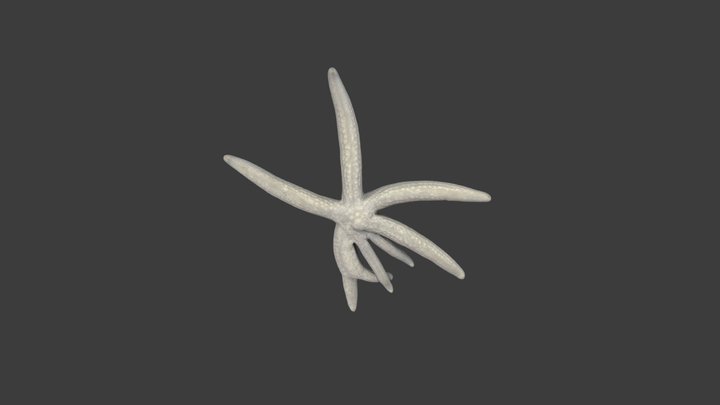
3D model
- Source
- Sketchfab
- Licence
- CC0 Public Domain
- Commercial use
- the licence allows it
Smithsonian Open Access was not reached for this taxon, so this list is what the others held rather than everything there is.
The description on this site
- Source
- Wikipedia, “Starfish”
- Licence
- CC BY-SA 4.0
This is what the site found, which is not the same as what exists.
Keep going
What may have been alongside itAsterozoa through timeFormations of the CarboniferousThe world it lived on
Occurrence data from the Paleobiology Database, CC BY 4.0. (de Blainville 1830)