Asterozoa
The Asterozoa are a subphylum in the phylum Echinodermata, within the Eleutherozoa. Characteristics include a star-shaped body and radially divergent axes of symmetry. The subphylum includes the classes Asteroidea, Ophiuroidea, Somasteroidea, and Stenuroidea. A fifth class, Concentricycloidea, was proposed for the unusual genus Xyloplax, but was later demoted to the status of infraclass as the sister of Neoasteroidea within the asteroidean subclass Ambuloasteroidea.

NOAA Ocean Exploration · CC BY-SA 2.0 · via Wikipedia/Commons. May be a photograph of a specimen, or an artist’s reconstruction — an interpretation of a skeleton, since colour and soft tissue are almost never preserved.
On record
Recorded, not inferred- Sits inside
- EleutherozoaPBDB
- Diet
- carnivorePBDB
- Life habit
- epifaunalPBDB
- Motility
- actively mobilePBDB
- Environment
- marinePBDB, for Echinodermata
Time the record covers
At least 476 million years on record.
The record covers at least 477.1 Mya to 129 ka. No occurrence read is dated outside 488.9 Mya to 11.7 ka.
2,571 occurrences of Asterozoa on record, most of them in the Late Cretaceous. The Paleobiology Database records this as a living group. Bar height is expected occurrences, not a count: each fossil is spread across the span it is dated to, so a tall narrow bar means tight dating and a low wide one means loose.
When
2,571 occurrences- Cambrianunder 1%
- Ordovician8%
- Silurian3%
- Devonian8%
- Carboniferous5%
- Permian1%
- Early Triassic1%
- Middle Triassic3%
- Late Triassic2%
- Early Jurassic5%
- Middle Jurassic7%
- Late Jurassic6%
- Early Cretaceous5%
- Late Cretaceous34%
- Paleocene2%
- Eocene4%
- Oligoceneunder 1%
- Miocene2%
- Plioceneunder 1%
- Pleistoceneunder 1%
These are dates about fossils, not the animal: the record can only begin after it arose and end before it died out, so either end may reach further. Shares are expected occurrences: a fossil dated to a span is counted partly in each period it straddles. More on what this infers.
Found in
460 formations
- Gulpen Formation92
- Maastricht Formation78
- White Chalk Formation59
- La Meseta Formation52
- Hunsrück Slate Formation45
- Bangor Limestone Formation27
Loading coastlines…
The named rock units Asterozoa has been recovered from, largest first. Drawn where the rock is now, not where it formed. 436 further formations hold fewer occurrences each and are not listed. 931 occurrences have no formation on record, which is common for older literature.
Asterozoa and its relatives
Late CretaceousWhere Asterozoa and its relatives were recorded in the Late Cretaceous.
Found in the same rock
3,011 taxa- Echinoidea62 sites
- Fenestella43 sites
- Asteroidea39 sites
- Ophiuroidea39 sites
- Cleiothyridina36 sites
- Fistulipora36 sites
- Cornulites35 sites
- Bryozoa33 sites
- Crinoidea32 sites
- Dichocrinus31 sites
- Spirorbis30 sites
- Orthotetes29 sites
- Composita28 sites
- Rhabdomeson28 sites
- Pentremites27 sites
- Rhombopora27 sites
- Anthracospirifer leidyi26 sites
- Eumetria26 sites
- Torynifer26 sites
- Camptocrinus24 sites
- Aphelacrinus sp.23 sites
- Archimedes23 sites
- Productida23 sites
- Tolypammina23 sites
The Paleobiology Database records at least 805 sites for Asterozoa, and this reads 240 of them. Of that, one read hit the database's own return limit, so every count below is a floor rather than a total. The number is how many of those sites it was catalogued from too. The 24 sharing the most are listed.
This is not a list of everything alive at the time. It is only what has come out of the same ground as this animal and been written down.
Entered from
531 references- Les Goniasteridae (Asteroidea, Echinodermata) jurassiques et crétacés de France. Taphonomie, systématique, biostratigraphie, paléobiogéographie, évolution.169
- Late Cretaceous-Early Paleocene echinoderms and the K/T boundary in the southeast Netherlands and the northeast Belgium. - part 3: Ophiuroids165
- Late Cretaceous-Early Paleocene echinoderms and the K/T boundary in the southeast Netherlands and the northeast Belgium. - part 5: Asteroids105
- Systématique des astérides (Asteroidea, Echinodermata) de Tercis-les-Bains (Landes, France)63
- Campanian-Maastrichtian ophiuroids (Echinodermata) from Tercis les Bains (Landes, France)61
- The fossil fauna of the Ordovician in the Cincinnati Region52
- Echinodermata aus dem Ober-Toarcium und Aalenium Deutschlands II: Ophiuroidea51
- Eocene stelleroids (Echinodermata) at Seymour Island, Antarctic Peninsula50
- Palaeoenvironmental interpretation of echinoderm assemblages from Bathonian ore-bearing clays at Gnaszyn (Kraków-Silesia Homocline, Poland)47
- Isolated sclerites of Devonian non−pelmatozoan echinoderms47
- Astérides du Cénomanien de Charente-Maritime (SW France)43
- Pflanzen im Hunsrueckschiefer43
Each of the 2,571 occurrences read was entered from one of these publications, ordered by how many each accounts for. This is not a search for papers mentioning the name. 519 further references are not listed. Entries link to doi.org where the Paleobiology Database holds an identifier, and to its own record where it does not. Relayed as the Paleobiology Database holds them, not checked against what they resolve to.
Media and terms
Media content2

Picture of Asterozoa
- Source
- Wikipedia/Commons
- Credit
- NOAA Ocean Exploration
- Licence
- CC BY-SA 2.0
- Commercial use
- the licence allows it
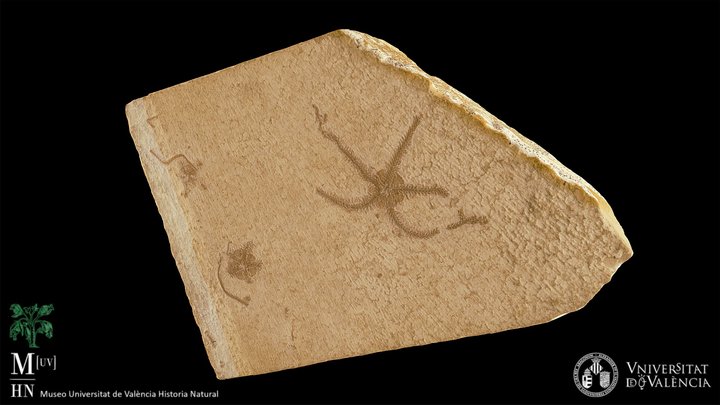
3D model
- Source
- Sketchfab
- Licence
- CC Attribution
- Commercial use
- cannot be read from the licence given — check the record
Smithsonian Open Access was not reached for this taxon, so this list is what the others held rather than everything there is.
The description on this site
- Source
- Wikipedia, “Asterozoa”
- Licence
- CC BY-SA 4.0
This is what the site found, which is not the same as what exists.
Keep going
What may have been alongside itEleutherozoa through timeFormations of the Late CretaceousThe world it lived on
Occurrence data from the Paleobiology Database, CC BY 4.0. (von Zittel 1895)