Atrina pectinata
Atrina pectinata is a species of bivalves belonging to the family Pinnidae, and has the common names comb pen shell and fan mussel in English.

Scanned by Tom Meijer · Public Domain · via Wikipedia/Commons. May be a photograph of a specimen, or an artist’s reconstruction — an interpretation of a skeleton, since colour and soft tissue are almost never preserved.
On record
Recorded, not inferred- Sits inside
- AtrinaPBDB
- Diet
- suspension feederPBDB, for Atrina
- Life habit
- semi-infaunalPBDB, for Atrina
- Motility
- stationary, attachedPBDB, for Atrina
- Vision
- blindPBDB, for Bivalvia
- Environment
- marine,brackishPBDB, for Ostreida
Time the record covers
At least 19 million years on record.
The record covers at least 23.04 Mya to 3.6 Mya. No occurrence read is dated outside 27.3 Mya to 2.58 Mya.
30 occurrences of Atrina pectinata on record, most of them in the Miocene. The Paleobiology Database records this as a living group, and the chart stops with its fossils rather than at the present. Bar height is expected occurrences, not a count: each fossil is spread across the span it is dated to, so a tall narrow bar means tight dating and a low wide one means loose.
When
30 occurrencesThese are dates about fossils, not the animal: the record can only begin after it arose and end before it died out, so either end may reach further. Shares are expected occurrences: a fossil dated to a span is counted partly in each period it straddles. More on what this infers.
Found in
8 formations
- Breda Formation2
- Maraldi Sandstone Formation1
- Pinczow Formation1
- Niechobrz Formation1
- Linz Formation1
- Tajima Formation1
Loading coastlines…
The named rock units Atrina pectinata has been recovered from, largest first. Drawn where the rock is now, not where it formed. 21 occurrences have no formation on record, which is common for older literature.
Atrina pectinata and its relatives
MioceneWhere Atrina pectinata and its relatives were recorded in the Miocene.
Found in the same rock
801 taxa- Varicorbula gibba24 sites
- Venus (Ventricoloidea) multilamella24 sites
- Limopsis22 sites
- Ringicula buccinea22 sites
- Aporrhais (Aporrhais)21 sites
- Astarte (Astarte) radiata21 sites
- Gemmula (Gemmula)21 sites
- Gouldia (Gouldia) minima21 sites
- Limopsis (Limopsis) aurita21 sites
- Scapharca (Scapharca) diluvii21 sites
- Turritella21 sites
- Yoldia (Yoldia) glaberrima21 sites
- Lyrotyphis20 sites
- Mitrella20 sites
- Nassarius20 sites
- Parvicardium20 sites
- Pleurotomoides20 sites
- Saccella westendorpi20 sites
- Strioterebrum20 sites
- Teretia20 sites
- Unedogemmula20 sites
- Asthenotoma19 sites
- Boreodrillia19 sites
- Conus (Conolithes)19 sites
The Paleobiology Database records 30 sites for Atrina pectinata, and this reads all of them. The number is how many of those sites it was catalogued from too. The 24 sharing the most are listed.
This is not a list of everything alive at the time. It is only what has come out of the same ground as this animal and been written down.
Entered from
10 references- Die Fauna des marinen Miozäns von Kevelaer (Niederrhein). Band 2 Bivalvia, Scaphopoda, Cephalopoda, Bryozoa, Annelida, Brachiopoda19
- Middle Miocene bivalve faunas from the carbonate deposits of Poland (Central Paratethys)2
- The mollusc fauna of the Stemerdink Bed (Miocene, Reinbekian) from outcrops in the Slinge brook at Winterswijk-Brinkheurne (The Netherlands, province of Gelderland)2
- A late Burdigalian bathyal mollusc fauna from the Vienna Basin (Slovakia)1
- Nuove specie di Gasteropodi del Piacenziano di rio Crevalese, Castell’Arquato (Piacenza, Italia)1
- Late Oligocene gastropods and bivalves from the Lower and Upper Austrian Molasse Basin1
- The bivalvia (Mollusca) from the Upper Miocene of the Sais Basin (Southern Rifian Corridor, Morocco). Palaeobiogeography and paleoecology1
- Molluscan palaeoecology and sedimentological features: an integrated appraoch from the Miocene Meduna section, northern Italy1
- Nautiloids of the genus Aturia from the uppermost Miocene of Australia and New Zealand1
- Pliocene marine fauna from Tane-ga-shima, South Kyushu, Japan1
Each of the 30 occurrences read was entered from one of these publications, ordered by how many each accounts for. This is not a search for papers mentioning the name. Entries link to doi.org where the Paleobiology Database holds an identifier, and to its own record where it does not. Relayed as the Paleobiology Database holds them, not checked against what they resolve to.
Media and terms
Media content2

Picture of Atrina pectinata
- Source
- Wikipedia/Commons
- Credit
- Scanned by Tom Meijer
- Licence
- Public Domain
- Commercial use
- the licence allows it
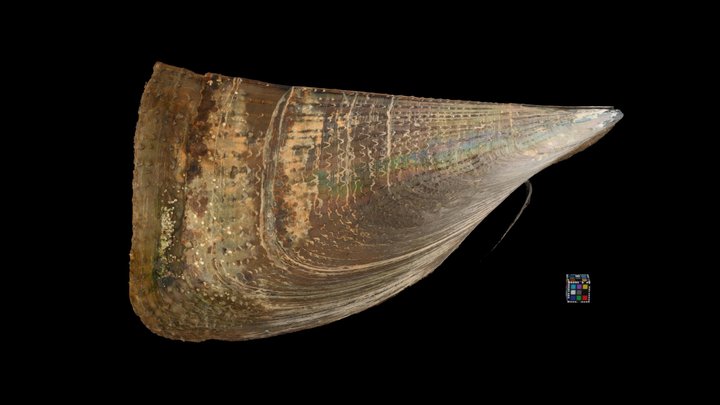
3D model
- Source
- Sketchfab
- Licence
- CC0 Public Domain
- Commercial use
- the licence allows it
Smithsonian Open Access was not reached for this taxon, so this list is what the others held rather than everything there is.
The description on this site
- Licence
- CC BY-SA 4.0
This is what the site found, which is not the same as what exists.
Keep going
What may have been alongside itAtrina through timeFormations of the MioceneThe world it lived on
Occurrence data from the Paleobiology Database, CC BY 4.0. (Linnaeus 1758)