Aurila

via iDigBio · CC0 · via iDigBio. May be a photograph of a specimen, or an artist’s reconstruction — an interpretation of a skeleton, since colour and soft tissue are almost never preserved.
On record
Recorded, not inferred- Sits inside
- HemicytheridaePBDB
- Diet
- detritivore, grazerPBDB, for Podocopida
- Life habit
- epifaunalPBDB, for Podocopida
- Motility
- actively mobilePBDB, for Ostracoda
- Vision
- limitedPBDB, for Ostracoda
- Environment
- freshwaterPBDB, for Hemicytheridae
Time the record covers
At least 65 million years on record.
The record covers at least 66 Mya to 11.7 ka. No occurrence read is dated outside 72.2 Mya to 0 Mya.
131 occurrences of Aurila on record, most of them in the Miocene. The Paleobiology Database records this as a living group. Bar height is expected occurrences, not a count: each fossil is spread across the span it is dated to, so a tall narrow bar means tight dating and a low wide one means loose.
When
131 occurrences- Late Cretaceousunder 1%
- Oligocene8%
- Miocene82%
- Plioceneunder 1%
- Pleistocene8%
- Holocene2%
These are dates about fossils, not the animal: the record can only begin after it arose and end before it died out, so either end may reach further. Shares are expected occurrences: a fossil dated to a span is counted partly in each period it straddles. More on what this infers.
Found in
12 formations
- Gliwice Formation20
- Antigua Formation5
- Cibao Marl Formation4
- Lares Limestone Formation3
- Kaplankaya Formation3
- San Sebastián Formation2
Loading coastlines…
The named rock units Aurila has been recovered from, largest first. Drawn where the rock is now, not where it formed. 87 occurrences have no formation on record, which is common for older literature.
Aurila and its relatives
MioceneWhere Aurila and its relatives were recorded in the Miocene.
Found in the same rock
1,134 taxa- Bairdia21 sites
- Loxoconcha20 sites
- Xestoleberis13 sites
- Cytherella12 sites
- Costa10 sites
- Haplocytheridea8 sites
- Ammonia7 sites
- Cytheridea7 sites
- Elphidium7 sites
- Procythereis7 sites
- Bolivina6 sites
- Cnestocythere6 sites
- Cushmanidea6 sites
- Hermanites6 sites
- Jugosocythereis6 sites
- Loxocorniculum6 sites
- Nassarius6 sites
- Paracytheridea6 sites
- Quadracythere6 sites
- Callistocythere5 sites
- Cytherelloidea5 sites
- Henryhowella asperrima5 sites
- Heterostegina5 sites
- Paracypris5 sites
The Paleobiology Database records 37 sites for Aurila, and this reads all of them. The number is how many of those sites it was catalogued from too. The 24 sharing the most are listed.
This is not a list of everything alive at the time. It is only what has come out of the same ground as this animal and been written down.
Entered from
19 references- Late Miocene ostracod assemblages from eastern Mediterranean coral reef complexes (central Crete, Greece)58
- Middle Miocene ostracods of the Fore-Carpathian Depression (Central Paratethys, southwestern Poland)20
- Preliminary stratigraphical investigations of the Miocene successions of the Porto Torres Basin (northern Sardinia, Italy)13
- Middle Tertiary Ostracoda from northwestern Puerto Rico9
- Ostracoda from the Antigua Formation (Oligocene, Lesser Antilles)5
- New faunistic data on the Pleistocene environmental evolution of the south-western edge of the Hyblean Plateau (SE Sicily)4
- Ostracoda and Foraminifera assemblages of the Lower-Middle Miocene reefal carbonates within the Değirmençay Area, NW Mersin/S Turkey3
- The Burdigalian historical stratotype in the Rhodanian area3
- Ambergris cololites of Pleistocene sperm whales from central Italy and description of the new ichnogenus and ichnospecies Ambergrisichnus alleronae2
- Spectacular preservation of seagrasses and seagrass-associated communities from the Pliocene of Rhodes, Greece2
- The Pannonian Palaeoecology and Biostratigraphy of Molluscs from Kostanjek- Medvednica Mt. Croatia2
- L'environnement côtier des Alpes-Maritimes à la fin de la transgression versilienne d'après l'étude biostratigraphique du site de l'Etoile à Nice (France)2
Each of the 131 occurrences read was entered from one of these publications, ordered by how many each accounts for. This is not a search for papers mentioning the name. 7 further references are not listed. Entries link to doi.org where the Paleobiology Database holds an identifier, and to its own record where it does not. Relayed as the Paleobiology Database holds them, not checked against what they resolve to.
Media and terms
Media content2
Picture of Aurila
- Source
- iDigBio
- Credit
- via iDigBio
- Licence
- CC0
- Commercial use
- the licence allows it
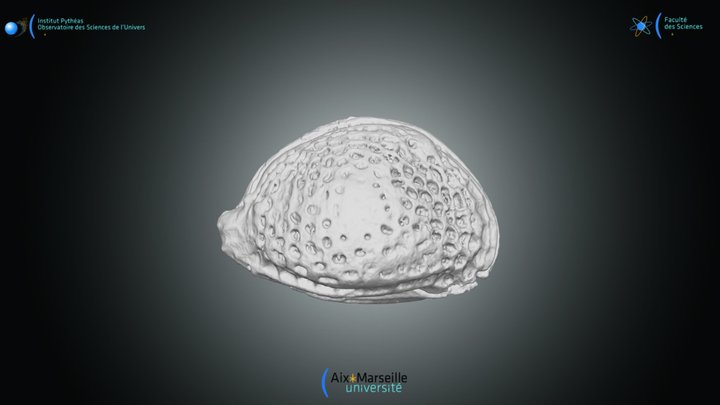
3D model
- Source
- Sketchfab
- Licence
- CC Attribution-NonCommercial-ShareAlike
- Commercial use
- the licence does not allow it
Smithsonian Open Access and MorphoSource were not reached for this taxon, so this list is what the others held rather than everything there is.
This is what the site found, which is not the same as what exists.
Keep going
What may have been alongside itHemicytheridae through timeFormations of the MioceneThe world it lived on
Occurrence data from the Paleobiology Database, CC BY 4.0.