Baggina
Baggina is a genus of foraminiferans in the order Rotaliida.
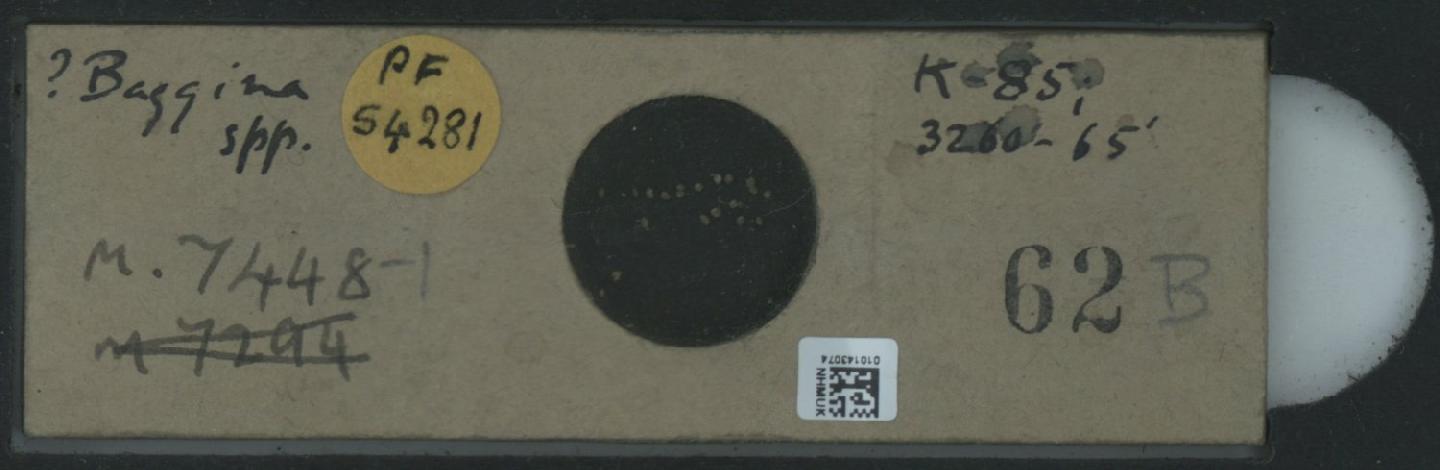
via iDigBio · CC BY · via iDigBio. May be a photograph of a specimen, or an artist’s reconstruction — an interpretation of a skeleton, since colour and soft tissue are almost never preserved.
On record
Recorded, not inferred- Sits inside
- BagginidaePBDB
- Diet
- omnivorePBDB, for Foraminifera
- Life habit
- semi-infaunalPBDB, for Foraminifera
- Motility
- stationaryPBDB, for Rotaliina
- Environment
- outer shelf,marinePBDB, for Rotaliina
Time the record covers
At least 35 million years on record.
The record covers at least 41.03 Mya to 5.333 Mya. No occurrence read is dated outside 56 Mya to 3.6 Mya.
26 occurrences of Baggina on record, most of them in the Eocene. The Paleobiology Database records this as a living group, and the chart stops with its fossils rather than at the present. Bar height is expected occurrences, not a count: each fossil is spread across the span it is dated to, so a tall narrow bar means tight dating and a low wide one means loose.
When
26 occurrencesThese are dates about fossils, not the animal: the record can only begin after it arose and end before it died out, so either end may reach further. Shares are expected occurrences: a fossil dated to a span is counted partly in each period it straddles. More on what this infers.
Found in
8 formations
- Wuchihshan Formation8
- Chungliao Formation7
- Ihungia Formation2
- Gehannam Formation2
- Selsey Formation · Bracklesham Group1
- Borbon Formation1
Loading coastlines…
The named rock units Baggina has been recovered from, largest first. Drawn where the rock is now, not where it formed. 3 occurrences have no formation on record, which is common for older literature.
Baggina and its relatives
EoceneWhere Baggina and its relatives were recorded in the Eocene.
Found in the same rock
306 taxa- Lenticulina16 sites
- Gaudryina hayasakai13 sites
- Hanzawaia asterizana13 sites
- Haplophragmoides12 sites
- Gaudryina11 sites
- Planularia11 sites
- Bathysiphon eocenicus10 sites
- Planktons indet.10 sites
- Cristellaria (Marginulina)8 sites
- Heterolepa8 sites
- Ostracoda8 sites
- Quinqueloculina8 sites
- Saccammina sphaerica8 sites
- Ammodiscus incertus7 sites
- Cribrostomoides7 sites
- Karreriella7 sites
- Nodosaria7 sites
- Cribrostomoides yeni5 sites
- Ammonia4 sites
- Cyclammina tani4 sites
- Martinottiella communis4 sites
- Nonion4 sites
- Bolivina3 sites
- Bulimina3 sites
The Paleobiology Database records 23 sites for Baggina, and this reads all of them. The number is how many of those sites it was catalogued from too. The 24 sharing the most are listed.
This is not a list of everything alive at the time. It is only what has come out of the same ground as this animal and been written down.
Entered from
9 references- Benthic foraminiferal fauna and sedimen provenance of Eocene syn-rift sequences in Taiwan: implication for onset of Asian epi-continental marginal seas off China coast16
- Benthic foraminifera and biostratigraphy of the Middle–Upper Eocene transition at Wadi Hitan area, Fayum, Egypt2
- Stratigraphy, paleontology, and tectonics of Lower Miocene rocks in the Waipatiki/Mangatuna area, southern Hawke's Bay, New Zealand2
- Paleontology and stratigraphy of the Miocene Saddleback Valley Limestone, Orange County, Southern California1
- Oceanographic conditions as a trigger for the formation of an Early Miocene (Aquitanian) Konservat-Lagerstätte in the Central Paratethys Sea1
- Observations on the Neogene of Northwestern Ecuador1
- Stratigraphy and Biota of the Elmore Formation (Huntingbridge division, Bracklesham Group) at Lee-on-the-Solent, Gosport, Hampshire1
- Tertiary brachiopods from Puerto Rico and their paleontologic and paleoecologic significance1
- Marine Pliocene at Resolution Island, Dusky Sound, Fiordland (S156)1
Each of the 26 occurrences read was entered from one of these publications, ordered by how many each accounts for. This is not a search for papers mentioning the name. Entries link to doi.org where the Paleobiology Database holds an identifier, and to its own record where it does not. Relayed as the Paleobiology Database holds them, not checked against what they resolve to.
Media and terms
Media content1
Picture of Baggina
- Source
- iDigBio
- Credit
- via iDigBio
- Licence
- CC BY
- Commercial use
- the licence allows it
No 3D scan of Baggina was found in Sketchfab.
Smithsonian Open Access and MorphoSource were not reached for this taxon, so this list is what the others held rather than everything there is.
The description on this site
- Source
- Wikipedia, “Baggina”
- Licence
- CC BY-SA 4.0
This is what the site found, which is not the same as what exists.
Keep going
What may have been alongside itBagginidae through timeFormations of the EoceneThe world it lived on
Occurrence data from the Paleobiology Database, CC BY 4.0. Cushman 1926