Brachaeluridae
Brachaelurus is the sole genus of sharks in the family Brachaeluridae in the order Orectolobiformes. Only two extant species of blind sharks occur, both of which are native to shallow coastal waters up to 110 m (360 ft) deep, off the eastern coast of Australia.

David Breneman at English Wikipedia · CC BY-SA 3.0 · via Wikipedia/Commons. May be a photograph of a specimen, or an artist’s reconstruction — an interpretation of a skeleton, since colour and soft tissue are almost never preserved.
On record
Recorded, not inferred- Sits inside
- OrectoloboideiPBDB
- Diet
- carnivorePBDB, for Orectolobiformes
- Life habit
- nektobenthicPBDB, for Orectolobiformes
- Motility
- actively mobilePBDB, for Orectolobiformes
Time the record covers
At least 143 million years on record.
The record covers at least 170.9 Mya to 27.3 Mya. No occurrence read is dated outside 201.4 Mya to 23.04 Mya.
49 occurrences of Brachaeluridae on record, most of them in the Eocene. The Paleobiology Database records this as a living group, and the chart stops with its fossils rather than at the present. Bar height is expected occurrences, not a count: each fossil is spread across the span it is dated to, so a tall narrow bar means tight dating and a low wide one means loose.
When
49 occurrences- Early Jurassicunder 1%
- Middle Jurassic6%
- Late Jurassicunder 1%
- Early Cretaceous7%
- Late Cretaceous18%
- Paleocene8%
- Eocene55%
- Oligocene4%
These are dates about fossils, not the animal: the record can only begin after it arose and end before it died out, so either end may reach further. Shares are expected occurrences: a fossil dated to a span is counted partly in each period it straddles. More on what this infers.
Found in
25 formations
- Mesaverde Formation5
- Marnes de Donzacq Formation5
- Selsey Formation · Bracklesham Group4
- Gehannam Formation4
- Navesink Formation2
- Hythe Formation · Lower Greensand Group2
Loading coastlines…
The named rock units Brachaeluridae has been recovered from, largest first. Drawn where the rock is now, not where it formed. One further formation holds fewer occurrences and is not listed. 7 occurrences have no formation on record, which is common for older literature.
Brachaeluridae and its relatives
EoceneWhere Brachaeluridae and its relatives were recorded in the Eocene.
Found in the same rock
644 taxa- Squatina prima18 sites
- Eostegostoma angustum15 sites
- Heterodontus vincenti15 sites
- Premontreia (Oxyscyllium) gilberti15 sites
- Galeorhinus14 sites
- Isurolamna inflata14 sites
- Isurus praecursor13 sites
- Odontaspis winkleri13 sites
- Burnhamia daviesi12 sites
- Dasyatis12 sites
- Striatolamia macrota12 sites
- Abdounia recticona11 sites
- Isistius trituratus11 sites
- Scyliorhinus11 sites
- Coupatezia woutersi10 sites
- Eostegostoma10 sites
- Carcharias9 sites
- Gymnura9 sites
- Hexanchus agassizi9 sites
- Hypotodus verticalis9 sites
- Jaekelotodus trigonalis9 sites
- Physogaleus9 sites
- Physogaleus secundus9 sites
- Rhynchobatus vincenti9 sites
The Paleobiology Database records 43 sites for Brachaeluridae, and this reads all of them. The number is how many of those sites it was catalogued from too. The 24 sharing the most are listed.
This is not a list of everything alive at the time. It is only what has come out of the same ground as this animal and been written down.
Entered from
25 references- Nouvelle faunes de sélaciens (Elasmobranchii, Neoselachii) de l'Eocène moyen des Landes (Sud-Ouest, France). Implication dans la connaissance des communautés de sélaciens d'eau profondes6
- Shark and ray faunas in the Middle and Late Eocene of the Fayum Area, Egypt5
- A new selachian fauna from the late Campanian of Wyoming (Teapot Sandstone Member, Mesaverde Formation, Big Horn Basin)5
- The Selsey Division (Bracklesham Group) at Lee-on-the-Solent, Gosport, (Hants)5
- Late Eocene fishes from the Tupelo Bay Formation of South Carolina, USA2
- The Turanian Basin in the Eocene: the new data on the fossil sharks and rays from the Kyzylkum Desert (Uzbekistan)2
- Structure and ichthyofauna of the upper part of Eocene sediments in Belogorsk area (Crimea)2
- Les élasmobranches du Thanétien (Paléocène) du Nord de la France, des carrières de Templeuve et de Leforest2
- Les Orectolobiformes, Carcharhiniformes et Myliobatiformes (Elasmobranchii, Neoselachii) des bassins à phosphate du Maroc (Maastrichtien-Lutétien basal). Systématique, biostratigraphie, évolution et dynamique des faunes2
- Fish remains from a temporary exposure of Hythe Beds (Aptian-Lower Cretaceous) near Godstone, Surrey2
- Contribution a l'étude des sélaciens du Groupe Monmouth (Campanien-Maestrichtian) du New Jersey2
- Late Oligocene fishes (Chondrichthyes and Osteichthyes) from the Catahoula Formation in Wayne County, Mississippi, USA1
Each of the 49 occurrences read was entered from one of these publications, ordered by how many each accounts for. This is not a search for papers mentioning the name. 13 further references are not listed. Entries link to doi.org where the Paleobiology Database holds an identifier, and to its own record where it does not. Relayed as the Paleobiology Database holds them, not checked against what they resolve to.
Media and terms
Media content1
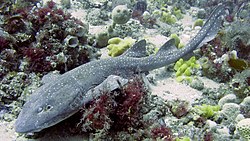
Picture of Brachaeluridae
- Source
- Wikipedia/Commons
- Credit
- David Breneman at English Wikipedia
- Licence
- CC BY-SA 3.0
- Commercial use
- the licence allows it
No 3D scan of Brachaeluridae was found in MorphoSource and Sketchfab.
Smithsonian Open Access was not reached for this taxon, so this list is what the others held rather than everything there is.
The description on this site
- Licence
- CC BY-SA 4.0
This is what the site found, which is not the same as what exists.
Keep going
What may have been alongside itOrectoloboidei through timeFormations of the EoceneThe world it lived on
Occurrence data from the Paleobiology Database, CC BY 4.0. Applegate 1972