Campophyllum

via iDigBio · CC0 · via iDigBio. May be a photograph of a specimen, or an artist’s reconstruction — an interpretation of a skeleton, since colour and soft tissue are almost never preserved.
On record
Recorded, not inferred- Sits inside
- CampophyllidaePBDB
- Diet
- suspension feederPBDB, for Rugosa
- Life habit
- epifaunalPBDB, for Rugosa
- Motility
- stationary, attachedPBDB, for Rugosa
- Vision
- blindPBDB, for Anthozoa
- Environment
- marinePBDB, for Rugosa
Time the record covers
At least 168 million years on record.
The record covers at least 432.9 Mya to 264.28 Mya. No occurrence read is dated outside 440.5 Mya to 259.857 Mya.
22 occurrences of Campophyllum on record, most of them in the Devonian. Bar height is expected occurrences, not a count: each fossil is spread across the span it is dated to, so a tall narrow bar means tight dating and a low wide one means loose.
When
22 occurrences- Silurian5%
- Devonian45%
- Carboniferous36%
- Permian14%
These are dates about fossils, not the animal: the record can only begin after it arose and end before it died out, so either end may reach further. Shares are expected occurrences: a fossil dated to a span is counted partly in each period it straddles. More on what this infers.
Found in
9 formations
- Graham Formation · Cisco Group4
- Percha Shale Formation3
- Capitan Formation2
- Halleck Formation1
- Manticoceras Limestone Formation1
- Dubie Formation1
Loading coastlines…
The named rock units Campophyllum has been recovered from, largest first. Drawn where the rock is now, not where it formed. 7 occurrences have no formation on record, which is common for older literature.
Campophyllum and its relatives
DevonianWhere Campophyllum and its relatives were recorded in the Devonian.
Found in the same rock
243 taxa- Algae4 sites
- Caninia4 sites
- Dictyoclostus semireticulatus3 sites
- Anisopyge perannulata2 sites
- Anteridocus swallovianus2 sites
- Chonetes2 sites
- Condrathyris perplexa2 sites
- Crania2 sites
- Crinoidea2 sites
- Derbyia2 sites
- Linoproductus cora2 sites
- Liosotella popei2 sites
- Lithostrotion2 sites
- Neospirifer cameratus2 sites
- Paraspiriferina billingsi2 sites
- Pustula2 sites
- Rhipidomella2 sites
- Schizodus securus2 sites
- Strigirhynchia indentata2 sites
- Syringopora2 sites
- Triplophyllum2 sites
- Zygopleura swalloviana2 sites
- Acanthocladia1 site
- Acanthocladia guadalupensis1 site
The Paleobiology Database records 19 sites for Campophyllum, and this reads all of them. The number is how many of those sites it was catalogued from too. The 24 sharing the most are listed.
This is not a list of everything alive at the time. It is only what has come out of the same ground as this animal and been written down.
Entered from
11 references- The surficial geology, paleontology, and paleoecology of the Finis Shale (Pennsylvanian, Lower Virgilian) in Jack County, Texas4
- Oekologie und Fazies des juengsten Ober-Devon von Velbert (Rheinisches Schiefergebirge)4
- Late Devonian (Famennian) rugose coral fauna of the Percha Shale of southwestern New Mexico3
- Geology and mineral deposits of southeastern Alaska3
- Famennian Rugosa and Heterocorallia from southern Poland2
- Fatsialnaya priurochennost korallov v rannekamennougolnykh moryakh vostochnogo sklona yuzhnogo Urala [Ecologic relationships of corals in Early Carboniferous seas of the eastern slope of the southern Urals]1
- Geology and mineral resources of the Ivanpah quadrangle, California and Nevada1
- A Middle Devonian lichid trilobite from south-eastern Australia1
- Contributions to the Paleontology of Northwest Georgia1
- The Guadalupian fauna1
- Notice of fossils from the Permian strata of Texas and New Mexico obtained by the United States expedition under Capt. John Pope, for boring artesian wells along the 32nd parallel, with descriptions of new species from these strata and the Coal Measures of that region1
Each of the 22 occurrences read was entered from one of these publications, ordered by how many each accounts for. This is not a search for papers mentioning the name. Entries link to doi.org where the Paleobiology Database holds an identifier, and to its own record where it does not. Relayed as the Paleobiology Database holds them, not checked against what they resolve to.
Media and terms
Media content2
Picture of Campophyllum
- Source
- iDigBio
- Credit
- via iDigBio
- Licence
- CC0
- Commercial use
- the licence allows it
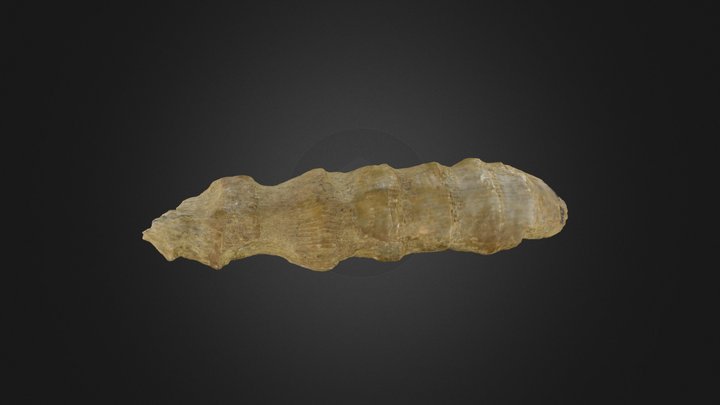
3D model
- Source
- Sketchfab
- Licence
- CC0 Public Domain
- Commercial use
- the licence allows it
This is what the site found, which is not the same as what exists.
Keep going
What may have been alongside itCampophyllidae through timeFormations of the DevonianThe world it lived on
Occurrence data from the Paleobiology Database, CC BY 4.0. Milne-Edwards and Haime 1850