Caprimulgidae
Nightjars are medium-sized nocturnal or crepuscular birds in the family Caprimulgidae and order Caprimulgiformes, characterised by long wings, short legs, and very short bills. Some New World species are called nighthawks. The English word nightjar originally referred to the European nightjar.

Nigel Voaden from UK · CC BY-SA 2.0 · via Wikipedia/Commons. May be a photograph of a specimen, or an artist’s reconstruction — an interpretation of a skeleton, since colour and soft tissue are almost never preserved.
On record
Recorded, not inferred- Sits inside
- CaprimulgiformesPBDB
- Diet
- insectivorePBDB
- Life habit
- volantPBDB
- Motility
- actively mobilePBDB, for Theropoda
- Environment
- terrestrialPBDB
Time the record covers
At least 48 million years on record.
The record covers at least 48.07 Mya to 11.7 ka. No occurrence read is dated outside 56 Mya to 0 Mya.
32 occurrences of Caprimulgidae on record, most of them in the Pleistocene. The Paleobiology Database records this as a living group. Bar height is expected occurrences, not a count: each fossil is spread across the span it is dated to, so a tall narrow bar means tight dating and a low wide one means loose.
When
32 occurrences- Eocene13%
- Oligocene3%
- Pleistocene61%
- Holocene24%
These are dates about fossils, not the animal: the record can only begin after it arose and end before it died out, so either end may reach further. Shares are expected occurrences: a fossil dated to a span is counted partly in each period it straddles. More on what this infers.
Found in
3 formations
Loading coastlines…
The named rock units Caprimulgidae has been recovered from, largest first. Drawn where the rock is now, not where it formed. 29 occurrences have no formation on record, which is common for older literature.
Caprimulgidae and its relatives
PleistoceneWhere Caprimulgidae and its relatives were recorded in the Pleistocene.
Found in the same rock
1,178 taxa- Tyto alba11 sites
- Falco sparverius8 sites
- Athene cunicularia7 sites
- Columbidae7 sites
- Patagioenas leucocephala7 sites
- Patagioenas squamosa7 sites
- Accipiter striatus6 sites
- Columbina passerina6 sites
- Porzana carolina6 sites
- Tyrannus dominicensis6 sites
- Bubo virginianus5 sites
- Zenaida macroura5 sites
- Accipiter gentilis4 sites
- Anas platyrhynchos4 sites
- Asio flammeus4 sites
- Asio otus4 sites
- Buteo4 sites
- Caprimulgus4 sites
- Passeriformes4 sites
- Petrochelidon fulva4 sites
- Rallidae4 sites
- Turdus plumbeus4 sites
- Zenaida asiatica4 sites
- Zenaida aurita4 sites
The Paleobiology Database records 29 sites for Caprimulgidae, and this reads all of them. The number is how many of those sites it was catalogued from too. The 24 sharing the most are listed.
This is not a list of everything alive at the time. It is only what has come out of the same ground as this animal and been written down.
Entered from
27 references- Faunal extinction and human habitation in New Caledonia: initial results and implications of new research at the Pindai Caves2
- The late Pleistocene (Rancholabrean) avifauna of Little Box Elder Cave, Wyoming2
- The non-passerine Pleistocene avifauna of the Talara Tar Seeps, northwestern Peru2
- Fossil birds from the Dominican Republic2
- Bird remains from the caves of Porto Rico2
- The late Quaternary bird community of New Providence, Bahamas1
- The diversity and biogeography of late Pleistocene birds from the lowland Neotropics1
- A late-Holocene bird community from Hispaniola: Refining the chronology of vertebrate extinction in the West Indies1
- Part 6. Early Eocene Birds from Eastern North America: A Faunule from the Nanjemoy Formation of Virginia1
- The Middle Pleistocene avifauna of Spinagallo Cave (Sicily, Italy): preliminary report1
- Prehistoric birds from New Ireland, Papua New Guinea: extinctions on a large Melanesian island1
- Pleistocene avian fossils from Pyramids Cave (M-89), eastern Victoria, Australia1
Each of the 32 occurrences read was entered from one of these publications, ordered by how many each accounts for. This is not a search for papers mentioning the name. 15 further references are not listed. Entries link to doi.org where the Paleobiology Database holds an identifier, and to its own record where it does not. Relayed as the Paleobiology Database holds them, not checked against what they resolve to.
Media and terms
Media content1
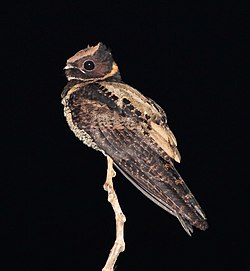
Picture of Caprimulgidae
- Source
- Wikipedia/Commons
- Credit
- Nigel Voaden from UK
- Licence
- CC BY-SA 2.0
- Commercial use
- the licence allows it
No 3D scan of Caprimulgidae was found in MorphoSource and Sketchfab.
Smithsonian Open Access was not reached for this taxon, so this list is what the others held rather than everything there is.
The description on this site
- Source
- Wikipedia, “Nightjar”
- Licence
- CC BY-SA 4.0
This is what the site found, which is not the same as what exists.
Keep going
What may have been alongside itCaprimulgiformes through timeFormations of the PleistoceneThe world it lived on
Occurrence data from the Paleobiology Database, CC BY 4.0. Vigors 1825