Caprimulgus europaeus
The European nightjar, common goatsucker, Eurasian nightjar or just nightjar is a crepuscular and nocturnal bird in the nightjar family that breeds across most of Europe and the Palearctic to Mongolia and Northwestern China. The Latin generic name refers to the old myth that the nocturnal nightjar suckled from goats, causing them to cease to give milk. The six subspecies differ clinally, the birds becoming smaller and paler towards the east of the range. All populations are migratory, wintering in sub-Saharan Africa. Their densely patterned grey and brown plumage makes individuals difficult to see in the daytime when they rest on the ground or perch motionless along a branch, although the male shows white patches in the wings and tail as he flies at night.

Dûrzan cîrano · CC BY-SA 3.0 · via Wikipedia/Commons. May be a photograph of a specimen, or an artist’s reconstruction — an interpretation of a skeleton, since colour and soft tissue are almost never preserved.
On record
Recorded, not inferred- Also called
- Eurasian nightjarPBDB
- Sits inside
- CaprimulgusPBDB
- Diet
- insectivorePBDB, for Caprimulgidae
- Life habit
- volantPBDB, for Caprimulgidae
- Motility
- actively mobilePBDB, for Theropoda
- Environment
- terrestrialPBDB, for Caprimulgidae
Time the record covers
At least 117 thousand years on record.
The record covers at least 129 ka to 11.7 ka. No occurrence read is dated outside 774 ka to 0 Mya.
3 occurrences of Caprimulgus europaeus on record, most of them in the Pleistocene. The Paleobiology Database records this as a living group. Bar height is expected occurrences, not a count: each fossil is spread across the span it is dated to, so a tall narrow bar means tight dating and a low wide one means loose.
When
3 occurrences- Pleistocene67%
- Holocene33%
These are dates about fossils, not the animal: the record can only begin after it arose and end before it died out, so either end may reach further. Shares are expected occurrences: a fossil dated to a span is counted partly in each period it straddles. More on what this infers.
Caprimulgus europaeus and its relatives
PleistoceneWhere Caprimulgus europaeus and its relatives were recorded in the Pleistocene.
Found in the same rock
90 taxa- Accipiter gentilis2 sites
- Accipiter nisus2 sites
- Apus melba2 sites
- Columba palumbus2 sites
- Dendrocopos leucotos2 sites
- Falco eleonorae2 sites
- Falco subbuteo2 sites
- Falco tinnunculus2 sites
- Fringilla2 sites
- Mareca penelope2 sites
- Oenanthe hispanica2 sites
- Otus scops2 sites
- Pyrrhocorax graculus2 sites
- Scolopax rusticola2 sites
- Sturnus2 sites
- Turdus2 sites
- Aegolius funereus1 site
- Aegolius martae1 site
- Anser erythropus1 site
- Anthus1 site
- Apus1 site
- Aquila chrysaetos simurgh1 site
- Asio otus1 site
- Athene cretensis1 site
The Paleobiology Database records 3 sites for Caprimulgus europaeus, and this reads all of them. The number is how many of those sites it was catalogued from too. The 24 sharing the most are listed.
This is not a list of everything alive at the time. It is only what has come out of the same ground as this animal and been written down.
Entered from
3 references- Birds in Finnish prehistory1
- The Middle Pleistocene avifauna of Spinagallo Cave (Sicily, Italy): preliminary report1
- The Quaternary avifauna of Crete, Greece1
Each of the 3 occurrences read was entered from one of these publications, ordered by how many each accounts for. This is not a search for papers mentioning the name. Each entry links to the Paleobiology Database's own record for the work.
Media and terms
Media content2
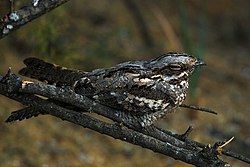
Picture of Caprimulgus europaeus
- Source
- Wikipedia/Commons
- Credit
- Dûrzan cîrano
- Licence
- CC BY-SA 3.0
- Commercial use
- the licence allows it

CT scan
- Source
- MorphoSource
- Licence
- In Copyright
- Commercial use
- cannot be read from the licence given — check the record
- Specimen
- Caprimulgus europaeus · nms:z:unreg., cat. num. 27
Smithsonian Open Access was not reached for this taxon, so this list is what the others held rather than everything there is.
The description on this site
- Licence
- CC BY-SA 4.0
This is what the site found, which is not the same as what exists.
Keep going
What may have been alongside itCaprimulgus through timeFormations of the PleistoceneThe world it lived on
Occurrence data from the Paleobiology Database, CC BY 4.0. Linnaeus 1758