Carcharhinus leucas
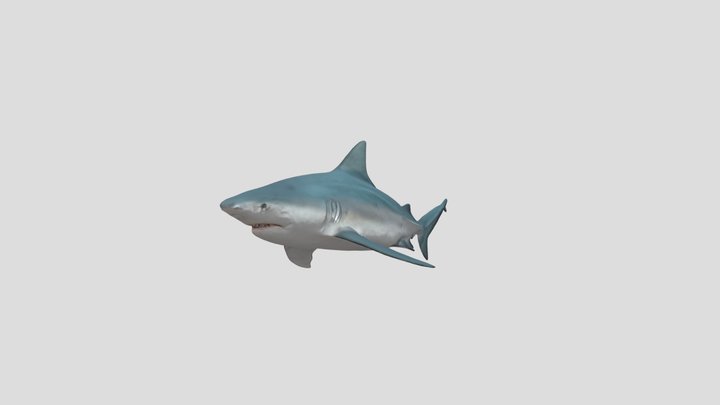
The bull shark, also known as the Zambezi shark in Africa and Lake Nicaragua shark in Nicaragua, is a species of requiem shark commonly found worldwide in warm, shallow waters along coasts and in rivers. It is known for its aggressive nature, and presence mainly in warm, shallow brackish and freshwater systems including estuaries and (usually) lower reaches of rivers. Their aggressive nature has led to ongoing shark-culling efforts near beaches to protect beachgoers, which is one of the causes of bull shark populations continuing to decrease. Bull sharks are listed as vulnerable on the IUCN Red List.

João D'Andretta · CC BY 4.0 · via Wikipedia/Commons. May be a photograph of a specimen, or an artist’s reconstruction — an interpretation of a skeleton, since colour and soft tissue are almost never preserved.
On record
Recorded, not inferred- Also called
- bull sharkPBDB
- Sits inside
- CarcharhinusPBDB
- Diet
- carnivorePBDB, for Carcharhiniformes
- Life habit
- nektonicPBDB, for Carcharhiniformes
- Motility
- actively mobilePBDB, for Carcharhiniformes
Time the record covers
At least 23 million years on record.
The record covers at least 23.04 Mya to 11.7 ka. No occurrence read is dated outside 27.3 Mya to 0 Mya.
57 occurrences of Carcharhinus leucas on record, most of them in the Miocene. The Paleobiology Database records this as a living group. Bar height is expected occurrences, not a count: each fossil is spread across the span it is dated to, so a tall narrow bar means tight dating and a low wide one means loose.
When
57 occurrences- Oligocene2%
- Miocene53%
- Pliocene29%
- Pleistocene15%
- Holocene2%
These are dates about fossils, not the animal: the record can only begin after it arose and end before it died out, so either end may reach further. Shares are expected occurrences: a fossil dated to a span is counted partly in each period it straddles. More on what this infers.
Found in
27 formations
- Urumaco Formation6
- Esbarrondadoiro Formation3
- Pisco Formation3
- Alachua Formation2
- Bermont Formation2
- Gatun Formation2
Loading coastlines…
The named rock units Carcharhinus leucas has been recovered from, largest first. Drawn where the rock is now, not where it formed. 3 further formations hold fewer occurrences each and are not listed. 14 occurrences have no formation on record, which is common for older literature.
Carcharhinus leucas and its relatives
MioceneWhere Carcharhinus leucas and its relatives were recorded in the Miocene.
Found in the same rock
1,232 taxa- Hemipristis serra31 sites
- Negaprion brevirostris29 sites
- Otodus megalodon27 sites
- Carcharodon hastalis25 sites
- Myliobatis22 sites
- Carcharias taurus18 sites
- Galeocerdo cuvier18 sites
- Carcharhinus obscurus17 sites
- Isurus oxyrinchus17 sites
- Carcharhinus plumbeus15 sites
- Galeocerdo aduncus14 sites
- Carcharhinus brachyurus12 sites
- Carcharodon carcharias12 sites
- Pristis12 sites
- Sphyrna zygaena12 sites
- Aetobatus narinari11 sites
- Rhinoptera11 sites
- Aetobatus10 sites
- Carcharhinus perezi10 sites
- Physogaleus contortus9 sites
- Pogonias cromis9 sites
- Rhizoprionodon9 sites
- Carcharhinus limbatus8 sites
- Dasyatidae7 sites
The Paleobiology Database records 55 sites for Carcharhinus leucas, and this reads all of them. The number is how many of those sites it was catalogued from too. The 24 sharing the most are listed.
This is not a list of everything alive at the time. It is only what has come out of the same ground as this animal and been written down.
Entered from
37 references- Sawfishes and other elasmobranch assemblages from the Mio-Pliocene of the south Caribbean (Urumaco sequence, northwestern Venezuela)7
- Carcharocles megalodon unpublished collections from Natural History Museums around the world4
- The late Miocene elasmobranch assemblage from Cerro Colorado (Pisco Formation, Peru)3
- Early Pliocene fishes (Chondrichthyes, Osteichthyes) from Gran Canaria and Fuerteventura (Canary Islands, Spain)3
- A new vertebrate continental assemblage from the Tortonian of Venezuela2
- Sharks and Rays (Chondrichthyes, Elasmobranchii) from the late Miocene Gatun Formation of Panama2
- Systematics, palaeoecology and palaeobiogeography of the Neogene fossil sharks from the Azores (Northeast Atlantic)2
- Los tiburones Carcharhiniformes (Chondrichthyes, Galeomorphii) del Plioceno inferior de la Formación Arenas de Huelva, suroeste de la cuenca del Guadalquivir, España2
- The Neogene sharks, rays, and bony fishes from Lee Creek Mine, Aurora, North Carolina2
- Sélaciens du Miocène terminal du bassin d'Alvalade (Portugal) Essai de synthèse2
- Pleistocene (Rancholabrean) vertebrate faunas from coastal Georgia2
- The early Miocene elasmobranch assemblage from Zamaca (Chilcatay T Formation, Peru)1
Each of the 57 occurrences read was entered from one of these publications, ordered by how many each accounts for. This is not a search for papers mentioning the name. 25 further references are not listed. Entries link to doi.org where the Paleobiology Database holds an identifier, and to its own record where it does not. Relayed as the Paleobiology Database holds them, not checked against what they resolve to.
Media and terms
Media content3

Picture of Carcharhinus leucas
- Source
- Wikipedia/Commons
- Credit
- João D'Andretta
- Licence
- CC BY 4.0
- Commercial use
- the licence allows it
CT scan
- Source
- MorphoSource
- Licence
- not stated by the source
- Commercial use
- cannot be read from the licence given — check the record
- Specimen
- Carcharhinus leucas · uf:fish:246746
Smithsonian Open Access was not reached for this taxon, so this list is what the others held rather than everything there is.
The description on this site
- Source
- Wikipedia, “Bull shark”
- Licence
- CC BY-SA 4.0
This is what the site found, which is not the same as what exists.
Keep going
What may have been alongside itCarcharhinus through timeFormations of the MioceneThe world it lived on
Occurrence data from the Paleobiology Database, CC BY 4.0. (Valenciennes 1839)