Carcharodon carcharias
The great white shark, also known as the white shark, white pointer, or great white, is a large shark. It is closely related to the mako sharks, the porbeagle, and the salmon shark. It is a robustly built species with a grayish upperside and a white underside. The white shark is one of the largest living shark and fish species, though it is still smaller than the whale shark and basking shark. It has about 300 triangular, serrated teeth that are continuously replaced. Its massive, fatty liver can reach over a quarter of its body weight, providing buoyancy and storing energy. The species is partially warm-blooded, an adaptation that allows it to remain active in colder waters.

Pterantula (Terry Goss) at en.wikipedia · CC BY 2.5 · via Wikipedia/Commons. May be a photograph of a specimen, or an artist’s reconstruction — an interpretation of a skeleton, since colour and soft tissue are almost never preserved.
On record
Recorded, not inferred- Also called
- great white sharkPBDB
- Sits inside
- CarcharodonPBDB
- Diet
- carnivorePBDB, for Lamniformes
- Life habit
- nektonicPBDB, for Lamniformes
- Motility
- actively mobilePBDB, for Lamniformes
- Mass
- 2400 poundWikidata
Time the record covers
At least 15 million years on record.
The record covers at least 15.98 Mya to 11.7 ka. No occurrence read is dated outside 23.04 Mya to 0 Mya.
127 occurrences of Carcharodon carcharias on record, most of them in the Pliocene. The Paleobiology Database records this as a living group. Bar height is expected occurrences, not a count: each fossil is spread across the span it is dated to, so a tall narrow bar means tight dating and a low wide one means loose.
When
127 occurrences- Miocene25%
- Pliocene49%
- Pleistocene23%
- Holocene3%
These are dates about fossils, not the animal: the record can only begin after it arose and end before it died out, so either end may reach further. Shares are expected occurrences: a fossil dated to a span is counted partly in each period it straddles. More on what this infers.
Found in
60 formations
- Palos Verdes Sand Formation5
- Argille Azzurre Formation5
- Bahía Inglesa Formation4
- Purisima Formation4
- Ogikubo Formation4
- San Mateo Formation3
Loading coastlines…
The named rock units Carcharodon carcharias has been recovered from, largest first. Drawn where the rock is now, not where it formed. 36 further formations hold fewer occurrences each and are not listed. 31 occurrences have no formation on record, which is common for older literature.
Carcharodon carcharias and its relatives
PlioceneWhere Carcharodon carcharias and its relatives were recorded in the Pliocene.
Found in the same rock
1,986 taxa- Isurus oxyrinchus36 sites
- Carcharhinus35 sites
- Otodus megalodon30 sites
- Carcharodon hastalis26 sites
- Carcharias taurus23 sites
- Myliobatis21 sites
- Hemipristis serra19 sites
- Galeocerdo cuvier16 sites
- Negaprion brevirostris16 sites
- Sphyrna zygaena13 sites
- Balaenopteridae12 sites
- Carcharhinus leucas12 sites
- Carcharhinus brachyurus11 sites
- Raja10 sites
- Delphinidae9 sites
- Squatina9 sites
- Carcharhinus obscurus8 sites
- Carcharhinus plumbeus8 sites
- Galeorhinus galeus8 sites
- Parotodus benedeni8 sites
- Phalacrocorax8 sites
- Seriphus politus8 sites
- Alopias vulpinus7 sites
- Balaenoptera7 sites
The Paleobiology Database records 117 sites for Carcharodon carcharias, and this reads all of them. The number is how many of those sites it was catalogued from too. The 24 sharing the most are listed.
This is not a list of everything alive at the time. It is only what has come out of the same ground as this animal and been written down.
Entered from
86 references- A review of the Tertiary fossil Cetacea (Mammalia) localities in Australia5
- Fossil teeth of the great white shark, Carcharodon carcharias, from the Kazusa and Shimosa Groups (Pliocene to Pleistocene) in Boso Peninsula and Shimosa Upland, central Japan5
- A new marine vertebrate assemblage from the Late Neogene Purisima Formation in Central California, Part I: Fossil sharks, bony fish, birds, and implications for the age of the Purisimia Formation west of the San Gregorio Fault4
- On the fossil teeth of the lamnoid sharks from the Shigarami Formation (Neogene) in the north part of Nagano Prefecture, central Japan4
- Sui pesci pliocenici dell'imolese4
- Fossil elasmobranchs from the Miura Group (Late Miocene-Early Pliocene) in the Miura Peninsula, central Japan3
- Peces galeomorfos y squatinomorfos en el Plioceno de Guardamar del Segura (Alicante).3
- New or little-known fossils in the National Museum, Part XXVII.-Some Cainozoic fish remains, with a revision of the group3
- Condrictios fósiles del Plioceno Superior de la Formación Horcón, Región de Valparaíso, Chile central2
- The southernmost sirenian record in the eastern Pacific Ocean, from the Late Miocene of Chile2
- Molluscan biostratigraphy of the Tertiary sediments of Mizoram, India2
- Selachian fauna from the Upper Miocene Senhata Formation, Boso Peninsula, Central Japan2
Each of the 127 occurrences read was entered from one of these publications, ordered by how many each accounts for. This is not a search for papers mentioning the name. 74 further references are not listed. Entries link to doi.org where the Paleobiology Database holds an identifier, and to its own record where it does not. Relayed as the Paleobiology Database holds them, not checked against what they resolve to.
Media and terms
Media content3
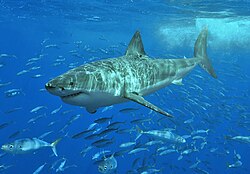
Picture of Carcharodon carcharias
- Source
- Wikipedia/Commons
- Credit
- Pterantula (Terry Goss) at en.wikipedia
- Licence
- CC BY 2.5
- Commercial use
- the licence allows it
CT scan
- Source
- MorphoSource
- Licence
- not stated by the source
- Commercial use
- cannot be read from the licence given — check the record
- Specimen
- Carcharodon carcharias · L-MEP:W153_322.6FL_male
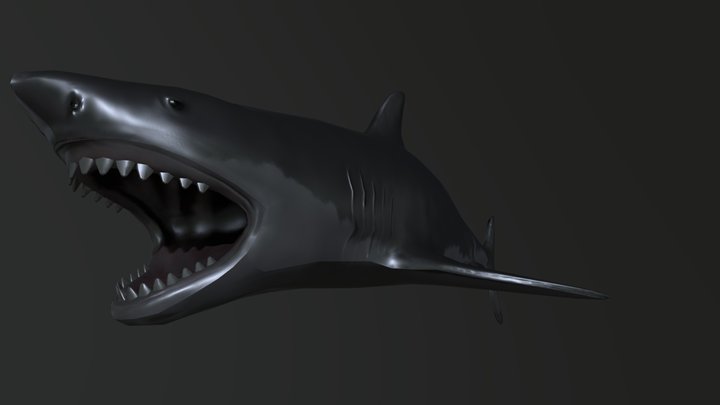
The description on this site
- Licence
- CC BY-SA 4.0
This is what the site found, which is not the same as what exists.
Keep going
What may have been alongside itCarcharodon through timeFormations of the PlioceneThe world it lived on
Occurrence data from the Paleobiology Database, CC BY 4.0. (Linnaeus 1758)