Caudata
Salamanders are a group of amphibians typically characterized by their lizard-like appearance, with slender bodies, blunt snouts, short limbs projecting at right angles to the body, and the presence of a tail in both larvae and adults. All ten extant salamander families are grouped together under the order Urodela, the sole surviving order from the group Caudata. Urodela is a scientific Latin term based on the Ancient Greek οὐρά δήλη: ourà dēlē "conspicuous tail". Caudata is the Latin for "tailed ones", from cauda: "tail".

Camazine at English Wikipedia ) (Scott Camazine web.mac.com/camazine) · CC BY-SA 3.0 · via Wikipedia/Commons. May be a photograph of a specimen, or an artist’s reconstruction — an interpretation of a skeleton, since colour and soft tissue are almost never preserved.
On record
Recorded, not inferred- Also called
- salamanderPBDB
- Sits inside
- BatrachiaPBDB
- Diet
- carnivorePBDB, for Temnospondyli
- Life habit
- amphibiousPBDB, for Temnospondyli
- Motility
- actively mobilePBDB, for Temnospondyli
- Environment
- brackish,freshwater,terrestrialPBDB, for Tetrapoda
Time the record covers
At least 227 million years on record.
The record covers at least 227.3 Mya to 11.7 ka. No occurrence read is dated outside 241.464 Mya to 0 Mya.
1,329 occurrences of Caudata on record, most of them in the Late Cretaceous. The Paleobiology Database records this as a living group. Bar height is expected occurrences, not a count: each fossil is spread across the span it is dated to, so a tall narrow bar means tight dating and a low wide one means loose.
When
1,329 occurrences- Middle Triassicunder 1%
- Late Triassicunder 1%
- Early Jurassicunder 1%
- Middle Jurassic3%
- Late Jurassic2%
- Early Cretaceous4%
- Late Cretaceous40%
- Paleocene8%
- Eocene3%
- Oligocene3%
- Miocene16%
- Pliocene2%
- Pleistocene18%
- Holoceneunder 1%
These are dates about fossils, not the animal: the record can only begin after it arose and end before it died out, so either end may reach further. Shares are expected occurrences: a fossil dated to a span is counted partly in each period it straddles. More on what this infers.
Found in
184 formations
- Hell Creek Formation · Montana Group180
- Dinosaur Park Formation · Belly River Group72
- Lance Formation59
- Fort Union Formation49
- Oldman Formation · Belly River Group40
- Alamosa Formation37
Loading coastlines…
The named rock units Caudata has been recovered from, largest first. Drawn where the rock is now, not where it formed. 160 further formations hold fewer occurrences each and are not listed. 366 occurrences have no formation on record, which is common for older literature.
Caudata and its relatives
Late CretaceousWhere Caudata and its relatives were recorded in the Late Cretaceous.
Found in the same rock
2,874 taxa- Scapherpeton tectum108 sites
- Myledaphus bipartitus92 sites
- Trionychidae88 sites
- Lepisosteus occidentalis83 sites
- Opisthotriton kayi80 sites
- Ceratopsidae78 sites
- Anura76 sites
- Baenidae73 sites
- Teleostei69 sites
- Chelydridae68 sites
- Hadrosauridae62 sites
- Champsosaurus60 sites
- Belonostomus longirostris55 sites
- Theropoda54 sites
- Paronychodon52 sites
- Coriops amnicolus49 sites
- Lepisosteus49 sites
- Multituberculata49 sites
- Paralbula casei49 sites
- Aves45 sites
- Borealosuchus sternbergii45 sites
- Crocodylia44 sites
- Saurornitholestes langstoni44 sites
- Adocus42 sites
The Paleobiology Database records 720 sites for Caudata, and this reads 240 of them. The number is how many of those sites it was catalogued from too. The 24 sharing the most are listed.
This is not a list of everything alive at the time. It is only what has come out of the same ground as this animal and been written down.
Entered from
402 references- Mesozoic and Palaeocene lissamphibian assemblages of North America: a comprehensive review103
- Fossil Vertebrate Collections60
- Vertebrate biostratigraphy of the Hell Creek Formation in southwestern North Dakota and northwestern South Dakota47
- Pleistocene Amphibians and Reptiles in Britain and Europe41
- Vertebrate microsite assemblages (exclusive of mammals) from the Foremost and Oldman Formations of the Judith River Group (Campanian) of southeastern Alberta: an illustrated guide38
- Paleontology of the Judith River Formation (Campanian) of Dinosaur National Park, Alberta, Canada: evidence from vertebrate microfossil locality38
- Middle Pleistocene (late Irvingtonian: Nebraskan) climatic changes in south-central Colorado34
- Fossil vertebrates from the Late Cretaceous Lance Formation, eastern Wyoming33
- Preliminary report on salamanders (Lissamphibia; Caudata) from the Late Cretaceous (late Cenomanian–late Campanian of southern Utah, U.S.A.25
- Paleoecology of an estuarine, incised-valley fill in the Dinosaur Park Formation (Judith River Group, Upper Cretaceous) of southern Alberta, Canada25
- Amphibians and squamate reptiles from the late Miocene of Fălciu (Eastern Romania)18
- Terrestrial and marine faunas from the Miocene deposits of the Mokra Plateau (Drahany Upland, Czech Republic) - impact on palaeogeography15
Each of the 1,329 occurrences read was entered from one of these publications, ordered by how many each accounts for. This is not a search for papers mentioning the name. 390 further references are not listed. Entries link to doi.org where the Paleobiology Database holds an identifier, and to its own record where it does not. Relayed as the Paleobiology Database holds them, not checked against what they resolve to.
Media and terms
Media content3
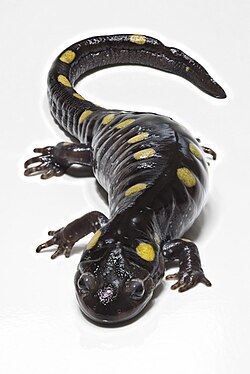
Picture of Caudata
- Source
- Wikipedia/Commons
- Credit
- Camazine at English Wikipedia ) (Scott Camazine web.mac.com/camazine)
- Licence
- CC BY-SA 3.0
- Commercial use
- the licence allows it
Photogrammetry
- Source
- MorphoSource
- Credit
- Moore Lab of Zoology
- Licence
- not stated by the source
- Commercial use
- cannot be read from the licence given — check the record
- Specimen
- Chiroxiphia caudata · MLZ:Bird:MLZ:Bird:65760
The description on this site
- Source
- Wikipedia, “Salamander”
- Licence
- CC BY-SA 4.0
This is what the site found, which is not the same as what exists.
Keep going
What may have been alongside itBatrachia through timeFormations of the Late CretaceousThe world it lived on
Occurrence data from the Paleobiology Database, CC BY 4.0. (Scopoli 1777)