Cecidomyiidae
Cecidomyiidae is a family of flies known as gall midges or gall gnats. As the name implies, the larvae of most gall midges feed within plant tissue, creating abnormal plant growths called galls. Cecidomyiidae are very fragile small insects usually only 2–3 mm (0.079–0.118 in) in length; many are less than 1 mm (0.039 in) long. They are characterised by hairy wings, unusual in the order Diptera, and have long antennae. Some Cecidomyiids are also known for the strange phenomenon of paedogenesis in which the larval stage reproduces without maturing first. In some species, the daughter larvae consume the mother, while in others, reproduction occurs later on in the egg or pupa.

Alvesgaspar · CC BY-SA 3.0 · via Wikipedia/Commons. May be a photograph of a specimen, or an artist’s reconstruction — an interpretation of a skeleton, since colour and soft tissue are almost never preserved.
On record
Recorded, not inferred- Also called
- gall midgePBDB
- Sits inside
- SciaroideaPBDB
- Motility
- actively mobilePBDB, for Arthropoda
- Environment
- terrestrialPBDB, for Insecta
Time the record covers
At least 143 million years on record.
The record covers at least 143.1 Mya to 11.7 ka. No occurrence read is dated outside 149.2 Mya to 0 Mya.
213 occurrences of Cecidomyiidae on record, most of them in the Eocene. The Paleobiology Database records this as a living group. Bar height is expected occurrences, not a count: each fossil is spread across the span it is dated to, so a tall narrow bar means tight dating and a low wide one means loose.
When
213 occurrences- Late Jurassicunder 1%
- Early Cretaceous5%
- Late Cretaceous11%
- Eocene73%
- Oligoceneunder 1%
- Miocene8%
- Plioceneunder 1%
- Holoceneunder 1%
These are dates about fossils, not the animal: the record can only begin after it arose and end before it died out, so either end may reach further. Shares are expected occurrences: a fossil dated to a span is counted partly in each period it straddles. More on what this infers.
Found in
17 formations
- Kheta Formation10
- Argiles d'lignite du Soissonnais Formation7
- Foremost Formation · Belly River Group4
- Florissant Formation2
- Green River Formation2
- Escucha Formation2
Loading coastlines…
The named rock units Cecidomyiidae has been recovered from, largest first. Drawn where the rock is now, not where it formed. 175 occurrences have no formation on record, which is common for older literature.
Cecidomyiidae and its relatives
EoceneWhere Cecidomyiidae and its relatives were recorded in the Eocene.
Found in the same rock
3,595 taxa- Culicoides filipalpis6 sites
- Forcipomyia6 sites
- Yantaromyrmex geinitzi6 sites
- Araneae5 sites
- Atriculicoides globosus5 sites
- Ceratopogon5 sites
- Chironomidae5 sites
- Lasius schiefferdeckeri5 sites
- Lype sericea5 sites
- Monogedania clunipes5 sites
- Nylanderia pygmaea5 sites
- Orthocladiinae5 sites
- Plagiolepis klinsmanni5 sites
- Prenolepis henschei5 sites
- Pseudoteutana stigmatosa5 sites
- Scelioninae5 sites
- Stilobezzia5 sites
- Tetraponera simplex5 sites
- Arachnida4 sites
- Atriculicoides4 sites
- Baeomorpha ovatata4 sites
- Berothidae4 sites
- Brachypogon (Isohelea) prominulus4 sites
- Cretomiastor ferejunctus4 sites
The Paleobiology Database records 58 sites for Cecidomyiidae, and this reads all of them. The number is how many of those sites it was catalogued from too. The 24 sharing the most are listed.
This is not a list of everything alive at the time. It is only what has come out of the same ground as this animal and been written down.
Entered from
59 references- Monographie des Cecidomyidae, des Sciaridae, des Mycetophilidae et des Chironomidae de l'ambre de la Baltique31
- New gall midges of the Tribe Leptosynini (Diptera, Cecidomyiidae) from the Late Eocene ambers and the classification of the Supertribe Heteropezidi28
- Cecidomyiidae from Mexican Tertiary amber (Diptera)11
- First gall midges (Diptera, Cecidomyioidea) from Late Cretaceous amber of the Taimyr Peninsula8
- New gall midges of the Subfamily Lestremiinae (Diptera, Cecidomyiidae) from the Rovno Amber8
- New gall midges (Diptera, Cecidomyiidae) from the Rovno amber: subfamily Porricondylinae (tribtes Bryocryptini and Winnertziini) and subfamily Lasiopterinae (tribes Brachineurini and Oligotrophini)8
- New Species of Gall Midges (Diptera, Cecidomyiidae) from Rovno Amber: Subfamily Lestremiinae, Tribes Micromyiini and Peromyiini8
- Cecidomyiidae (Diptera) from Canadian amber8
- New gall midges (Diptera, Cecidomyiidae) from the Rovno amber: Subfamily Lestremiinae, Tribes Strobliellini and Campylomyzini; Subfamily Porricondylinae, Tribes Diadocidiini and Asynaptini7
- New gall midges (Diptera, Cecidomyiidae, Brachineurini, Ledomyiini) from the late Eocene Rovno amber6
- On the systematics of the gall-midge supertribe Heteropezidi (Diptera, Cecidomyiidae) from the Rovno amber. New taxa and combinations of the tribes Heteropezini and Miastorini6
- New Cecidomyiidae from the Lower Cretaceous Lebanese amber (Diptera)5
Each of the 213 occurrences read was entered from one of these publications, ordered by how many each accounts for. This is not a search for papers mentioning the name. 47 further references are not listed. Entries link to doi.org where the Paleobiology Database holds an identifier, and to its own record where it does not. Relayed as the Paleobiology Database holds them, not checked against what they resolve to.
Media and terms
Media content1
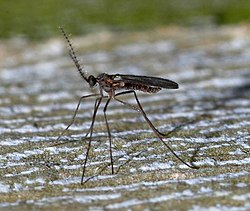
Picture of Cecidomyiidae
- Source
- Wikipedia/Commons
- Credit
- Alvesgaspar
- Licence
- CC BY-SA 3.0
- Commercial use
- the licence allows it
No 3D scan of Cecidomyiidae was found in Sketchfab.
Smithsonian Open Access and MorphoSource were not reached for this taxon, so this list is what the others held rather than everything there is.
The description on this site
- Licence
- CC BY-SA 4.0
This is what the site found, which is not the same as what exists.
Keep going
What may have been alongside itSciaroidea through timeFormations of the EoceneThe world it lived on
Occurrence data from the Paleobiology Database, CC BY 4.0. Newman 1834