Ceratitida
Ceratitida is an order that contains almost all ammonoid cephalopod genera from the Triassic as well as ancestral forms from the Upper Permian, the exception being the phylloceratids which gave rise to the great diversity of post-Triassic ammonites.

Didier Descouens · CC BY-SA 4.0 · via Wikipedia/Commons. May be a photograph of a specimen, or an artist’s reconstruction — an interpretation of a skeleton, since colour and soft tissue are almost never preserved.
On record
Recorded, not inferred- Also called
- ceratitePBDB
- Sits inside
- AmmonoideaPBDB
- Diet
- carnivorePBDB
- Life habit
- nektonicPBDB
- Motility
- actively mobilePBDB
- Vision
- well-developedPBDB, for Cephalopoda
- Environment
- marinePBDB, for Cephalopoda
Time the record covers
At least 73 million years on record.
The record covers at least 274.4 Mya to 201.4 Mya. No occurrence read is dated outside 283.3 Mya to 199.5 Mya.
12,000+ occurrences of Ceratitida on record. Bar height is expected occurrences, not a count: each fossil is spread across the span it is dated to, so a tall narrow bar means tight dating and a low wide one means loose.
When
12,000 occurrences read- Permian10%
- Early Triassic42%
- Middle Triassic29%
- Late Triassic18%
- Early Jurassicunder 1%
These are dates about fossils, not the animal: the record can only begin after it arose and end before it died out, so either end may reach further. Shares are expected occurrences: a fossil dated to a span is counted partly in each period it straddles. The read hit its cap, so every figure above is a floor and the shares are of the occurrences read. More on what this infers.
Found in
at least 289 formations
- Pardonet Formation · Schooler Creek Group585
- Toad Formation573
- Wordie Creek Formation538
- Thaynes Formation458
- Prida Formation · Star Peak Group416
- Felsoörs Formation330
Loading coastlines…
The named rock units Ceratitida has been recovered from, largest first. Drawn where the rock is now, not where it formed. The read hit its cap, so each count is a floor. 265 further formations hold fewer occurrences each and are not listed. 2,901 occurrences have no formation on record, which is common for older literature.
Found in the same rock
1,231 taxa- Bivalvia34 sites
- Ammonoidea28 sites
- Gastropoda24 sites
- Arcavicula19 sites
- Pseudosageceras multilobatum18 sites
- Halobia17 sites
- Cassianella16 sites
- Nuculana15 sites
- Tropites15 sites
- Mentzelia mentzeli14 sites
- Septocardia14 sites
- Elegantinia13 sites
- Protostrea sinensis13 sites
- Cassianella simplex12 sites
- Diholkorhynchia sinensis12 sites
- Elegantinia elegans12 sites
- Encrinus liliiformis12 sites
- Mentzelia subspherica12 sites
- Myophoria12 sites
- Newaagia12 sites
- Pteria12 sites
- Solenopora12 sites
- Weixiserpula12 sites
- Wortheniella12 sites
The Paleobiology Database records at least 520 sites for Ceratitida, and this reads 240 of them. The number is how many of those sites it was catalogued from too. The 24 sharing the most are listed.
This is not a list of everything alive at the time. It is only what has come out of the same ground as this animal and been written down.
Entered from
at least 388 references- Canadian Triassic Ammonoid Faunas1,687
- The Pelsonian ammonoid fauna of the Balaton Highland431
- Smithian (Early Triassic) ammonoid faunas from northwestern Guangxi (South China): taxonomy and biochronology385
- Additions to the Eo-Triassic invertebrate fauna of east Greenland383
- Middle Triassic Molluscan Fossils of Biostratigraphic Significance from the Humboldt Range, Northwestern Nevada343
- New Middle and Late Anisian (Middle Triassic) Ammonoid Faunas From Northwestern Nevada(USA): Taxonomy and Biochronology283
- Triassic Ammonoid succession in South Primorye: 1. Lower Olenekian Hedenstroemia bosphorensis and Anasibirites nevolini Zones277
- Anisian ammonites from Gebze area (Kokaeli Peninsula, Turkey)269
- Selected ammonoid fauna from Prati Di Stuores/Stuores Wiesen and related sections across the Ladinian-Carnian boundary (southern Alps, Italy)257
- Kotlyar et al., 1983246
- Late Permian cephalopods of south China241
- Lower Triassic Ammonoids from Western Kwangsi, China217
Each of the 12,000 occurrences read was entered from one of these publications, ordered by how many each accounts for. This is not a search for papers mentioning the name. That read hit its cap, so each count is a floor. 376 further references are not listed. Entries link to doi.org where the Paleobiology Database holds an identifier, and to its own record where it does not. Relayed as the Paleobiology Database holds them, not checked against what they resolve to.
Media and terms
Media content2
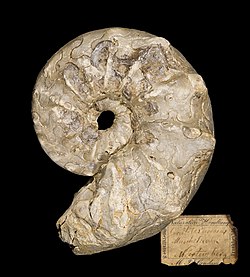
Picture of Ceratitida
- Source
- Wikipedia/Commons
- Credit
- Didier Descouens
- Licence
- CC BY-SA 4.0
- Commercial use
- the licence allows it
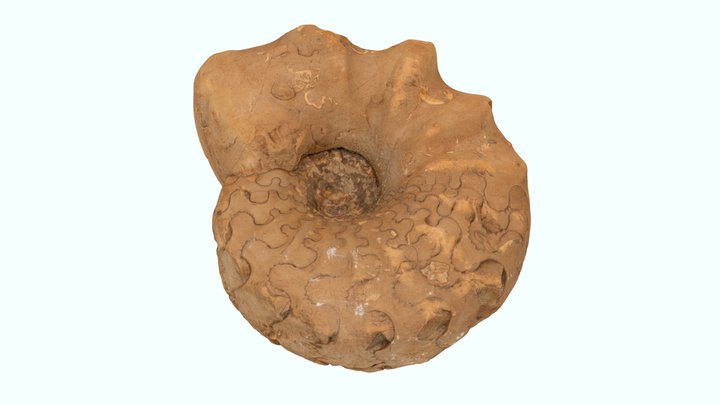
3D model
- Source
- Sketchfab
- Licence
- CC Attribution-NonCommercial-ShareAlike
- Commercial use
- the licence does not allow it
Smithsonian Open Access was not reached for this taxon, so this list is what the others held rather than everything there is.
The description on this site
- Source
- Wikipedia, “Ceratitida”
- Licence
- CC BY-SA 4.0
This is what the site found, which is not the same as what exists.
Keep going
What may have been alongside itAmmonoidea through timeThe world it lived on
Occurrence data from the Paleobiology Database, CC BY 4.0. Hyatt 1884