Cheilea equestris
Cheilea equestris is a species of small limpet-like sea snail, a marine gastropod mollusk in the family Hipponicidae, the hoof snails.

Naturalis Biodiversity Center · CC0 · via Wikipedia/Commons. May be a photograph of a specimen, or an artist’s reconstruction — an interpretation of a skeleton, since colour and soft tissue are almost never preserved.
On record
Recorded, not inferred- Also called
- false cup-and-saucerPBDB
- Sits inside
- CheileaPBDB
- Diet
- grazer, suspension feederPBDB, for Hipponicidae
- Life habit
- epifaunalPBDB, for Hipponicidae
- Motility
- facultatively mobile, attachedPBDB, for Hipponicidae
- Vision
- limitedPBDB, for Gastropoda
Time the record covers
At least 15 million years on record.
The record covers at least 15.98 Mya to 129 ka. No occurrence read is dated outside 23.04 Mya to 11.7 ka.
23 occurrences of Cheilea equestris on record, most of them in the Pliocene. The Paleobiology Database records this as a living group. Bar height is expected occurrences, not a count: each fossil is spread across the span it is dated to, so a tall narrow bar means tight dating and a low wide one means loose.
When
23 occurrences- Miocene22%
- Pliocene48%
- Pleistocene30%
These are dates about fossils, not the animal: the record can only begin after it arose and end before it died out, so either end may reach further. Shares are expected occurrences: a fossil dated to a span is counted partly in each period it straddles. More on what this infers.
Found in
7 formations
- Bowden Formation · Coastal Group5
- Fernando Formation2
- Talparo Formation1
- Ndalithoni Limestone Formation1
- Ra Formation1
- Falmouth Formation · Coastal Group1
Loading coastlines…
The named rock units Cheilea equestris has been recovered from, largest first. Drawn where the rock is now, not where it formed. 11 occurrences have no formation on record, which is common for older literature.
Cheilea equestris and its relatives
PlioceneWhere Cheilea equestris and its relatives were recorded in the Pliocene.
Found in the same rock
1,035 taxa- Rissoina5 sites
- Astralium3 sites
- Cancellaria3 sites
- Cerithiopsis3 sites
- Cerithium3 sites
- Conus3 sites
- Diodora3 sites
- Fossarus3 sites
- Hipponix3 sites
- Solariorbis3 sites
- Tegula3 sites
- Thylacodes squamigerus3 sites
- Triphora3 sites
- Acar domingensis2 sites
- Acmaea2 sites
- Alvania2 sites
- Anadara2 sites
- Antisabia panamensis2 sites
- Antropora2 sites
- Architectonica nobilis2 sites
- Arcopsis adamsi2 sites
- Argopecten2 sites
- Astrangia insignifica2 sites
- Atilia2 sites
The Paleobiology Database records 10 sites for Cheilea equestris, and this reads all of them. The number is how many of those sites it was catalogued from too. The 24 sharing the most are listed.
This is not a list of everything alive at the time. It is only what has come out of the same ground as this animal and been written down.
Entered from
15 references- Unpublished census data from Atlantic coastal plain and circum-Caribbean Neogene assemblages and taxonomic opinions4
- Cenozoic fossil mollusks from Western Pacific Islands; Gastropods (Turritellidae through Strombidae)3
- Late Pleistocene molluscan assemblages from the coral reefs of the Kenya coast2
- Additional Notes on the Pliocene Molluscan Fauna of Los Angeles City2
- Marine Pleistocene mollusks from the Galapagos Islands2
- Palaeoecology, taphonomy, and preservation of a lower Pliocene shell bed (coquina) froma volcanic oceanic island (Santa Maria Island, Azores)1
- Ecospace variability along a carbonate platform at the northern boundary of the Miocene reef belt (Upper Langhian, Austria)1
- The maximum warmings of the Pleistocene world climate recorded in the Canary Islands1
- The benthic mollusk faunas of two contrasting reef paleosubenvironments: Falmouth Formation (late Pleistocene, last interglacial), Jamaica1
- Cenozoic fossil mollusks from Western Pacific Islands; Gastropods (Volutidae through Terebridae)1
- Notes on the fauna of the Chipola Formation - XVIII. Some new or otherwise interesting members of the Calyptraeidae (Mollusca: Gastropoda)1
- Miocene and Pliocene mollusks from Trinidad1
Each of the 23 occurrences read was entered from one of these publications, ordered by how many each accounts for. This is not a search for papers mentioning the name. 3 further references are not listed. Entries link to doi.org where the Paleobiology Database holds an identifier, and to its own record where it does not. Relayed as the Paleobiology Database holds them, not checked against what they resolve to.
Media and terms
Media content1
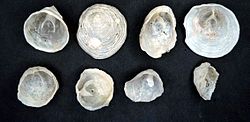
Picture of Cheilea equestris
- Source
- Wikipedia/Commons
- Credit
- Naturalis Biodiversity Center
- Licence
- CC0
- Commercial use
- the licence allows it
No 3D scan of Cheilea equestris was found in Sketchfab.
Smithsonian Open Access and MorphoSource were not reached for this taxon, so this list is what the others held rather than everything there is.
The description on this site
- Licence
- CC BY-SA 4.0
This is what the site found, which is not the same as what exists.
Keep going
What may have been alongside itCheilea through timeFormations of the PlioceneThe world it lived on
Occurrence data from the Paleobiology Database, CC BY 4.0. (Linnaeus 1758)