Cichlidae
Cichlids are a large, diverse, and widespread family of percomorph fish in the family Cichlidae, order Cichliformes. At least 1,760 species have been scientifically described, making it one of the largest vertebrate families, with only the Cyprinidae being more speciose. New species are discovered annually, and many species remain undescribed. The actual number of species is therefore unknown, with estimates varying between 2,000 and 3,000. They are native to the Neotropics, Africa, the Middle East, and the Indian subcontinent, although some species have been introduced worldwide.

Photograph by Mike Peel ( www.mikepeel.net ). · CC BY-SA 4.0 · via Wikipedia/Commons. May be a photograph of a specimen, or an artist’s reconstruction — an interpretation of a skeleton, since colour and soft tissue are almost never preserved.
On record
Recorded, not inferred- Also called
- cichlidPBDB
- Sits inside
- CichliformesPBDB
- Motility
- actively mobilePBDB, for Osteichthyes
- Environment
- freshwaterPBDB
Time the record covers
At least 41 million years on record.
The record covers at least 41.03 Mya to 11.7 ka. No occurrence read is dated outside 56 Mya to 0 Mya.
63 occurrences of Cichlidae on record, most of them in the Miocene. The Paleobiology Database records this as a living group. Bar height is expected occurrences, not a count: each fossil is spread across the span it is dated to, so a tall narrow bar means tight dating and a low wide one means loose.
When
63 occurrencesThese are dates about fossils, not the animal: the record can only begin after it arose and end before it died out, so either end may reach further. Shares are expected occurrences: a fossil dated to a span is counted partly in each period it straddles. More on what this infers.
Found in
23 formations
- Nkondo Formation · Albertine Group8
- Koobi Fora Formation · Omo Group6
- Nachukui Formation · Omo Group3
- Wembere-Manonga Formation3
- Olduvai Formation3
- Shungura Formation · Omo Group2
Loading coastlines…
The named rock units Cichlidae has been recovered from, largest first. Drawn where the rock is now, not where it formed. 15 occurrences have no formation on record, which is common for older literature.
Cichlidae and its relatives
MioceneWhere Cichlidae and its relatives were recorded in the Miocene.
Found in the same rock
759 taxa- Synodontis26 sites
- Hydrocynus22 sites
- Clarias19 sites
- Lates niloticus17 sites
- Gymnarchus15 sites
- Barbus12 sites
- Bovidae11 sites
- Characidae11 sites
- Clariidae11 sites
- Palaeoloxodon recki11 sites
- Polypterus11 sites
- Protopterus11 sites
- Suidae11 sites
- Alestes sp.9 sites
- Bunocharax sp.9 sites
- Hyperopisus sp.9 sites
- Alcelaphini8 sites
- Bagrus8 sites
- Cyprinidae8 sites
- Hominidae8 sites
- Labeo sp.8 sites
- Osteichthyes8 sites
- Siluriformes8 sites
- Sindacharax sp.8 sites
The Paleobiology Database records 61 sites for Cichlidae, and this reads all of them. The number is how many of those sites it was catalogued from too. The 24 sharing the most are listed.
This is not a list of everything alive at the time. It is only what has come out of the same ground as this animal and been written down.
Entered from
46 references- Koobi Fora Research Project The Fossil Ungulates: Proboscidea, Perissodactyla, Suidae4
- Equidae of the Albertine rift valley,Uganda3
- Late Pleistocene hunter-gatherers at Ishango (eastern Zaire): the faunal evidence3
- Les bovides miocenes de la formation de Ngorora du Bassin de Baringo (Rift Valley, Kenya) 33
- Lothagam: the dawn of humanity in eastern Africa2
- A middle stone age worked bone industry from Katanda,Upper Semliki Valley,Zaire2
- Hippopotamidae,Mammalia,Artiodactyla from the Western Rift,Lake Albert Basin,Uganda;preliminary study2
- Evolution of bovid diversity in the Plio-Pleistocene of Africa2
- Carnivora from Nkondo and Kisegi-Nyabusosi,Western Rift, Uganda2
- Fish remains from Late Pleistocene and Holocene archaeological sites near Khashm el Girba,Sudan2
- The Vertebrate Taphonomy and Paleoecology of the Olorgesailie Formation (Middle Pleistocene, Kenya)2
- Fish remains from Olduvai2
Each of the 63 occurrences read was entered from one of these publications, ordered by how many each accounts for. This is not a search for papers mentioning the name. 34 further references are not listed. Entries link to doi.org where the Paleobiology Database holds an identifier, and to its own record where it does not. Relayed as the Paleobiology Database holds them, not checked against what they resolve to.
Media and terms
Media content1
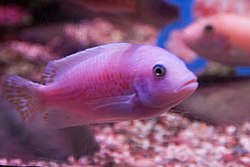
Picture of Cichlidae
- Source
- Wikipedia/Commons
- Credit
- Photograph by Mike Peel ( www.mikepeel.net ).
- Licence
- CC BY-SA 4.0
- Commercial use
- the licence allows it
No 3D scan was found. Smithsonian Open Access, MorphoSource and Sketchfab were all searched.
The description on this site
- Source
- Wikipedia, “Cichlid”
- Licence
- CC BY-SA 4.0
This is what the site found, which is not the same as what exists.
Keep going
What may have been alongside itCichliformes through timeFormations of the MioceneThe world it lived on
Occurrence data from the Paleobiology Database, CC BY 4.0. Heckel 1840