Cirolanidae
Cirolanidae is a family of aquatic isopods.

Hans Hillewaert · CC BY-SA 4.0 · via Wikipedia/Commons. May be a photograph of a specimen, or an artist’s reconstruction — an interpretation of a skeleton, since colour and soft tissue are almost never preserved.
On record
Recorded, not inferred- Also called
- pill bugPBDB
- Sits inside
- CymothooideaPBDB
- Diet
- omnivorePBDB, for Malacostraca
- Life habit
- epifaunalPBDB, for Malacostraca
- Motility
- actively mobilePBDB, for Malacostraca
- Vision
- well-developedPBDB, for Malacostraca
Time the record covers
At least 243 million years on record.
The record covers at least 245.19 Mya to 1.8 Mya. No occurrence read is dated outside 247 Mya to 774 ka.
63 occurrences of Cirolanidae on record, most of them in the Middle Jurassic. The Paleobiology Database records this as a living group, and the chart stops with its fossils rather than at the present. Bar height is expected occurrences, not a count: each fossil is spread across the span it is dated to, so a tall narrow bar means tight dating and a low wide one means loose.
When
63 occurrences- Middle Triassic3%
- Late Triassic2%
- Middle Jurassic24%
- Late Jurassic2%
- Early Cretaceous16%
- Late Cretaceous16%
- Paleocene2%
- Eocene8%
- Oligocene13%
- Miocene5%
- Pliocene3%
- Pleistocene8%
These are dates about fossils, not the animal: the record can only begin after it arose and end before it died out, so either end may reach further. Shares are expected occurrences: a fossil dated to a span is counted partly in each period it straddles. More on what this infers.
Found in
28 formations
- Opalinus Clay Formation6
- Makah Formation5
- Opalinuston Formation4
- Sierra Madre Formation4
- Pysht Formation3
- Opalinuston Formation2
Loading coastlines…
The named rock units Cirolanidae has been recovered from, largest first. Drawn where the rock is now, not where it formed. 4 further formations hold fewer occurrences each and are not listed. 13 occurrences have no formation on record, which is common for older literature.
Cirolanidae and its relatives
Middle JurassicWhere Cirolanidae and its relatives were recorded in the Middle Jurassic.
Found in the same rock
461 taxa- Palaega jurassica13 sites
- Palaega goedertorum11 sites
- Bositra buchi4 sites
- Planolites4 sites
- Jurapseudes friedericianus3 sites
- Lenticulina dorbignyi dorbignyi3 sites
- Macroacaena alseanus3 sites
- Reinholdella3 sites
- Reophax3 sites
- Ammobaculites subcretaceus2 sites
- Antrimpos atavus2 sites
- Chondrostei2 sites
- Cirolana enigma2 sites
- Cirolana titanophila2 sites
- Eoscorpiidae2 sites
- Euestheria minuta2 sites
- Euthycarcinus kessleri2 sites
- Halicyne ornata2 sites
- Idas olympicus2 sites
- Lenticulina dorbignyi aulosensis2 sites
- Lingularia tenuissima2 sites
- Micraster2 sites
- Nuculana posterolaevia2 sites
- Palaega2 sites
The Paleobiology Database records 57 sites for Cirolanidae, and this reads all of them. The number is how many of those sites it was catalogued from too. The 24 sharing the most are listed.
This is not a list of everything alive at the time. It is only what has come out of the same ground as this animal and been written down.
Entered from
31 references- Palaega goedertorum, a fossil isopod (Crustacea) from Late Eocene to Early Miocene rocks of Washington state11
- Isopoden und Tanaidaceen (Crustacea, Malacostraca) aus dem unteren Opalinuston der Nordschweiz6
- New report of decapod and isopod crustaceans from the Lower-Middle Pleistocene of Montalbano Jonico, Matera (Basilicata, southern Italy)5
- Paläontologische Untersuchungen im unteren Opalinuston der Nordschweiz4
- New species of fossil Cirolanidae (Isopoda, Cymothoida) from the Lower Cretaceous (Aptian) Sierra Madre Formation plattenkalk dolomites of El Espinal quarries, Chiapas, SE Mexico3
- Die Grenzziehung Unter-/Mitteljura (Toarcium/Aalenium) bei Wittnau und Fuentelsaz [Determinig the boundary between Toarcium/Aalenium near Wittnau and Fuentelsaz]3
- Fossil Crustacea of the Atlantic and Gulf Coastal Plain3
- Eocene isopods on electric rays: tracking ancient biological interactions from a complex fossil record2
- Lower Cretaceous marine isopods (Isopoda: Cirolanidae, Sphaeromatidae) from the San Juan Raya and Tlayúa formations, Puebla, Mexico2
- Mesozoic and Cenozoic fossil isopods of North America2
- Faunes et paysages du Grès à Voltzia du Nord des Vosges: Essai paléoécologique sur le Buntsandstein supérieur2
- Isopod crustacean fossils from the Cenomanian stratotype: five new species in suborders Cymothoida, Asellota and Valvifera1
Each of the 63 occurrences read was entered from one of these publications, ordered by how many each accounts for. This is not a search for papers mentioning the name. 19 further references are not listed. Entries link to doi.org where the Paleobiology Database holds an identifier, and to its own record where it does not. Relayed as the Paleobiology Database holds them, not checked against what they resolve to.
Media and terms
Media content2

Picture of Cirolanidae
- Source
- Wikipedia/Commons
- Credit
- Hans Hillewaert
- Licence
- CC BY-SA 4.0
- Commercial use
- the licence allows it
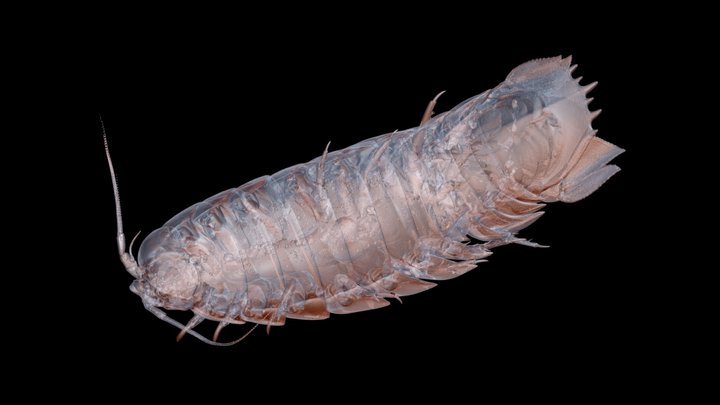
3D model
- Source
- Sketchfab
- Licence
- CC Attribution-NonCommercial-ShareAlike
- Commercial use
- the licence does not allow it
Smithsonian Open Access and MorphoSource were not reached for this taxon, so this list is what the others held rather than everything there is.
The description on this site
- Source
- Wikipedia, “Cirolanidae”
- Licence
- CC BY-SA 4.0
This is what the site found, which is not the same as what exists.
Keep going
What may have been alongside itCymothooidea through timeFormations of the Middle JurassicThe world it lived on
Occurrence data from the Paleobiology Database, CC BY 4.0. Dana 1852