Planolites
Planolites is an ichnogenus found throughout the Ediacaran and the Phanerozoic that is made during the feeding process of worm-like animals. The traces are generally small, 1–5 mm (0.039–0.197 in), unlined, and rarely branched, with fill that differs from the host rock.

FunkMonk · CC BY-SA 3.0 · via Wikipedia/Commons. May be a photograph of a specimen, or an artist’s reconstruction — an interpretation of a skeleton, since colour and soft tissue are almost never preserved.
On record
Recorded, not inferred- Sits inside
- IchnofossilsPBDB
Time the record covers
At least 1362 million years on record.
The record covers at least 1400 Mya to 37.71 Mya. No occurrence read is dated outside 1600 Mya to 33.9 Mya.
439 occurrences of Planolites on record, most of them in the Middle Jurassic. Bar height is expected occurrences, not a count: each fossil is spread across the span it is dated to, so a tall narrow bar means tight dating and a low wide one means loose.
When
439 occurrences- Cambrian20%
- Ordovician2%
- Silurian1%
- Devonianunder 1%
- Carboniferous2%
- Permianunder 1%
- Early Triassicunder 1%
- Middle Triassic1%
- Late Triassicunder 1%
- Early Jurassicunder 1%
- Middle Jurassic52%
- Late Jurassic4%
- Early Cretaceous4%
- Late Cretaceous3%
- Eoceneunder 1%
These are dates about fossils, not the animal: the record can only begin after it arose and end before it died out, so either end may reach further. Shares are expected occurrences: a fossil dated to a span is counted partly in each period it straddles. More on what this infers.
Found in
103 formations
- Opalinuston Formation223
- Laeso Formation14
- Pedroche Formation13
- Kap Leslie Formation12
- Campito Formation9
- Czarna Shale Formation7
Loading coastlines…
The named rock units Planolites has been recovered from, largest first. Drawn where the rock is now, not where it formed. 79 further formations hold fewer occurrences each and are not listed. 10 occurrences have no formation on record, which is common for older literature.
Planolites and its relatives
Middle JurassicWhere Planolites and its relatives were recorded in the Middle Jurassic.
Found in the same rock
910 taxa- Bositra buchi121 sites
- Parainoceramya dubia69 sites
- Astarte35 sites
- Cingentolium (Cingentolium) cingulatum35 sites
- Chondrites32 sites
- Toarctocera subpunctata26 sites
- Palaeonucula hammeri21 sites
- Nuculana19 sites
- Grammatodon18 sites
- Tancredia17 sites
- Palaeophycus16 sites
- Thalassinoides16 sites
- Decapoda15 sites
- Jurapseudes friedericianus12 sites
- Ammonoidea11 sites
- Didymaulichnus11 sites
- Palaeophycus tubularis11 sites
- Camptonectes10 sites
- Skolithos10 sites
- Arenicolites9 sites
- Crinoidea9 sites
- Belemnitida8 sites
- Buchia mosquensis8 sites
- Entolium orbiculare8 sites
The Paleobiology Database records 279 sites for Planolites, and this reads 240 of them. The number is how many of those sites it was catalogued from too. The 24 sharing the most are listed.
This is not a list of everything alive at the time. It is only what has come out of the same ground as this animal and been written down.
Entered from
96 references- Paläontologische Untersuchungen im unteren Opalinuston der Nordschweiz223
- Planolites and Skolithos from the Upper Precambrian-Lower Cambrian, White-Inyo Mountains, California20
- Substrate control of lower cambrian trace fossils from bornholm, Denmark16
- Trace and soft body fossils from the Pedroche Formation (Ovetian, Lower Cambrian of the Sierra de Córdoba, S Spain) and their relation to the Pedroche event13
- Trace fossils in the Lower Cambrian sequence in the Swietokrzyskie Mountains, Central Poland13
- Genesis and environmental significance of Upper Cretaceous shell concentrations from the Cauvery Basin, southern India9
- Ichnology of the Upper Cambrian? to Lower Ordovician Bell Island and Wabana groups of eastern Newfoundland, Canada7
- Three new early Namurian (E1c-E2a) marine bands in central and northern England, UK, and their bearing on correlations with the Askrigg Block6
- Ediacaran biota of the Wernecke Mountains, Yukon, Canada6
- Ediacaran body and trace fossils in Miette Group (Windermere Supergroup) near Salient Mountain, British Columbia, Canada5
- Early Triassic Ophiuroids: their paleoecology, taphonomy and distribution4
- Silurian reefal buildups: Spiti-Kinnaur, Himachal Himalaya, India4
Each of the 439 occurrences read was entered from one of these publications, ordered by how many each accounts for. This is not a search for papers mentioning the name. 84 further references are not listed. Entries link to doi.org where the Paleobiology Database holds an identifier, and to its own record where it does not. Relayed as the Paleobiology Database holds them, not checked against what they resolve to.
Media and terms
Media content2

Picture of Planolites
- Source
- Wikipedia/Commons
- Credit
- FunkMonk
- Licence
- CC BY-SA 3.0
- Commercial use
- the licence allows it
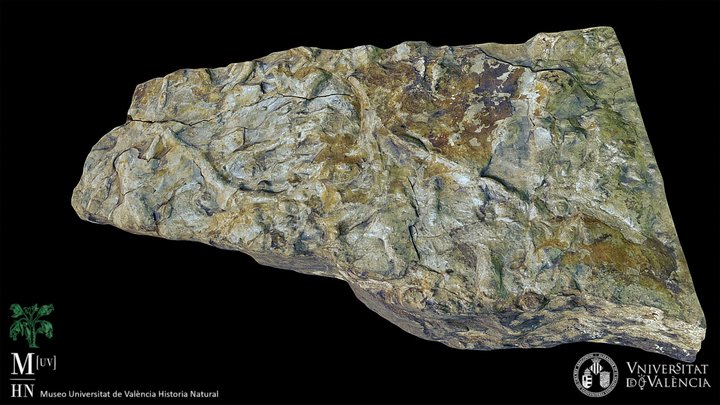
3D model
- Source
- Sketchfab
- Licence
- CC Attribution
- Commercial use
- cannot be read from the licence given — check the record
The description on this site
- Source
- Wikipedia, “Planolites”
- Licence
- CC BY-SA 4.0
This is what the site found, which is not the same as what exists.
Keep going
What may have been alongside itIchnofossils through timeFormations of the Middle JurassicThe world it lived on
Occurrence data from the Paleobiology Database, CC BY 4.0. Nicholson 1873