Coeloma
Coeloma is an extinct genus of crabs belonging to the family Geryonidae or Mathildellidae. The genus includes 17 species, formerly distributed among several subgenera. The fossil record of the genus extends from the Thanetian to the Pliocene.

Hectonichus · CC BY-SA 3.0 · via Wikipedia/Commons. May be a photograph of a specimen, or an artist’s reconstruction — an interpretation of a skeleton, since colour and soft tissue are almost never preserved.
On record
Recorded, not inferred- Sits inside
- PolybiinaePBDB
- Diet
- carnivorePBDB, for Decapoda
- Life habit
- semi-infaunalPBDB, for Portunoidea
- Motility
- actively mobilePBDB, for Malacostraca
- Vision
- well-developedPBDB, for Malacostraca
Time the record covers
At least 50 million years on record.
The record covers at least 56 Mya to 5.333 Mya. No occurrence read is dated outside 59.24 Mya to 2.58 Mya.
19 occurrences of Coeloma on record, most of them in the Eocene. The Paleobiology Database records this as a living group, and the chart stops with its fossils rather than at the present. Bar height is expected occurrences, not a count: each fossil is spread across the span it is dated to, so a tall narrow bar means tight dating and a low wide one means loose.
When
19 occurrencesThese are dates about fossils, not the animal: the record can only begin after it arose and end before it died out, so either end may reach further. Shares are expected occurrences: a fossil dated to a span is counted partly in each period it straddles. More on what this infers.
Found in
5 formations
Loading coastlines…
The named rock units Coeloma has been recovered from, largest first. Drawn where the rock is now, not where it formed. 14 occurrences have no formation on record, which is common for older literature.
Coeloma and its relatives
EoceneWhere Coeloma and its relatives were recorded in the Eocene.
Found in the same rock
472 taxa- Glycymeris3 sites
- Squalus alsaticus3 sites
- Carcharias cuspidatus2 sites
- Foraminifera2 sites
- Hoploparia klebsi2 sites
- Isurolamna gracilis2 sites
- Keasius parvus2 sites
- Lepidopus2 sites
- Litoricola macrodactyla2 sites
- Nucula duchasteli2 sites
- ? Calamoideae indet.1 site
- ? Collinsicarcinus sp.1 site
- Abadzekhia1 site
- Abadzekhia tarletskovi1 site
- Achaeus parvulus1 site
- Achilleodinium1 site
- Achomosphaera1 site
- Acrilla (Ferminoscala) aragoensis1 site
- Acteon1 site
- Actinodaphne1 site
- Acutostrea idrianensis fettkei1 site
- Aeoliscus1 site
- Aeoliscus heinrichi1 site
- Aetomylaeus dixoni1 site
The Paleobiology Database records 16 sites for Coeloma, and this reads all of them. The number is how many of those sites it was catalogued from too. The 24 sharing the most are listed.
This is not a list of everything alive at the time. It is only what has come out of the same ground as this animal and been written down.
Entered from
16 references- Further notes on Eocene Crustacea from Portsmouth3
- I crostacei brachiuri a anomuri del Pliocene Italiano2
- New spider crabs (Brachyura, Majoidea) from the early Eocene of Spain with a reassignment of the species "Periacanthus" tetracornis1
- An exceptional concentration of marine fossils associated with wood-fall in the Terhagen Member (Boom Formation; Schelle, Belgium), Rupelian of the southern North Sea Basin1
- Rogueus belgodereae, a new raninoid crab (Crustacea: Brachyura: Raninoidea) from the Upper Palaeocene (Thanetian) of southern France, with comments on early Palaeocene decapod crustacean faunules1
- The Rauenberg fossil Lagerstätte (Baden-Württemberg, Germany): A window into early Oligocene marine and coastal ecosystems of Central Europe1
- Crostacei decapodi del Veneto occidentale (Vicenza, Italia Settentrionale)1
- Coeloma rupeliense (Crustacea, Decapoda, Brachyura) from the Bilzen Formation (Rupel Group, Lower Oligocene) in northeast Belgium1
- Brachyuran and anomuran fauna from the Cenozoic of Piedmont (NW Italy)1
- Marine fauna of the middle Eocene Tukwila Formation, King County1
- I crostacei Eocenici della Cava "Boschetto" di Nogarole Vicentino (VIcenza - Italia settentrionale1
- Die tertiären Krebse von Helmstedt bei Braunschweig, Deutschland1
Each of the 19 occurrences read was entered from one of these publications, ordered by how many each accounts for. This is not a search for papers mentioning the name. 4 further references are not listed. Entries link to doi.org where the Paleobiology Database holds an identifier, and to its own record where it does not. Relayed as the Paleobiology Database holds them, not checked against what they resolve to.
Media and terms
Media content1
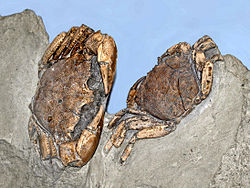
Picture of Coeloma
- Source
- Wikipedia/Commons
- Credit
- Hectonichus
- Licence
- CC BY-SA 3.0
- Commercial use
- the licence allows it
No 3D scan of Coeloma was found in Sketchfab.
Smithsonian Open Access and MorphoSource were not reached for this taxon, so this list is what the others held rather than everything there is.
The description on this site
- Source
- Wikipedia, “Coeloma”
- Licence
- CC BY-SA 4.0
This is what the site found, which is not the same as what exists.
Keep going
What may have been alongside itPolybiinae through timeFormations of the EoceneThe world it lived on
Occurrence data from the Paleobiology Database, CC BY 4.0. Milne-Edwards 1865