Combretum
Combretum, the bushwillows or combretums, make up the type genus of the family Combretaceae. The genus comprises about 272 species of trees and shrubs, most of which are native to tropical and southern Africa, about 5 to Madagascar, but there are others that are native to tropical Asia, New Guinea and the Bismarck Archipelago, Australia, and tropical America.

Marco Schmidt · CC BY-SA 2.5 · via Wikipedia/Commons. May be a photograph of a specimen, or an artist’s reconstruction — an interpretation of a skeleton, since colour and soft tissue are almost never preserved.
On record
Recorded, not inferred- Also called
- bushwillowPBDB
- Sits inside
- CombretaceaePBDB
- Diet
- "photoautotroph"PBDB, for Angiospermae
Time the record covers
At least 68 million years on record.
The record covers at least 72.2 Mya to 3.6 Mya. No occurrence read is dated outside 89.8 Mya to 11.7 ka.
35 occurrences of Combretum on record, most of them in the Miocene. Bar height is expected occurrences, not a count: each fossil is spread across the span it is dated to, so a tall narrow bar means tight dating and a low wide one means loose.
When
35 occurrences- Late Cretaceous6%
- Paleoceneunder 1%
- Eocene10%
- Oligoceneunder 1%
- Miocene67%
- Pliocene12%
- Pleistocene5%
These are dates about fossils, not the animal: the record can only begin after it arose and end before it died out, so either end may reach further. Shares are expected occurrences: a fossil dated to a span is counted partly in each period it straddles. More on what this infers.
Found in
9 formations
- Nkondo Formation · Albertine Group18
- Comox Formation · Nanaimo Group1
- Extension Formation · Nanaimo Group1
- Rockdale Formation · Wilcox Group1
- Lower Churia Formation · Siwalik Group1
- Kimin Formation · Siwalik Group1
Loading coastlines…
The named rock units Combretum has been recovered from, largest first. Drawn where the rock is now, not where it formed. 9 occurrences have no formation on record, which is common for older literature.
Combretum and its relatives
MioceneWhere Combretum and its relatives were recorded in the Miocene.
Found in the same rock
386 taxa- Acacia8 sites
- Lates niloticus7 sites
- Bunocharax sp.6 sites
- Chrysichthys6 sites
- Lanistes6 sites
- Brachystegia sp.5 sites
- Salacia sp.5 sites
- Suidae5 sites
- Synodontis5 sites
- Annona4 sites
- Berlinia4 sites
- Eurygnathohippus turkanense4 sites
- Hipparion4 sites
- Hydrocynus4 sites
- Persea4 sites
- Brachystegia spiciformis3 sites
- Characidae3 sites
- Dichapetalum sp.3 sites
- Dipterocarpus siwalicus3 sites
- Ficus3 sites
- Maytenus3 sites
- Nectandra3 sites
- Nectandra lancifolia3 sites
- Oreodaphne obtusifolia3 sites
The Paleobiology Database records 26 sites for Combretum, and this reads all of them. The number is how many of those sites it was catalogued from too. The 24 sharing the most are listed.
This is not a list of everything alive at the time. It is only what has come out of the same ground as this animal and been written down.
Entered from
19 references- Palaeovegetation (fossil plants) of the Albertine rift valley9
- Palaeobiology of the Albertine rift valley,Uganda-Zaire3
- Equidae of the Albertine rift valley,Uganda2
- Evolution of bovid diversity in the Plio-Pleistocene of Africa2
- Fossiliferous Neogene karst fillings in Angola,Botswana and Namibia2
- Flora of the Upper Cretaceous Nanaimo Group of Vancouver Island, British Columbia2
- Tertiary plants from Venezuela2
- The Lower Eocene floras of Southeastern North America2
- Middle Miocene flora from Siwalik foreland basin of Uttarakhand, India and its phytogeographic and palaeoclimatic implications1
- Leaf cuticular morphology of some angiosperm taxa from the Siwalik sediments (middle Miocene to lower Pleistocene) of Arunachal Pradesh, eastern Himalaya: Systematic and palaeoclimatic implications1
- Floral diversity during Plio-Pleistocene Siwalik sedimentation (Kimin Formation) in Arunachal Pradesh, India, and its palaeoclimatic significance1
- Angiospermous fossil leaves from the Siwalik foreland basins and their palaeoclimatic implications1
Each of the 35 occurrences read was entered from one of these publications, ordered by how many each accounts for. This is not a search for papers mentioning the name. 7 further references are not listed. Entries link to doi.org where the Paleobiology Database holds an identifier, and to its own record where it does not. Relayed as the Paleobiology Database holds them, not checked against what they resolve to.
Media and terms
Media content1
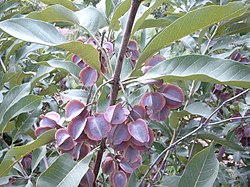
Picture of Combretum
- Source
- Wikipedia/Commons
- Credit
- Marco Schmidt
- Licence
- CC BY-SA 2.5
- Commercial use
- the licence allows it
No 3D scan of Combretum was found in MorphoSource and Sketchfab.
Smithsonian Open Access was not reached for this taxon, so this list is what the others held rather than everything there is.
The description on this site
- Source
- Wikipedia, “Combretum”
- Licence
- CC BY-SA 4.0
This is what the site found, which is not the same as what exists.
Keep going
What may have been alongside itCombretaceae through timeFormations of the MioceneThe world it lived on
Occurrence data from the Paleobiology Database, CC BY 4.0. Löfling 1763