Corallina
Corallina is a genus of red seaweeds with hard, abrasive calcareous skeletons in the family Corallinaceae. They are stiff, branched frond-like protists with articulated stipes. Corallina, like all red algae, are not considered plants under some definitions, but can be considered as belonging to plants in a broad sense.

J. McKenna · Public Domain · via Wikipedia/Commons. May be a photograph of a specimen, or an artist’s reconstruction — an interpretation of a skeleton, since colour and soft tissue are almost never preserved.
On record
Recorded, not inferred- Sits inside
- CorallinoideaePBDB
- Diet
- "photoautotroph"PBDB, for Corallinaceae
- Life habit
- epifaunal, clonalPBDB, for Corallinaceae
- Motility
- stationary, attached, epibiontPBDB, for Corallinaceae
- Environment
- marinePBDB, for Corallinaceae
Time the record covers
At least 61 million years on record.
The record covers at least 61.66 Mya to 11.7 ka. No occurrence read is dated outside 66 Mya to 0 Mya.
177 occurrences of Corallina on record, most of them in the Eocene. The Paleobiology Database records this as a living group. Bar height is expected occurrences, not a count: each fossil is spread across the span it is dated to, so a tall narrow bar means tight dating and a low wide one means loose.
When
177 occurrencesThese are dates about fossils, not the animal: the record can only begin after it arose and end before it died out, so either end may reach further. Shares are expected occurrences: a fossil dated to a span is counted partly in each period it straddles. More on what this infers.
Found in
43 formations
- Sylhet Formation Formation22
- Umatac Formation12
- Cluj Limestone Formation10
- Miyara Formation9
- Guitar Formation Formation9
- Alutom Formation6
Loading coastlines…
The named rock units Corallina has been recovered from, largest first. Drawn where the rock is now, not where it formed. 19 further formations hold fewer occurrences each and are not listed. 43 occurrences have no formation on record, which is common for older literature.
Corallina and its relatives
EoceneWhere Corallina and its relatives were recorded in the Eocene.
Found in the same rock
304 taxa- Lithophyllum47 sites
- Jania42 sites
- Miliolida34 sites
- Lithothamnion33 sites
- Miscellanea31 sites
- Amphiroa30 sites
- Discocyclina28 sites
- Distichoplax24 sites
- Sporolithon22 sites
- Spongites20 sites
- Mesophyllum19 sites
- Polystrata alba18 sites
- Anthozoa17 sites
- Distichoplax biserialis15 sites
- Echinodermata15 sites
- Lithoporella melobesioides15 sites
- Mollusca15 sites
- Lithoporella13 sites
- Neomeris12 sites
- Textulariida12 sites
- Amphistegina11 sites
- Nummulitidae10 sites
- Rotaliida10 sites
- Gastropoda8 sites
The Paleobiology Database records 115 sites for Corallina, and this reads all of them. The number is how many of those sites it was catalogued from too. The 24 sharing the most are listed.
This is not a list of everything alive at the time. It is only what has come out of the same ground as this animal and been written down.
Entered from
57 references- The Enigmatic Paleocene-Eocene coralline Distichoplax: Approaching the structural complexities, ecological affinities and extinction hypotheses22
- Fossil and recent calcareous algae from Guam20
- Coralline Algae and Benthic Foraminifera from the Long Formation (middle Miocene) of the Little Andaman Island, India: Biofacies Analysis, Systematics and Palaeoenvironmental Implications14
- Facies analysis and paleoenvironmental interpretation of Piacenzian carbonate deposits from the Guitar Formation of Car Nicobar Island, India9
- Upper Eocene paleobathymetry approach based on paleoecological assemblages (preliminary report from the Plesca Valley 2. outcrop, Transylvania)9
- Eocene algae from Isliigaki-shima, Ryukyu-retto9
- Dominance of coralline algae in the South China Sea: Insights into their responses to paleoceanographic events over the last 20 million years6
- Carbonate buildup in the Lakadong Formation of the South Shillong Plateau, NE India: A micropaleontological perspective5
- Calcareous algae from the Lakadong Formation of the South Shillong Plateau, NE India4
- Les algues des formations transgressives maestrichtiennes, paléocènes et yprésiennes de la côte sud-orientale de la Corse4
- Eocene coralline algae from the Kuma Group in the Ishizuchi Range, Shikoku, Japan4
- Coralline algae from the Neill West Coast Formation (Pleistocene), Neil Island, South Andaman, India3
Each of the 177 occurrences read was entered from one of these publications, ordered by how many each accounts for. This is not a search for papers mentioning the name. 45 further references are not listed. Entries link to doi.org where the Paleobiology Database holds an identifier, and to its own record where it does not. Relayed as the Paleobiology Database holds them, not checked against what they resolve to.
Media and terms
Media content1
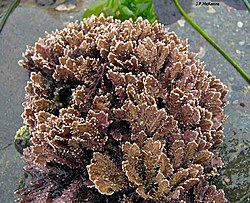
Picture of Corallina
- Source
- Wikipedia/Commons
- Credit
- J. McKenna
- Licence
- Public Domain
- Commercial use
- the licence allows it
No 3D scan of Corallina was found in MorphoSource and Sketchfab.
Smithsonian Open Access was not reached for this taxon, so this list is what the others held rather than everything there is.
The description on this site
- Source
- Wikipedia, “Corallina”
- Licence
- CC BY-SA 4.0
This is what the site found, which is not the same as what exists.
Keep going
What may have been alongside itCorallinoideae through timeFormations of the EoceneThe world it lived on
Occurrence data from the Paleobiology Database, CC BY 4.0. Linnaeus 1758