Cretoxyrhina
Cretoxyrhina is an extinct genus of large mackerel shark that lived about 107 to 73 million years ago during the late Albian to late Campanian of the Late Cretaceous. The type species, C. mantelli, is more commonly referred to as the Ginsu shark, first popularized in reference to the Ginsu knife, as its theoretical feeding mechanism is often compared with the "slicing and dicing" when one uses the knife. Cretoxyrhina is traditionally classified as the likely sole member of the family Cretoxyrhinidae but other taxonomic placements have been proposed, such as within the Alopiidae and Lamnidae.

User:A,Ocram · Public Domain · via Wikipedia/Commons. May be a photograph of a specimen, or an artist’s reconstruction — an interpretation of a skeleton, since colour and soft tissue are almost never preserved.
On record
Recorded, not inferred- Sits inside
- CretoxyrhinidaePBDB
- Diet
- carnivorePBDB, for Lamniformes
- Life habit
- nektonicPBDB, for Lamniformes
- Motility
- actively mobilePBDB, for Lamniformes
Time the record covers
At least 37 million years on record.
The record covers at least 110.1 Mya to 72.2 Mya. No occurrence read is dated outside 121.4 Mya to 66 Mya.
194 occurrences of Cretoxyrhina on record, most of them in the Late Cretaceous. Bar height is expected occurrences, not a count: each fossil is spread across the span it is dated to, so a tall narrow bar means tight dating and a low wide one means loose.
When
194 occurrencesThese are dates about fossils, not the animal: the record can only begin after it arose and end before it died out, so either end may reach further. Shares are expected occurrences: a fossil dated to a span is counted partly in each period it straddles. More on what this infers.
Found in
47 formations
- Greenhorn Limestone Formation · Colorado Group22
- Greenhorn Formation17
- Niobrara Formation · Colorado Group14
- Mancos Shale Formation13
- Scaglia Rossa Formation9
- Carlile Shale Formation · Colorado Group7
Loading coastlines…
The named rock units Cretoxyrhina has been recovered from, largest first. Drawn where the rock is now, not where it formed. 23 further formations hold fewer occurrences each and are not listed. 46 occurrences have no formation on record, which is common for older literature.
Cretoxyrhina and its relatives
Late CretaceousWhere Cretoxyrhina and its relatives were recorded in the Late Cretaceous.
Found in the same rock
672 taxa- Cretalamna appendiculata80 sites
- Squalicorax falcatus59 sites
- Scapanorhynchus raphiodon34 sites
- Archaeolamna kopingensis30 sites
- Squalicorax curvatus29 sites
- Ptychodus anonymus27 sites
- Squalicorax27 sites
- Cretodus semiplicatus25 sites
- Ptychodus decurrens24 sites
- Pachyrhizodus minimus22 sites
- Cretomanta canadensis21 sites
- Enchodus shumardi20 sites
- Microcarcharias saskatchewanensis20 sites
- Ptychodus whipplei20 sites
- Enchodus gladiolus19 sites
- Squalicorax kaupi19 sites
- Xiphactinus audax19 sites
- Protosphyraena18 sites
- Pseudoscapanorhynchus compressidens16 sites
- Ptychodus mammillaris16 sites
- Ptychodus occidentalis16 sites
- Rhinobatos incertus16 sites
- Cenocarcharias tenuiplicatus14 sites
- Haimirichia amonensis14 sites
The Paleobiology Database records 191 sites for Cretoxyrhina, and this reads all of them. The number is how many of those sites it was catalogued from too. The 24 sharing the most are listed.
This is not a list of everything alive at the time. It is only what has come out of the same ground as this animal and been written down.
Entered from
95 references- Cretaceous elasmobranchs of the Greenhorn Formation (Middle Cenomanian-Middle Turonian), western South Dakota17
- Selachians from the Greenhorn Cyclothem ("Middle" Cretaceous: Cenomanian-Turonian), Black Mesa, Arizona, and the paleogeographic distribution of Late Cretaceous selachians15
- Large deadfalls of the 'ginsu' shark Cretoxyrhina mantelli (Agassiz, 1835) (Neoselachii, Lamniformes) from the Upper Cretaceous of northeastern Italy9
- Chondrichthyans from the Menuha Formation (Late Cretaceous: Santonian–Early Campanian) of the Makhtesh Ramon region, southern Israel7
- Fossil fishes from the basal Greenhorn Limestone (Upper Cretaceous, Late Cenomanian) in Russell County, Kansas6
- Catalogue des poissons fossiles du terrain Crétacé du Nord de la France6
- Evoluyutsiya zubnykh sistem akul roda Pseudoisurus Gluckman, 1957 - krupneishikh melovykh pelagicheskikh akul evrazii5
- Les poissons fossiles du Bas-Congo et des régions voisines5
- Skeleton of the fossil shark Isurus denticulatus from the Turonian (Late Cretaceous) of Germany - ecological coevolution with prey of mackerel sharks4
- Selachians from the Fort Hays Limestone Member of the Niobrara Chalk (Upper Cretaceous), Ellis County, Kansas4
- Biology, dental morphology and taxonomy of lamniform sharks from the Campanian of the Kristianstad Basin, Sweden4
- Les sélaciens des terrains néocrétacés and paléocènes de Belgique and des contrées limitrophes. Eléments d'une biostratigraphie intercontinentale4
Each of the 194 occurrences read was entered from one of these publications, ordered by how many each accounts for. This is not a search for papers mentioning the name. 83 further references are not listed. Entries link to doi.org where the Paleobiology Database holds an identifier, and to its own record where it does not. Relayed as the Paleobiology Database holds them, not checked against what they resolve to.
Media and terms
Media content2

Picture of Cretoxyrhina
- Source
- Wikipedia/Commons
- Credit
- User:A,Ocram
- Licence
- Public Domain
- Commercial use
- the licence allows it
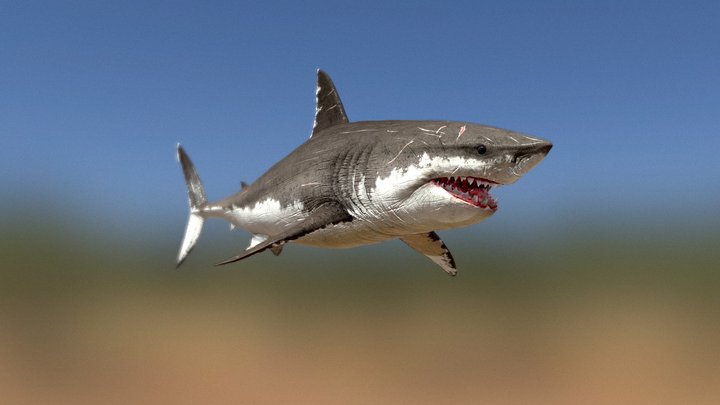
3D model
- Source
- Sketchfab
- Credit
- Julian Johnson-Mortimer
- Licence
- CC Attribution
- Commercial use
- cannot be read from the licence given — check the record
The description on this site
- Licence
- CC BY-SA 4.0
This is what the site found, which is not the same as what exists.
Keep going
What may have been alongside itCretoxyrhinidae through timeFormations of the Late CretaceousThe world it lived on
Occurrence data from the Paleobiology Database, CC BY 4.0. Glikman 1958