Cycadophyta
Cycads —constituting the division Cycadophyta—are seed plants with a stout, woody cylindrical trunk with a crown of large, hard, stiff, evergreen and usually pinnate (feather-shaped) leaves. The species are dioecious, that is, individual plants of a species are either male or female. Cycads vary in size from having trunks only a few centimeters to several meters tall. They typically grow slowly and have long lifespans. They superficially resemble palms or ferns, but are not closely related to either group. Cycads are gymnosperms. Cycads have specialized pollinators, usually a specific beetle, and more rarely a thrips or a moth.

Uncredited · CC BY-SA 3.0 · via Wikipedia/Commons. May be a photograph of a specimen, or an artist’s reconstruction — an interpretation of a skeleton, since colour and soft tissue are almost never preserved.
On record
Recorded, not inferred- Sits inside
- EmbryophytaPBDB
- Diet
- "photoautotroph"PBDB, for Streptophyta
Time the record covers
At least 426 million years on record.
The record covers at least 426.7 Mya to 11.7 ka. No occurrence read is dated outside 538.8 Mya to 0 Mya.
3,962 occurrences of Cycadophyta on record, most of them in the Late Triassic. The Paleobiology Database records this as a living group. Bar height is expected occurrences, not a count: each fossil is spread across the span it is dated to, so a tall narrow bar means tight dating and a low wide one means loose.
When
3,962 occurrences- Cambrianunder 1%
- Ordovicianunder 1%
- Silurianunder 1%
- Devonianunder 1%
- Carboniferous4%
- Permian17%
- Early Triassic2%
- Middle Triassic4%
- Late Triassic19%
- Early Jurassic10%
- Middle Jurassic18%
- Late Jurassic11%
- Early Cretaceous8%
- Late Cretaceous5%
- Paleocene2%
- Eocene1%
- Oligoceneunder 1%
- Mioceneunder 1%
- Plioceneunder 1%
- Pleistoceneunder 1%
- Holoceneunder 1%
These are dates about fossils, not the animal: the record can only begin after it arose and end before it died out, so either end may reach further. Shares are expected occurrences: a fossil dated to a span is counted partly in each period it straddles. More on what this infers.
Found in
684 formations
- Saltwick Formation · Ravenscar Group113
- Santa Clara Formation · Barranca Group85
- Rajmahal Formation55
- Fort Union Formation51
- Molteno Formation · Stormberg Group51
- Pottsville Formation41
Loading coastlines…
The named rock units Cycadophyta has been recovered from, largest first. Drawn where the rock is now, not where it formed. 660 further formations hold fewer occurrences each and are not listed. 1,228 occurrences have no formation on record, which is common for older literature.
Cycadophyta and its relatives
Late TriassicWhere Cycadophyta and its relatives were recorded in the Late Triassic.
Found in the same rock
1,126 taxa- Taeniopteris68 sites
- Pseudoctenis51 sites
- Nilsonia50 sites
- Sphenopteris46 sites
- Pecopteris44 sites
- Brachyphyllum43 sites
- Neuropteris41 sites
- Equisetum38 sites
- Sphenobaiera38 sites
- Sphenophyllum35 sites
- Ptilophyllum34 sites
- Cladophlebis33 sites
- Pachypteris33 sites
- Lepidopteris31 sites
- Dicroidium30 sites
- Equisetum columnare29 sites
- Gymnospermopsida29 sites
- Annularia28 sites
- Zamites28 sites
- Cordaites27 sites
- Cycadolepis27 sites
- Pteridophyta27 sites
- Pecopteris (Alethopteris)26 sites
- Calamites25 sites
The Paleobiology Database records at least 946 sites for Cycadophyta, and this reads 240 of them. The number is how many of those sites it was catalogued from too. The 24 sharing the most are listed.
This is not a list of everything alive at the time. It is only what has come out of the same ground as this animal and been written down.
Entered from
600 references- A Catalogue of Indian Fossil Plants130
- Triassic Floras of Eurasia96
- Principal Components and Correspondence Analyses of Quantitative Data from a Jurassic Plant Bed88
- A Catalogue of Fossil Plants from India Part 2: Palaeozoic and Mesozoic Megafossils80
- Triassic Floras of Eurasia75
- Early Jurassic land flora of the Getic Nappe65
- The Stratigraphic Tables of Sichuan57
- Nuevo ensayo de un panorama de la paleoecologia de comunidades de la tafoflora Santa Clara (Triasico Tardio, Sonora)55
- Table 35 Molteno vegetative genera, phytosociological table53
- About subdivisions of the Lower Jurassic of Tadzhikistan based on paleobotanic data50
- About the Middle Asia Jurassic flora50
- Paleoenvironmental reconstruction based on palynological and palynofacies analyses of the Aptian-Albian succession in the Sergipe Basin, northeastern Brazil49
Each of the 3,962 occurrences read was entered from one of these publications, ordered by how many each accounts for. This is not a search for papers mentioning the name. 588 further references are not listed. Entries link to doi.org where the Paleobiology Database holds an identifier, and to its own record where it does not. Relayed as the Paleobiology Database holds them, not checked against what they resolve to.
Media and terms
Media content1
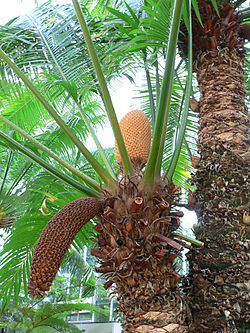
Picture of Cycadophyta
- Source
- Wikipedia/Commons
- Credit
- nobody named on the record
- Licence
- CC BY-SA 3.0
- Commercial use
- the licence allows it
No 3D scan of Cycadophyta was found in Sketchfab.
Smithsonian Open Access and MorphoSource were not reached for this taxon, so this list is what the others held rather than everything there is.
The description on this site
- Source
- Wikipedia, “Cycad”
- Licence
- CC BY-SA 4.0
This is what the site found, which is not the same as what exists.
Keep going
What may have been alongside itEmbryophyta through timeFormations of the Late TriassicThe world it lived on
Occurrence data from the Paleobiology Database, CC BY 4.0. Bessey 1907