Diplomystus
Diplomystus is an extinct genus of freshwater and marine clupeomorph fish distantly related to modern-day extant herrings, anchovies, and sardines. It is known from the United States, Canada, China, Uzbekistan and Lebanon from the Late Cretaceous to the middle Eocene. Many other clupeomorph species from around the world were also formerly placed in the genus, due to it being a former wastebasket taxon. It was among the last surviving members of the formerly-diverse order Ellimmichthyiformes, with only its close relative Guiclupea living for longer.

Didier Descouens · CC BY-SA 4.0 · via Wikipedia/Commons. May be a photograph of a specimen, or an artist’s reconstruction — an interpretation of a skeleton, since colour and soft tissue are almost never preserved.
On record
Recorded, not inferred- Sits inside
- ArmigatidaePBDB
- Diet
- carnivorePBDB, for Ellimmichthyiformes
- Life habit
- nektonicPBDB, for Ellimmichthyiformes
- Motility
- actively mobilePBDB, for Ellimmichthyiformes
Time the record covers
At least 74 million years on record.
The record covers at least 125.77 Mya to 51.1 Mya. No occurrence read is dated outside 143.1 Mya to 33.9 Mya.
25 occurrences of Diplomystus on record, most of them in the Eocene. Bar height is expected occurrences, not a count: each fossil is spread across the span it is dated to, so a tall narrow bar means tight dating and a low wide one means loose.
When
25 occurrencesThese are dates about fossils, not the animal: the record can only begin after it arose and end before it died out, so either end may reach further. Shares are expected occurrences: a fossil dated to a span is counted partly in each period it straddles. More on what this infers.
Found in
8 formations
- Green River Formation9
- Third Formation · Wakino Group4
- Akrabou Formation1
- Wasatch Formation1
- Naturita Formation1
- Dinosaur Park Formation · Belly River Group1
Loading coastlines…
The named rock units Diplomystus has been recovered from, largest first. Drawn where the rock is now, not where it formed. 6 occurrences have no formation on record, which is common for older literature.
Diplomystus and its relatives
EoceneWhere Diplomystus and its relatives were recorded in the Eocene.
Found in the same rock
280 taxa- Knightia4 sites
- Belonostomus3 sites
- Mioplosus3 sites
- Pimelodus antiquus3 sites
- Acanthomorphata2 sites
- Amia fragosa2 sites
- Amiidae2 sites
- Amyzon gosiutensis2 sites
- Asineops squamifrons2 sites
- Chelydridae2 sites
- Cladocyclus2 sites
- Clupavus2 sites
- Eichstaettisaurus gouldi2 sites
- Enchodus2 sites
- Hiodontidae2 sites
- Lepidotes2 sites
- Limnofregata hasegawai2 sites
- Notogoneus2 sites
- Ostariostoma2 sites
- Phareodus2 sites
- Priscacara2 sites
- Priscachara sp.2 sites
- Saniwa ensidens2 sites
- Teleostei2 sites
The Paleobiology Database records 21 sites for Diplomystus, and this reads all of them. The number is how many of those sites it was catalogued from too. The 24 sharing the most are listed.
This is not a list of everything alive at the time. It is only what has come out of the same ground as this animal and been written down.
Entered from
15 references- Early Cretaceous freshwater fish fauna in Kyushu, Japan4
- Paleontology of the Green River Formation, with a review of the fish fauna4
- A comparison of fish community structure along several paleoenvironments of Eocene Fossil Lake, Wyoming: a preliminary report3
- Scipionyx samniticus (Theropoda: Compsognathidae) from the Lower Cretaceous of Italy: osteology, ontogenetic assessment, phylogeny, soft tissue anatomy, taphonomy and palaeobiology2
- Early Cretaceous freshwater fishes from Northern Kyushu, Japan I. Description of two new species of the clupeid genus Diplomystus2
- Moderate extinctions and slow recovery of non-marine teleost fishes across the Cretaceous–Paleogene boundary, with a systematic appraisal of early Paleocene teleost fishes from Saskatchewan, Canada and Montana, USA1
- Paleoecology and sedimentology of a vertebrate microfossil assemblage from the easternmost Dinosaur Park Formation (Late Cretaceous, Upper Campanian,) Saskatchewan, Canada: reconstructing diversity in a coastal ecosystem1
- An early Eocene fish fauna from the Bitter Creek area of the Wasatch Formation of southwestern Wyoming, U.S.A.1
- The English Chalk and London Clay: two remarkable British bony fish Lagerstatten1
- Freshwater Osteichthyes from the Cenomanian to late Campanian of Grand Staircase-Escalante National Monument, Utah1
- A new Plattenkalk Konservat Lagerstätte in the Upper Cretaceous of Gara Sbaa, south-eastern Morocco1
- A Green River (Eocene) polychrotid (Squamata, Reptilia) and a re-examination of iguanian systematics1
Each of the 25 occurrences read was entered from one of these publications, ordered by how many each accounts for. This is not a search for papers mentioning the name. 3 further references are not listed. Entries link to doi.org where the Paleobiology Database holds an identifier, and to its own record where it does not. Relayed as the Paleobiology Database holds them, not checked against what they resolve to.
Media and terms
Media content2
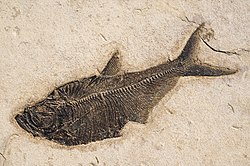
Picture of Diplomystus
- Source
- Wikipedia/Commons
- Credit
- Didier Descouens
- Licence
- CC BY-SA 4.0
- Commercial use
- the licence allows it
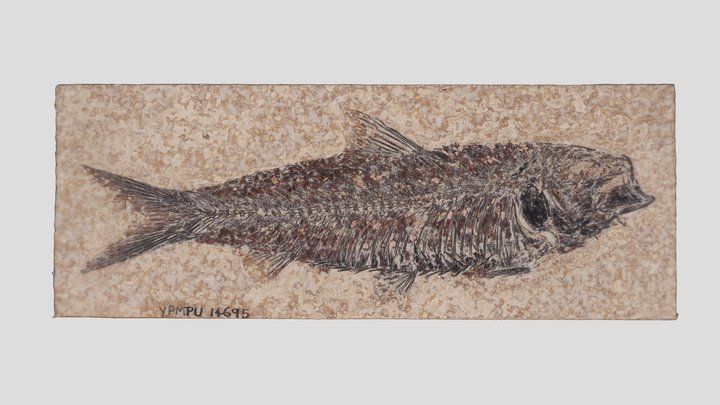
3D model
- Source
- Sketchfab
- Credit
- Yale Peabody Museum
- Licence
- CC Attribution
- Commercial use
- cannot be read from the licence given — check the record
The description on this site
- Source
- Wikipedia, “Diplomystus”
- Licence
- CC BY-SA 4.0
This is what the site found, which is not the same as what exists.
Keep going
What may have been alongside itArmigatidae through timeFormations of the EoceneThe world it lived on
Occurrence data from the Paleobiology Database, CC BY 4.0. Cope 1877