Dipodomys
Searched as Dipodomys cf. agilus. The Paleobiology Database treats Dipodomys as the accepted name.
Kangaroo rats, small mostly nocturnal rodents of genus Dipodomys, are native to arid areas of western North America. The common name derives from their bipedal form. They hop in a manner similar to the much larger kangaroo, but developed this mode of locomotion independently, like several other clades of rodents.

Juan Cruzado Cortés · CC BY-SA 4.0 · via Wikipedia/Commons. May be a photograph of a specimen, or an artist’s reconstruction — an interpretation of a skeleton, since colour and soft tissue are almost never preserved.
On record
Recorded, not inferred- Also called
- kangaroo ratPBDB
- Sits inside
- DipodomyinaePBDB
- Diet
- granivorePBDB
- Life habit
- saltatorialPBDB
- Motility
- actively mobilePBDB, for Osteichthyes
- Environment
- terrestrialPBDB, for Eutheria
Time the record covers
At most 196 thousand years on record.
The one occurrence read is dated to somewhere between 210 ka and 14 ka, which is a dating window rather than a span.
1 occurrence of Dipodomys on record, most of them in the Pleistocene. The Paleobiology Database records this as a living group, and the chart stops with its fossils rather than at the present. Bar height is expected occurrences, not a count: each fossil is spread across the span it is dated to, so a tall narrow bar means tight dating and a low wide one means loose.
When
1 occurrences- Pleistocene100%
These are dates about fossils, not the animal: the record can only begin after it arose and end before it died out, so either end may reach further. Shares are expected occurrences: a fossil dated to a span is counted partly in each period it straddles. More on what this infers.
Dipodomys and its relatives
PleistoceneWhere Dipodomys and its relatives were recorded in the Pleistocene.
Found in the same rock
652 taxa- Equus56 sites
- Perognathinae49 sites
- Sylvilagus45 sites
- Neotoma42 sites
- Peromyscus40 sites
- Camelops37 sites
- Thomomys33 sites
- Leporidae32 sites
- Sigmodon minor31 sites
- Hemiauchenia28 sites
- Megascapheus bottae27 sites
- Sigmodon24 sites
- Canis latrans23 sites
- Lepus21 sites
- Microtus20 sites
- Odocoileus20 sites
- Hodomys19 sites
- Equus mexicanus17 sites
- Geomyidae16 sites
- Spermophilus15 sites
- Sorex14 sites
- Capromeryx13 sites
- Nerterogeomys anzensis13 sites
- Platygonus13 sites
The Paleobiology Database records 121 sites for Dipodomys, and this reads all of them. The number is how many of those sites it was catalogued from too. The 24 sharing the most are listed.
This is not a list of everything alive at the time. It is only what has come out of the same ground as this animal and been written down.
Entered from
1 referenceEach of the 1 occurrence read was entered from one of these publications, ordered by how many each accounts for. This is not a search for papers mentioning the name. Each entry links to doi.org. Relayed as the Paleobiology Database holds them, not checked against what they resolve to.
Media and terms
Media content2

Picture of Dipodomys
- Source
- Wikipedia/Commons
- Credit
- Juan Cruzado Cortés
- Licence
- CC BY-SA 4.0
- Commercial use
- the licence allows it
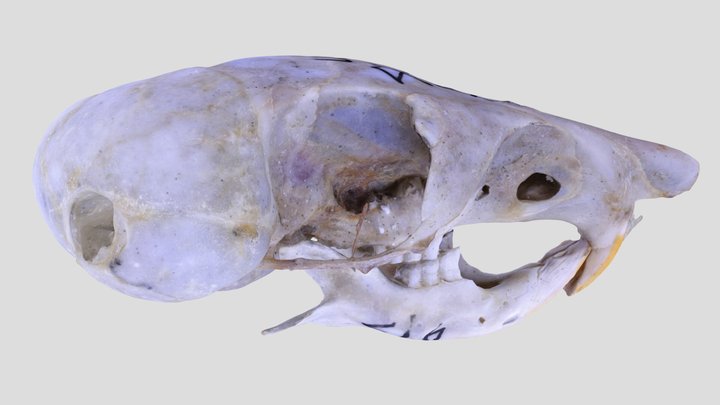
3D model
- Source
- Sketchfab
- Licence
- CC Attribution
- Commercial use
- cannot be read from the licence given — check the record
Smithsonian Open Access and MorphoSource were not reached for this taxon, so this list is what the others held rather than everything there is.
The description on this site
- Licence
- CC BY-SA 4.0
This is what the site found, which is not the same as what exists.
Keep going
What may have been alongside itDipodomyinae through timeFormations of the PleistoceneThe world it lived on
Occurrence data from the Paleobiology Database, CC BY 4.0. Gray 1841