Discus
Discus is a genus of small air-breathing land snails, terrestrial pulmonate gastropod mollusks in the family Discidae, the disk snails.

Francisco Welter Schultes · CC BY-SA 2.5 · via Wikipedia/Commons. May be a photograph of a specimen, or an artist’s reconstruction — an interpretation of a skeleton, since colour and soft tissue are almost never preserved.
On record
Recorded, not inferred- Also called
- disk snailPBDB
- Sits inside
- DiscidaePBDB
- Life habit
- epifaunalPBDB, for Gastropoda
- Motility
- actively mobilePBDB, for Pulmonata
- Vision
- limitedPBDB, for Gastropoda
- Environment
- terrestrialPBDB, for Pulmonata
Time the record covers
At least 113 million years on record.
The record covers at least 113.2 Mya to 11.7 ka. No occurrence read is dated outside 121.4 Mya to 0 Mya.
31 occurrences of Discus on record, most of them in the Miocene. The Paleobiology Database records this as a living group. Bar height is expected occurrences, not a count: each fossil is spread across the span it is dated to, so a tall narrow bar means tight dating and a low wide one means loose.
When
31 occurrences- Early Cretaceous10%
- Eocene3%
- Oligocene1%
- Miocene57%
- Pleistocene23%
- Holocene6%
These are dates about fossils, not the animal: the record can only begin after it arose and end before it died out, so either end may reach further. Shares are expected occurrences: a fossil dated to a span is counted partly in each period it straddles. More on what this infers.
Found in
10 formations
- Upper Freshwater Molasse Formation · Molasse Group2
- Randeck Maar Formation2
- Willwood Formation1
- Sappa Formation1
- Dalazi Formation1
- Laiyang Formation1
Loading coastlines…
The named rock units Discus has been recovered from, largest first. Drawn where the rock is now, not where it formed. 19 occurrences have no formation on record, which is common for older literature.
Discus and its relatives
MioceneWhere Discus and its relatives were recorded in the Miocene.
Found in the same rock
910 taxa- Gastrocopta acuminata8 sites
- Limax8 sites
- Gastrocopta nouletiana6 sites
- Gyraulus applanatus6 sites
- Lymnaea dilatata6 sites
- Pseudochloritis incrassata6 sites
- Vertigo6 sites
- Bufo5 sites
- Carychium5 sites
- Granaria5 sites
- Gyraulus5 sites
- Leucochroopsis kleinii5 sites
- Pisidium5 sites
- Planorbarius mantelli5 sites
- Sphaerium5 sites
- Apula coarctata4 sites
- Argna oppoliensis4 sites
- Cepaea4 sites
- Hyla4 sites
- Pomatias4 sites
- Vallonia4 sites
- Anisus (Odontogyrorbis) krambergeri3 sites
- Anisus confusus3 sites
- Aves3 sites
The Paleobiology Database records 25 sites for Discus, and this reads all of them. The number is how many of those sites it was catalogued from too. The 24 sharing the most are listed.
This is not a list of everything alive at the time. It is only what has come out of the same ground as this animal and been written down.
Entered from
23 references- Synopsis of the Late Miocene mollusc fauna of the classical sections Richardhof and Eichkogel in the Vienna Basin (Austria, Pannonian, MN 9-MN11)3
- Opole (Poland) - a key locality for middle Miocene terrestrial mollusc faunas2
- Fossil land and freshwater gastropods from the Middle Miocene of Bechingen and Daugendorf, southwestern Germany2
- Fossil gastropods from Miocene Lake Randeck Maar and its hinterland (SW Germany)2
- The fossil pulmonate snails of Sandelzhausen (Early/Middle Miocene, Germany) (Hygrophila, Punctoidea and limacoids)2
- L'environnement côtier des Alpes-Maritimes à la fin de la transgression versilienne d'après l'étude biostratigraphique du site de l'Etoile à Nice (France)2
- Eshelman and Hager, 19842
- Early Miocene continental gastropods from new localities of the Molasse Basin in southern Germany1
- The fossil land and freshwater snails of Gündlkofen (Middle Miocene, Germany)1
- Biostratigraphy and palaeoecology of a Middle Miocene (Karpathian, MN 5) fauna from the northern margin of the North Alpine Foreland Basin (Oggenhausen 2, SW' Germany)1
- Biostratigraphy of Middle Miocene (Sarmatian) wetland systems in an Eastern Alpine intramontane basin (Gratkorn Basin, Austria): the terrestrial gastropod approach1
- Recent Advances on Multidisciplinary Research at Rudabánya, Late Miocene (MN9), Hungary: a compendium1
Each of the 31 occurrences read was entered from one of these publications, ordered by how many each accounts for. This is not a search for papers mentioning the name. 11 further references are not listed. Entries link to doi.org where the Paleobiology Database holds an identifier, and to its own record where it does not. Relayed as the Paleobiology Database holds them, not checked against what they resolve to.
Media and terms
Media content4
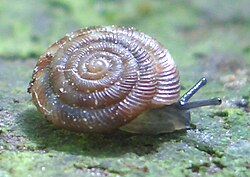
Picture of Discus
- Source
- Wikipedia/Commons
- Credit
- Francisco Welter Schultes
- Licence
- CC BY-SA 2.5
- Commercial use
- the licence allows it
3D scan
- Source
- Smithsonian
- Licence
- CC0 — this site’s default, not the record’s
- Commercial use
- the licence allows it
- Specimen
- Unio discus
CT scan
- Source
- MorphoSource
- Credit
- MCZ Ichthyology
- Licence
- In Copyright
- Commercial use
- cannot be read from the licence given — check the record
- Specimen
- Acestridium discus · MCZ:Ich:88581
3D model
- Source
- Sketchfab
- Licence
- CC0 Public Domain
- Commercial use
- the licence allows it
The description on this site
- Licence
- CC BY-SA 4.0
This is what the site found, which is not the same as what exists.
Keep going
What may have been alongside itDiscidae through timeFormations of the MioceneThe world it lived on
Occurrence data from the Paleobiology Database, CC BY 4.0. Fitzinger 1833