Dolichotis
Dolichotis is a genus of the cavy family of rodents. These large relatives of guinea pigs are common in the Patagonian steppes of Argentina, but also live in Paraguay and elsewhere in South America. It contains a single extant species, the Patagonian mara, which is one of the largest rodents in the world after the two species each of capybaras and beavers, and the large species of porcupines, reaching about 45 cm (18 in) in height.

Diana · CC BY-SA 3.0 · via Wikipedia/Commons. May be a photograph of a specimen, or an artist’s reconstruction — an interpretation of a skeleton, since colour and soft tissue are almost never preserved.
On record
Recorded, not inferred- Also called
- maraPBDB
- Sits inside
- CaviidaePBDB
- Diet
- herbivorePBDB, for Caviidae
- Life habit
- ground dwellingPBDB, for Caviidae
- Motility
- actively mobilePBDB, for Osteichthyes
- Environment
- terrestrialPBDB, for Eutheria
Time the record covers
At least 4.9 million years on record.
The record covers at least 5 Mya to 11.7 ka. No occurrence read is dated outside 8 Mya to 0 Mya.
19 occurrences of Dolichotis on record, most of them in the Pleistocene. The Paleobiology Database records this as a living group. Bar height is expected occurrences, not a count: each fossil is spread across the span it is dated to, so a tall narrow bar means tight dating and a low wide one means loose.
When
19 occurrences- Miocene9%
- Pliocene35%
- Pleistocene46%
- Holocene11%
These are dates about fossils, not the animal: the record can only begin after it arose and end before it died out, so either end may reach further. Shares are expected occurrences: a fossil dated to a span is counted partly in each period it straddles. More on what this infers.
Found in
11 formations
- Lujan Formation2
- San Andres Formation2
- Chiquimil Formation2
- Yupoi Formation1
- Vorohué Formation1
- Luján Formation1
Loading coastlines…
The named rock units Dolichotis has been recovered from, largest first. Drawn where the rock is now, not where it formed. 5 occurrences have no formation on record, which is common for older literature.
Dolichotis and its relatives
PleistoceneWhere Dolichotis and its relatives were recorded in the Pleistocene.
Found in the same rock
197 taxa- Lagostomus6 sites
- Lama6 sites
- Pampatherium5 sites
- Abrocoma4 sites
- Chaetophractus villosus4 sites
- Eumysops4 sites
- Glyptodon4 sites
- Lagostomus maximus4 sites
- Megatherium americanum4 sites
- Neosclerocalyptus4 sites
- Camelidae3 sites
- Dusicyon3 sites
- Eutatus seguini3 sites
- Glyptodon reticulatus3 sites
- Hemiauchenia paradoxa3 sites
- Hippidion3 sites
- Megatherium3 sites
- Microcavia3 sites
- Notiomastodon platensis3 sites
- Pithanotomys3 sites
- Reithrodon auritus3 sites
- Ringueletia simpsoni3 sites
- Scelidotherium leptocephalum3 sites
- Zaedyus pichiy3 sites
The Paleobiology Database records 19 sites for Dolichotis, and this reads all of them. The number is how many of those sites it was catalogued from too. The 24 sharing the most are listed.
This is not a list of everything alive at the time. It is only what has come out of the same ground as this animal and been written down.
Entered from
15 references- Cronobioestratigrafía del Mioceno tardío – Plioceno temprano, Puerta de Corral Quemado y Villavil, provincia de Catamarca, Argentina3
- Caviomorph rodents from the Pampean region (Argentina) in the historical Santiago Roth Collection in Switzerland2
- Pleistocene mammals from Uruguay: Biostratigraphic, biogeographic and environmental connotations2
- Advances in the understanding of Neogene mammalian fauna in the Pampean region (central Argentina) through revising “biozone” hypotheses based on new dates and biochronological analyses1
- Eumysops marplatensis Olivares and Verzi 2015 (Rodentia, Hystricognathi) from the Plio-Pleistocene of the Northern Pampa in Argentina: Paleoenvironmental and paleobiogeographic implications1
- First record of a Late Holocene fauna associated with an ephemeral fluvial sequence in La Pampa Province, Argentina. Taphonomy and paleoenvironment1
- The Campo Laborde site: New evidence for the Holocene survival of Pleistocene megafauna in the Argentine Pampas1
- The caviomorph rodents from the San Andrés Formation, east-central Argentina, and global Late Pliocene climatic change1
- Las Caleras, provincia de Córdoba, primer yacimiento fosilífero de origen cárstico de Argentina1
- El roedor Dolicavia minuscula (Caviomorpha, Caviidae) del Plioceno Superior de a provincia de Buenos Aires, Argentina1
- Reassesment of the Pliocene-Pleistocene continental time scale of Southern South America. Correlation of the type Chapadmalalan with Bolivian sections1
- Los Mamiferos de la Fauna Local Paso Otero (Pleistoceno Tardio), Provincia de Buenos Aires. Aspectos Paleoambientales y Biostratigraficos1
Each of the 19 occurrences read was entered from one of these publications, ordered by how many each accounts for. This is not a search for papers mentioning the name. 3 further references are not listed. Entries link to doi.org where the Paleobiology Database holds an identifier, and to its own record where it does not. Relayed as the Paleobiology Database holds them, not checked against what they resolve to.
Media and terms
Media content3
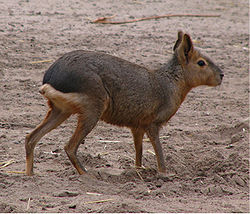
Picture of Dolichotis
- Source
- Wikipedia/Commons
- Credit
- Diana
- Licence
- CC BY-SA 3.0
- Commercial use
- the licence allows it
CT scan
- Source
- MorphoSource
- Licence
- In Copyright
- Commercial use
- cannot be read from the licence given — check the record
- Specimen
- Dolichotis salinicola · ummz:mammals:125578
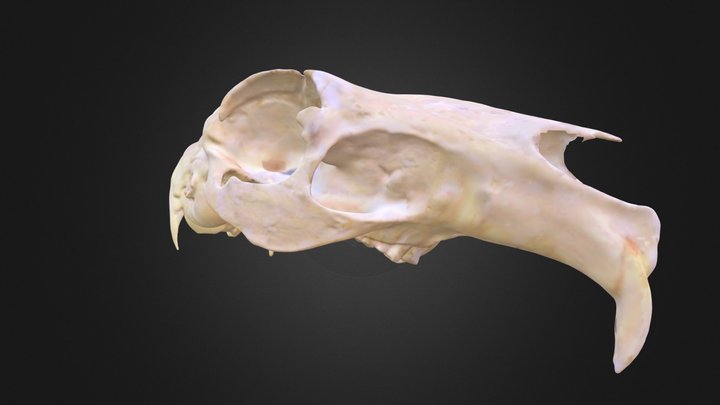
3D model
- Source
- Sketchfab
- Licence
- CC Attribution
- Commercial use
- cannot be read from the licence given — check the record
Smithsonian Open Access was not reached for this taxon, so this list is what the others held rather than everything there is.
The description on this site
- Source
- Wikipedia, “Dolichotis”
- Licence
- CC BY-SA 4.0
This is what the site found, which is not the same as what exists.
Keep going
What may have been alongside itCaviidae through timeFormations of the PleistoceneThe world it lived on
Occurrence data from the Paleobiology Database, CC BY 4.0. Desmarest 1820