Duostominidae
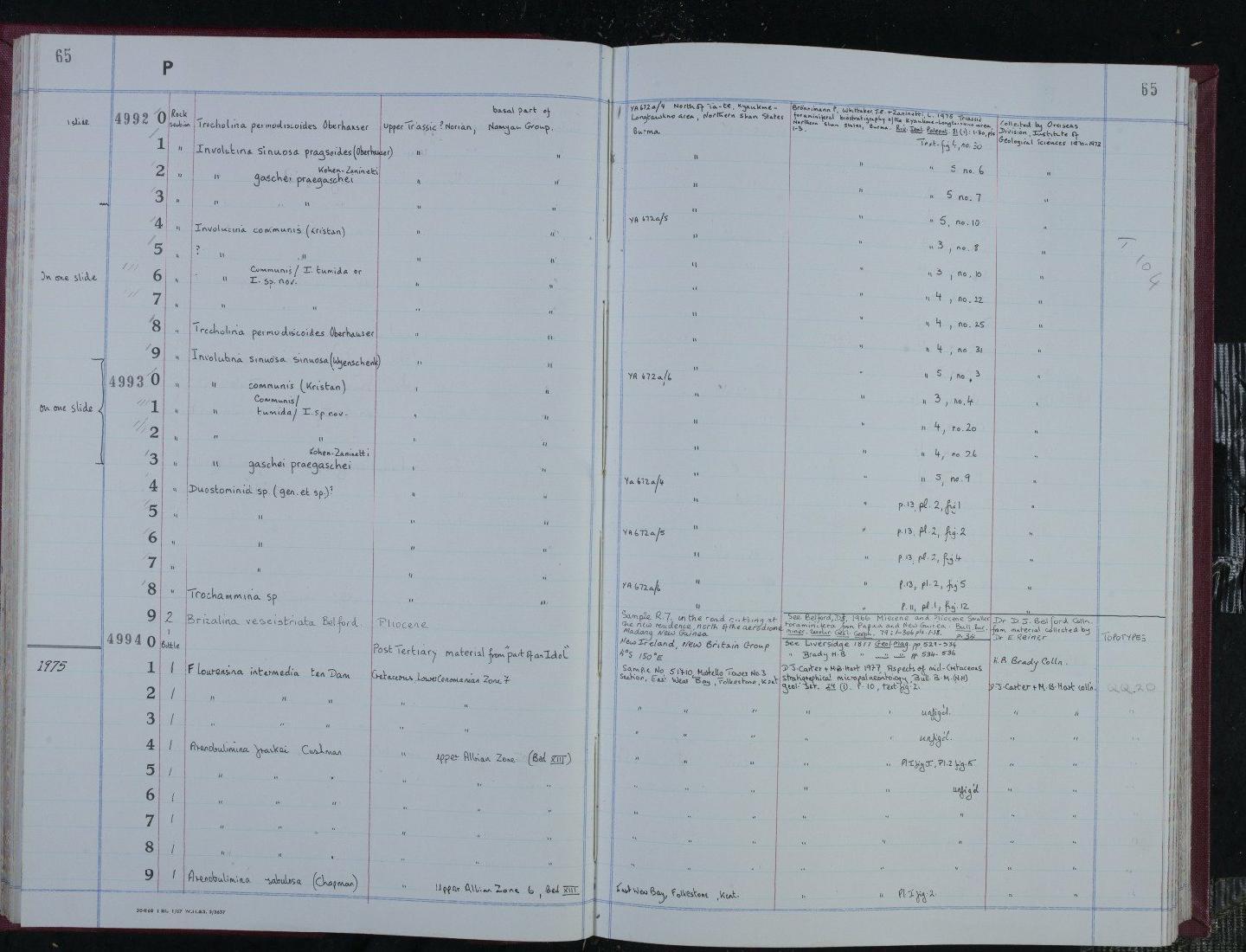
Institute of Geological Sciences · CC0 · via GBIF. May be a photograph of a specimen, or an artist’s reconstruction — an interpretation of a skeleton, since colour and soft tissue are almost never preserved.
On record
Recorded, not inferred- Sits inside
- DuostominaceaPBDB
- Diet
- omnivorePBDB, for Foraminifera
- Life habit
- semi-infaunalPBDB, for Foraminifera
- Motility
- stationaryPBDB, for Foraminifera
Time the record covers
At least 41 million years on record.
The record covers at least 247 Mya to 205.7 Mya. No occurrence read is dated outside 248.6 Mya to 201.4 Mya.
144 occurrences of Duostominidae on record, most of them in the Late Triassic. Bar height is expected occurrences, not a count: each fossil is spread across the span it is dated to, so a tall narrow bar means tight dating and a low wide one means loose.
When
144 occurrencesThese are dates about fossils, not the animal: the record can only begin after it arose and end before it died out, so either end may reach further. Shares are expected occurrences: a fossil dated to a span is counted partly in each period it straddles. More on what this infers.
Found in
30 formations
- San Cassiano Formation38
- Dachstein Formation6
- Hallstatt Formation5
- Sciliar Dolomite Formation4
- Wetterstein Limestone Formation3
- Kuta Formation3
Loading coastlines…
The named rock units Duostominidae has been recovered from, largest first. Drawn where the rock is now, not where it formed. 6 further formations hold fewer occurrences each and are not listed. 56 occurrences have no formation on record, which is common for older literature.
Duostominidae and its relatives
Late TriassicWhere Duostominidae and its relatives were recorded in the Late Triassic.
Found in the same rock
763 taxa- Ophthalmidium42 sites
- Diplotremina36 sites
- Duostomina35 sites
- Lenticulina26 sites
- Reophax26 sites
- Dentalina25 sites
- Aulotortus24 sites
- Osteocrinus rectus24 sites
- Glomospirella23 sites
- Glomospira22 sites
- Trochammina21 sites
- Variostoma21 sites
- Ammodiscus20 sites
- Planiinvoluta20 sites
- Gastropoda19 sites
- Kriptoseptida18 sites
- Osteocrinus18 sites
- Galeanella17 sites
- Nodosaria17 sites
- Endothyranella16 sites
- Meandrospira16 sites
- Endothyra15 sites
- Ostracoda14 sites
- Tolypammina14 sites
The Paleobiology Database records 102 sites for Duostominidae, and this reads all of them. The number is how many of those sites it was catalogued from too. The 24 sharing the most are listed.
This is not a list of everything alive at the time. It is only what has come out of the same ground as this animal and been written down.
Entered from
47 references- The Prati di Stuores/Stuores Wiesen Section (Dolomites, Italy): a candidate Global Stratotype Section and Point for the base of the Carnian stage.39
- Early and Middle Triassic trends in diversity, evenness, and size of foraminifers on a carbonate platform in south China: Implications for tempo and mode of biotic recovery from the end-Permian mass extinction27
- The Norian-Rhaetian boundary in the light of micropaleontological data8
- Upper Triassic Tethyan Carbonates off Northwest Australia (Wombat Plateau, ODP Leg 122)6
- Lithofacies palaeogeography and biostratigraphy of the lowermost horizons of the Middle Triassic Hallstatt Limestones (Argolis Peninsula, Greece)5
- Trias-Foraminiferen von Kumaun im Himalaya [Triassic foraminifers from Kumaun, Himalaya]4
- Uppermost Triassic limestone in the Karakaya Complex - stratigraphic and tectonic significance3
- Rhät-Foraminiferen aus dem Kuta-Kalk des Gurumugl-Riffes in Zentral-Papua/Neuguinea [Rhaetian foraminifers from the Kuta Limestone of the Gurumugl Reef in central Papua New Guinea]3
- Mikrofazies, Paläontologie und Palökologie der Dachsteinriffkalke (Nor) des Gosaukammes, Österreich3
- Fossilien aus dem Wettersteinkalke des Slowakischen Karstes (Lokalitat Silicka)3
- Microfacies and biostratigraphy of an Upper Triassic Dachstein limestone fore-reef block in the Jurassic Sirogojno carbonate-clastic Melange (Zlatibor Mt., SW Serbia)2
- Diversity, palaeoecology and systematics of a marine fossil assemblage from the Late Triassic Cassian Formation at Settsass Scharte, N Italy2
Each of the 144 occurrences read was entered from one of these publications, ordered by how many each accounts for. This is not a search for papers mentioning the name. 35 further references are not listed. Entries link to doi.org where the Paleobiology Database holds an identifier, and to its own record where it does not. Relayed as the Paleobiology Database holds them, not checked against what they resolve to.
Media and terms
Media content1
Picture of Duostominidae
- Source
- GBIF
- Credit
- Institute of Geological Sciences
- Licence
- CC0
- Commercial use
- the licence allows it
No 3D scan of Duostominidae was found in Sketchfab.
Smithsonian Open Access and MorphoSource were not reached for this taxon, so this list is what the others held rather than everything there is.
This is what the site found, which is not the same as what exists.
Keep going
What may have been alongside itDuostominacea through timeFormations of the Late TriassicThe world it lived on
Occurrence data from the Paleobiology Database, CC BY 4.0. Brotzen 1963