Edmontosaurus annectens
Edmontosaurus annectens, often colloquially and historically known as Anatotitan, is a species of flat-headed saurolophine hadrosaurid dinosaur from the late Maastrichtian age at the very end of the Cretaceous period, in what is now western North America. Remains of E. annectens have been preserved in the Frenchman, Hell Creek, and Lance Formations. All of these formations are dated to the late Maastrichtian age of the Late Cretaceous period, which represents the last three million years before the extinction of the non-avian dinosaurs. E. annectens is also found in the Laramie Formation, and magnetostratigraphy suggests an age of 69–68 Ma for the Laramie Formation.

Kevin Walsh from Bicester, England · CC BY 2.0 · via Wikipedia/Commons. May be a photograph of a specimen, or an artist’s reconstruction — an interpretation of a skeleton, since colour and soft tissue are almost never preserved.
On record
Recorded, not inferred- Sits inside
- EdmontosaurusPBDB
- Diet
- herbivorePBDB, for Ornithopoda
- Life habit
- ground dwelling, gregariousPBDB, for Ornithischia
- Motility
- actively mobilePBDB, for Ornithischia
- Environment
- terrestrialPBDB, for Ornithischia
Time the record covers
At most 18 million years on record.
Every occurrence read is dated to somewhere between 83.6 Mya and 66 Mya, and nothing in the dating separates them, so that window is what the record shows rather than a span.
30 occurrences of Edmontosaurus annectens on record, most of them in the Late Cretaceous. Bar height is expected occurrences, not a count: each fossil is spread across the span it is dated to, so a tall narrow bar means tight dating and a low wide one means loose.
When
30 occurrences- Late Cretaceous100%
These are dates about fossils, not the animal: the record can only begin after it arose and end before it died out, so either end may reach further. Shares are expected occurrences: a fossil dated to a span is counted partly in each period it straddles. More on what this infers.
Found in
3 formations
- Hell Creek Formation · Montana Group15
- Lance Formation11
- Frenchman Formation2
Loading coastlines…
The named rock units Edmontosaurus annectens has been recovered from, largest first. Drawn where the rock is now, not where it formed. 2 occurrences have no formation on record, which is common for older literature.
Edmontosaurus annectens and its relatives
Late CretaceousWhere Edmontosaurus annectens and its relatives were recorded in the Late Cretaceous.
Found in the same rock
190 taxa- Lepisosteus5 sites
- Triceratops5 sites
- Tyrannosauridae5 sites
- Tyrannosaurus rex5 sites
- Crocodylia4 sites
- Dromaeosauridae4 sites
- Myledaphus bipartitus4 sites
- Theropoda4 sites
- Trionychidae4 sites
- Aves3 sites
- Baenidae3 sites
- Brachychampsa montana3 sites
- Champsosaurus3 sites
- Cyclurus fragosus3 sites
- Pachycephalosaurus3 sites
- Thescelosaurus neglectus3 sites
- Adocus2 sites
- Ankylosauria2 sites
- Ankylosaurus magniventris2 sites
- Basilemys2 sites
- Borealosuchus2 sites
- Borealosuchus sternbergii2 sites
- Brachychampsa2 sites
- Ceratopsidae2 sites
The Paleobiology Database records 30 sites for Edmontosaurus annectens, and this reads all of them. The number is how many of those sites it was catalogued from too. The 24 sharing the most are listed.
This is not a list of everything alive at the time. It is only what has come out of the same ground as this animal and been written down.
Entered from
24 references- Hadrosaurian dinosaurs of North America6
- Taphonomy of the Standing Rock Hadrosaur Site, Corson County, South Dakota2
- Behavioral implications of an embedded tyrannosaurid tooth and associated tooth marks on an articulated skull of Edmontosaurus from the Hell Creek Formation, Montana1
- New scale type from a small-bodied hadrosaur in the Frenchman Formation of southern Saskatchewan: potential implications for integumentary diversity in Edmontosaurus annectens1
- The paleontology, geology and taphonomy of the Tooth Draw Deposit; Hell Creek Formation (Maastrictian), Butte County, South Dakota1
- A juvenile cf. Edmontosaurus annectens (Ornithischia, Hadrosauridae) femur documents a previously unreported intermediate growth stage for this taxon1
- A nestling-sized skeleton of Edmontosaurus (Ornithischia, Hadrosauridae) from the Hell Creek Formation of northeastern Montana, U.S.A., with an analysis of ontogenetic limb allometry1
- A juvenile Edmontosaurus from the late Maastrichtian (Cretaceous) of North America: Implications for ontogeny and phylogenetic inference in saurolophine dinosaurs1
- A snapshot into the terrestrial ecosystem of an exceptionally well- preserved dinosaur (Hadrosauridae) from the Upper Cretaceous of North Dakota, USA1
- Evidence of predatory behavior by carnivorous dinosaurs1
- Stratigraphy and paleontology of the Cretaceous Hell Creek Formation, Stumpf site, Morton County, North Dakota1
- A dinosaur by any other name1
Each of the 30 occurrences read was entered from one of these publications, ordered by how many each accounts for. This is not a search for papers mentioning the name. 12 further references are not listed. Entries link to doi.org where the Paleobiology Database holds an identifier, and to its own record where it does not. Relayed as the Paleobiology Database holds them, not checked against what they resolve to.
Media and terms
Media content2
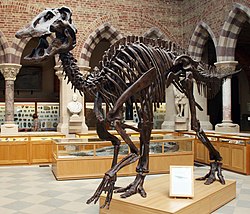
Picture of Edmontosaurus annectens
- Source
- Wikipedia/Commons
- Credit
- Kevin Walsh from Bicester, England
- Licence
- CC BY 2.0
- Commercial use
- the licence allows it
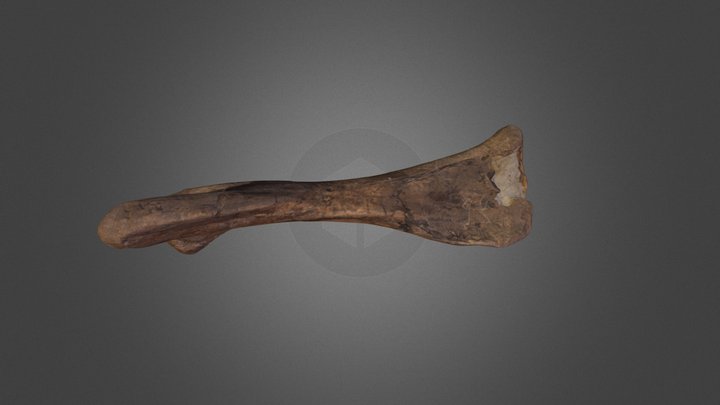
3D model
- Source
- Sketchfab
- Credit
- jschmidtcreaform
- Licence
- CC Attribution
- Commercial use
- cannot be read from the licence given — check the record
Smithsonian Open Access and MorphoSource were not reached for this taxon, so this list is what the others held rather than everything there is.
The description on this site
- Licence
- CC BY-SA 4.0
This is what the site found, which is not the same as what exists.
Keep going
What may have been alongside itEdmontosaurus through timeFormations of the Late CretaceousThe world it lived on
Occurrence data from the Paleobiology Database, CC BY 4.0. (Marsh 1892)