Elopomorpha
The superorder Elopomorpha contains a variety of types of fishes that range from typical silvery-colored species, such as the tarpons and ladyfishes of the Elopiformes and the bonefishes of the Albuliformes, to the long and slender, smooth-bodied eels of the Anguilliformes. The one characteristic uniting this group of fishes is they all have leptocephalus larvae, which are unique to the Elopomorpha. No other fishes have this type of larvae.

GerardM · CC BY-SA 3.0 · via Wikipedia/Commons. May be a photograph of a specimen, or an artist’s reconstruction — an interpretation of a skeleton, since colour and soft tissue are almost never preserved.
On record
Recorded, not inferred- Sits inside
- TeleosteiPBDB
- Motility
- actively mobilePBDB, for Osteichthyes
Time the record covers
At least 149 million years on record.
The record covers at least 149.2 Mya to 11.7 ka. No occurrence read is dated outside 152.21 Mya to 0 Mya.
1,364 occurrences of Elopomorpha on record, most of them in the Late Cretaceous. The Paleobiology Database records this as a living group. Bar height is expected occurrences, not a count: each fossil is spread across the span it is dated to, so a tall narrow bar means tight dating and a low wide one means loose.
When
1,364 occurrences- Late Jurassicunder 1%
- Early Cretaceous3%
- Late Cretaceous30%
- Paleocene3%
- Eocene29%
- Oligocene7%
- Miocene17%
- Pliocene3%
- Pleistocene5%
- Holoceneunder 1%
These are dates about fossils, not the animal: the record can only begin after it arose and end before it died out, so either end may reach further. Shares are expected occurrences: a fossil dated to a span is counted partly in each period it straddles. More on what this infers.
Found in
250 formations
- Dinosaur Park Formation · Belly River Group67
- Oldman Formation · Belly River Group45
- London Clay Formation · Thames Group26
- Hell Creek Formation · Montana Group19
- Selsey Formation · Bracklesham Group19
- Cook Mountain Formation · Claiborne Group19
Loading coastlines…
The named rock units Elopomorpha has been recovered from, largest first. Drawn where the rock is now, not where it formed. 226 further formations hold fewer occurrences each and are not listed. 427 occurrences have no formation on record, which is common for older literature.
Elopomorpha and its relatives
Late CretaceousWhere Elopomorpha and its relatives were recorded in the Late Cretaceous.
Found in the same rock
4,372 taxa- Teleostei77 sites
- Myledaphus bipartitus66 sites
- Hadrosauridae64 sites
- Paralbula casei61 sites
- Scapherpeton tectum61 sites
- Anura59 sites
- Opisthotriton kayi57 sites
- Baenidae54 sites
- Coriops amnicolus50 sites
- Lepisosteus50 sites
- Saurornitholestes langstoni49 sites
- Crocodylia47 sites
- Trionychidae47 sites
- Chelydridae45 sites
- Ceratopsidae44 sites
- Belonostomus longirostris43 sites
- Lepisosteus occidentalis42 sites
- Holostei38 sites
- Tyrannosauridae38 sites
- Champsosaurus natator36 sites
- Amiidae35 sites
- Theropoda34 sites
- Leidyosuchus canadensis33 sites
- Osteichthyes32 sites
The Paleobiology Database records 693 sites for Elopomorpha, and this reads 240 of them. Of that, one read hit the database's own return limit, so every count below is a floor rather than a total. The number is how many of those sites it was catalogued from too. The 24 sharing the most are listed.
This is not a list of everything alive at the time. It is only what has come out of the same ground as this animal and been written down.
Entered from
350 references- Reconstruction of the fossil marine bony fish fauna (Teleostei) from the Eocene to Pleistocene of New Zealand by means of otoliths. With studies of Recent congroid, morid and trachinoid otoliths139
- Middle and late Eocene fish otoliths from the eastern and southern USA69
- Vertebrate microsite assemblages (exclusive of mammals) from the Foremost and Oldman Formations of the Judith River Group (Campanian) of southeastern Alberta: an illustrated guide45
- Paleontology of the Judith River Formation (Campanian) of Dinosaur National Park, Alberta, Canada: evidence from vertebrate microfossil locality37
- Otolithes de poissons du paléocanyon de saubrigues (chattien à langhien), aquitaine méridionale, France28
- The Selsey Division (Bracklesham Group) at Lee-on-the-Solent, Gosport, (Hants)28
- Paleoecology of an estuarine, incised-valley fill in the Dinosaur Park Formation (Judith River Group, Upper Cretaceous) of southern Alberta, Canada26
- Fish otoliths from the New Zealand Tertiary25
- Early Eocene fish otoliths from the eastern and southern USA20
- Taxonomy and biostratigraphy of the elasmobranchs and bony fishes (Chondrichthyes and Osteichthyes) of the lower-to-middle Eocene (Ypresian to Bartonian) Claiborne Group in Alabama, USA, including an analysis of otoliths20
- The English Chalk and London Clay: two remarkable British bony fish Lagerstatten20
- New Fossiliferous Sites of the Romualdo Formation, Lower Cretaceous, Araripe Basin, Exu, Pernambuco, Northeast of Brazil18
Each of the 1,364 occurrences read was entered from one of these publications, ordered by how many each accounts for. This is not a search for papers mentioning the name. 338 further references are not listed. Entries link to doi.org where the Paleobiology Database holds an identifier, and to its own record where it does not. Relayed as the Paleobiology Database holds them, not checked against what they resolve to.
Media and terms
Media content1
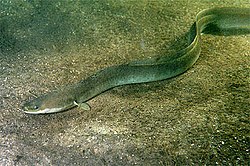
Picture of Elopomorpha
- Source
- Wikipedia/Commons
- Credit
- GerardM
- Licence
- CC BY-SA 3.0
- Commercial use
- the licence allows it
No 3D scan was found. Smithsonian Open Access, MorphoSource and Sketchfab were all searched.
The description on this site
- Source
- Wikipedia, “Elopomorpha”
- Licence
- CC BY-SA 4.0
This is what the site found, which is not the same as what exists.
Keep going
What may have been alongside itTeleostei through timeFormations of the Late CretaceousThe world it lived on
Occurrence data from the Paleobiology Database, CC BY 4.0. (Greenwood et al. 1966)