Euphractus sexcinctus
The six-banded armadillo, also known as the yellow armadillo, is an armadillo found in South America. The sole extant member of its genus, it was first described by Swedish zoologist Carl Linnaeus in 1758. The six-banded armadillo is typically between 40 and 50 centimeters in head-and-body length, and weighs 3.2 to 6.5 kilograms. The carapace is pale yellow to reddish brown, marked by scales of equal length, and scantily covered by buff to white bristle-like hairs. The forefeet have five distinct toes, each with moderately developed claws.

Charles J. Sharp · CC BY-SA 4.0 · via Wikipedia/Commons. May be a photograph of a specimen, or an artist’s reconstruction — an interpretation of a skeleton, since colour and soft tissue are almost never preserved.
On record
Recorded, not inferred- Also called
- six banded armadilloPBDB
- Sits inside
- EuphractusPBDB
- Diet
- insectivorePBDB, for Dasypodidae
- Life habit
- ground dwellingPBDB, for Dasypodidae
- Motility
- actively mobilePBDB, for Osteichthyes
- Environment
- terrestrialPBDB, for Eutheria
- Mass
- 4.68 kgWikidata
Time the record covers
At least 762 thousand years on record.
The record covers at least 774 ka to 11.7 ka. No occurrence read is dated outside 2.58 Mya to 0 Mya.
11 occurrences of Euphractus sexcinctus on record, most of them in the Pleistocene. The Paleobiology Database records this as a living group. Bar height is expected occurrences, not a count: each fossil is spread across the span it is dated to, so a tall narrow bar means tight dating and a low wide one means loose.
When
11 occurrences- Pleistocene70%
- Holocene30%
These are dates about fossils, not the animal: the record can only begin after it arose and end before it died out, so either end may reach further. Shares are expected occurrences: a fossil dated to a span is counted partly in each period it straddles. More on what this infers.
Found in
2 formations
Loading coastlines…
The named rock units Euphractus sexcinctus has been recovered from, largest first. Drawn where the rock is now, not where it formed. 7 occurrences have no formation on record, which is common for older literature.
Euphractus sexcinctus and its relatives
PleistoceneWhere Euphractus sexcinctus and its relatives were recorded in the Pleistocene.
Found in the same rock
226 taxa- Hydrochoerus hydrochaeris5 sites
- Panthera onca5 sites
- Dasypus (Dasypus) novemcinctus4 sites
- Smilodon populator4 sites
- Calomys3 sites
- Chrysocyon brachyurus3 sites
- Morenelaphus3 sites
- Myocastor coypus3 sites
- Propraopus sulcatus3 sites
- Protocyon troglodytes3 sites
- Ceratophrys2 sites
- Ctenomys2 sites
- Dasypus2 sites
- Dusicyon2 sites
- Eumops perotis2 sites
- Galea musteloides2 sites
- Glyptodon2 sites
- Lagostomus maximus2 sites
- Neochoerus2 sites
- Nothrotherium maquinense2 sites
- Pachyarmatherium brasiliense2 sites
- Palaeolama major2 sites
- Phyllotis2 sites
- Procyon cancrivorus2 sites
The Paleobiology Database records 9 sites for Euphractus sexcinctus, and this reads all of them. The number is how many of those sites it was catalogued from too. The 24 sharing the most are listed.
This is not a list of everything alive at the time. It is only what has come out of the same ground as this animal and been written down.
Entered from
9 references- The cingulates (Mammalia: Xenarthra) from the late Quaternary of northern Brazil: Fossil records, paleoclimates and displacements in America2
- The Eocene to Pleistocene vertebrates of Bolivia and their stratigraphic context: a review2
- Diversity and preservation of Pleistocene tetrapods from caves of southwestern Bahia, Brazil1
- Occurrence of Dicolpomys (Echimyidae) in the late Holocene of Argentina: The most recently extinct South American caviomorph genus1
- Quaternary mammals from Serra do Bodoquena, Mato Grosso do Sul, Brazil1
- Fauna de mamíferos do Quaternário de Serra da Mesa (Goiás, Brasil)1
- A new extinct primate among the Pleistocene megafauna of Bahia, Brazil1
- Hoffstetter, 19681
- Mammiféres fossiles de Tarija1
Each of the 11 occurrences read was entered from one of these publications, ordered by how many each accounts for. This is not a search for papers mentioning the name. Entries link to doi.org where the Paleobiology Database holds an identifier, and to its own record where it does not. Relayed as the Paleobiology Database holds them, not checked against what they resolve to.
Media and terms
Media content2
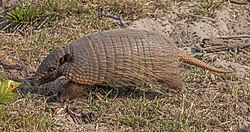
Picture of Euphractus sexcinctus
- Source
- Wikipedia/Commons
- Credit
- Charles J. Sharp
- Licence
- CC BY-SA 4.0
- Commercial use
- the licence allows it
CT scan
- Source
- MorphoSource
- Licence
- In Copyright
- Commercial use
- cannot be read from the licence given — check the record
- Specimen
- Euphractus sexcinctus · oumnh:7074
Smithsonian Open Access was not reached for this taxon, so this list is what the others held rather than everything there is.
The description on this site
- Licence
- CC BY-SA 4.0
This is what the site found, which is not the same as what exists.
Keep going
What may have been alongside itEuphractus through timeFormations of the PleistoceneThe world it lived on
Occurrence data from the Paleobiology Database, CC BY 4.0. (Linnaeus 1758)