Euspira catena
Euspira catena, previously known as Natica catena, common name the large necklace shell, is a medium-sized species of predatory sea snail, a marine gastropod mollusc in the family Naticidae, the moon snails.

Hans Hillewaert · CC BY-SA 4.0 · via Wikipedia/Commons. May be a photograph of a specimen, or an artist’s reconstruction — an interpretation of a skeleton, since colour and soft tissue are almost never preserved.
On record
Recorded, not inferred- Sits inside
- EuspiraPBDB
- Diet
- carnivorePBDB, for Euspira
- Life habit
- semi-infaunalPBDB, for Euspira
- Motility
- actively mobilePBDB, for Euspira
- Vision
- limitedPBDB, for Gastropoda
Time the record covers
At least 15 million years on record.
The record covers at least 15.98 Mya to 129 ka. No occurrence read is dated outside 20.45 Mya to 11.7 ka.
21 occurrences of Euspira catena on record, most of them in the Pleistocene. The Paleobiology Database records this as a living group. Bar height is expected occurrences, not a count: each fossil is spread across the span it is dated to, so a tall narrow bar means tight dating and a low wide one means loose.
When
21 occurrences- Miocene29%
- Pliocene24%
- Pleistocene48%
These are dates about fossils, not the animal: the record can only begin after it arose and end before it died out, so either end may reach further. Shares are expected occurrences: a fossil dated to a span is counted partly in each period it straddles. More on what this infers.
Found in
7 formations
- Termofourà Formation3
- Baldissero Formation3
- Red Crag Formation2
- Lillo Formation2
- Wexford Gravels Formation1
- Calabriano Formation1
Loading coastlines…
The named rock units Euspira catena has been recovered from, largest first. Drawn where the rock is now, not where it formed. 8 occurrences have no formation on record, which is common for older literature.
Euspira catena and its relatives
PleistoceneWhere Euspira catena and its relatives were recorded in the Pleistocene.
Found in the same rock
852 taxa- Nassarius13 sites
- Aporrhais pespelecani9 sites
- Haustator vermicularis9 sites
- Natica9 sites
- Mitrella8 sites
- Turris8 sites
- Dentalium7 sites
- Gemmula7 sites
- Neptunea7 sites
- Ostrea edulis7 sites
- Turritella7 sites
- Cancellaria6 sites
- Conus6 sites
- Euspira submamillaris6 sites
- Ficus conditus6 sites
- Fusinus6 sites
- Galeodea6 sites
- Genota6 sites
- Glycymeris pilosa6 sites
- Hiatella arctica6 sites
- Mitra6 sites
- Neverita josephinia6 sites
- Oliva6 sites
- Paroxystele amedei6 sites
The Paleobiology Database records 17 sites for Euspira catena, and this reads all of them. The number is how many of those sites it was catalogued from too. The 24 sharing the most are listed.
This is not a list of everything alive at the time. It is only what has come out of the same ground as this animal and been written down.
Entered from
11 references- Lower to Middle Miocene Mollusc assemblages from the Torino Hills (NW Italy): Synthesis of new data and chronostratigraphical arrangement6
- Ambergris cololites of Pleistocene sperm whales from central Italy and description of the new ichnogenus and ichnospecies Ambergrisichnus alleronae3
- Pliocene gastropod faunas from Kallo (Oost-Vlaanderen, Belgium) - Part 2. Caenogastropoda: Potamididae-Tornidae2
- Recherches sur le Neogene et le Quaternaire marins de la cote Atlantique du Maroc2
- Wood, 18822
- Scavengers and opportunists at work on whale carcasses: decapods, echinoids and fishes1
- Seagrass-Associated Molluscan and Fish Communities from the Early Pleistocene of the Island of Rhodes (Greece)1
- La Malacofauna Plio-Pleistocenica del Torrente Stirone Parte IX. Strombidae, Aporrhaiidae, Calyptreidae, Capulidae, Xenophoridae, Vermetidae, Cypraeidae, Eocypraeidae, Triviidae, Eratoidae, Ovulidae, Naticidae1
- Stratigraphical notes on Macoma (Bivalvia) in the southern part of the North Sea Basin and some remarks on the arrival of Pacific species1
- The marine Quaternary of the Canary Islands1
- The Mollusca of the Wexford Gravels (Pleistocene), South-East Ireland1
Each of the 21 occurrences read was entered from one of these publications, ordered by how many each accounts for. This is not a search for papers mentioning the name. Entries link to doi.org where the Paleobiology Database holds an identifier, and to its own record where it does not. Relayed as the Paleobiology Database holds them, not checked against what they resolve to.
Media and terms
Media content1
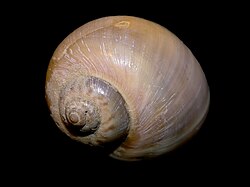
Picture of Euspira catena
- Source
- Wikipedia/Commons
- Credit
- Hans Hillewaert
- Licence
- CC BY-SA 4.0
- Commercial use
- the licence allows it
No 3D scan of Euspira catena was found in Sketchfab.
Smithsonian Open Access and MorphoSource were not reached for this taxon, so this list is what the others held rather than everything there is.
The description on this site
- Licence
- CC BY-SA 4.0
This is what the site found, which is not the same as what exists.
Keep going
What may have been alongside itEuspira through timeFormations of the PleistoceneThe world it lived on
Occurrence data from the Paleobiology Database, CC BY 4.0. (da Costa 1778)