Farancia abacura
The mud snake is a species of nonvenomous, semiaquatic, colubrid snake endemic to the southeastern United States.

John Sullivan · CC BY-SA 3.0 · via Wikipedia/Commons. May be a photograph of a specimen, or an artist’s reconstruction — an interpretation of a skeleton, since colour and soft tissue are almost never preserved.
On record
Recorded, not inferred- Sits inside
- FaranciaPBDB
- Diet
- carnivorePBDB, for Farancia
- Life habit
- amphibiousPBDB, for Farancia
- Motility
- actively mobilePBDB, for Osteichthyes
- Environment
- terrestrialPBDB, for Amniota
Time the record covers
At most 118 thousand years on record.
Every occurrence read is dated to somewhere between 129 ka and 11.7 ka, and nothing in the dating separates them, so that window is what the record shows rather than a span.
2 occurrences of Farancia abacura on record, most of them in the Pleistocene. Bar height is expected occurrences, not a count: each fossil is spread across the span it is dated to, so a tall narrow bar means tight dating and a low wide one means loose.
When
2 occurrences- Pleistocene100%
These are dates about fossils, not the animal: the record can only begin after it arose and end before it died out, so either end may reach further. Shares are expected occurrences: a fossil dated to a span is counted partly in each period it straddles. More on what this infers.
Farancia abacura and its relatives
PleistoceneWhere Farancia abacura and its relatives were recorded in the Pleistocene.
Found in the same rock
199 taxa- Aenocyon dirus2 sites
- Alligator mississippiensis2 sites
- Amphiuma means2 sites
- Ardea herodias2 sites
- Crotalus adamanteus2 sites
- Didelphis virginiana2 sites
- Equus2 sites
- Hesperotestudo crassiscutata2 sites
- Holmesina septentrionalis2 sites
- Lepisosteus2 sites
- Mammut americanum2 sites
- Mammuthus columbi2 sites
- Mycteria americana2 sites
- Odocoileus virginianus2 sites
- Procyon lotor2 sites
- Sigmodon hispidus2 sites
- Siren lacertina2 sites
- Tapirus (Helicotapirus) veroensis2 sites
- Acar domingensis1 site
- Acer rubrum1 site
- Aetobatus1 site
- Agkistrodon piscivorous1 site
- Amia1 site
- Amia calva1 site
The Paleobiology Database records 2 sites for Farancia abacura, and this reads all of them. The number is how many of those sites it was catalogued from too. The 24 sharing the most are listed.
This is not a list of everything alive at the time. It is only what has come out of the same ground as this animal and been written down.
Entered from
2 references- A Pleistocene vertebrate fauna from Palm Beach County, Florida1
- Vertebrata mostly from Stratum No. 3, at Vero, Florida, together with descriptions of new species1
Each of the 2 occurrences read was entered from one of these publications, ordered by how many each accounts for. This is not a search for papers mentioning the name. Each entry links to the Paleobiology Database's own record for the work.
Media and terms
Media content1
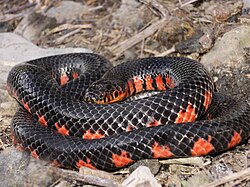
Picture of Farancia abacura
- Source
- Wikipedia/Commons
- Credit
- John Sullivan
- Licence
- CC BY-SA 3.0
- Commercial use
- the licence allows it
No 3D scan of Farancia abacura was found in Sketchfab.
Smithsonian Open Access and MorphoSource were not reached for this taxon, so this list is what the others held rather than everything there is.
The description on this site
- Source
- Wikipedia, “Mud snake”
- Licence
- CC BY-SA 4.0
This is what the site found, which is not the same as what exists.
Keep going
What may have been alongside itFarancia through timeFormations of the PleistoceneThe world it lived on
Occurrence data from the Paleobiology Database, CC BY 4.0. (Holbrook 1836)