Gastrochaenolites ornatus
No picture of Gastrochaenolites ornatus was found. Wikipedia and Wikidata were searched and had none. iDigBio and GBIF were not searched: the Paleobiology Database does not place Gastrochaenolites ornatus firmly enough to tell it from something else bearing the same name, and a search on the name alone returns whichever of them was photographed. Smithsonian Open Access did not answer, so this is what the others held rather than everything there is.
On record
Recorded, not inferred- Sits inside
- GastrochaenolitesPBDB
- Diet
- suspension feederPBDB, for Gastrochaenolites
- Life habit
- boringPBDB, for Gastrochaenolites
- Motility
- stationaryPBDB, for Gastrochaenolites
Time the record covers
At least 63 million years on record.
The record covers at least 66 Mya to 2.58 Mya. No occurrence read is dated outside 72.2 Mya to 11.7 ka.
5 occurrences of Gastrochaenolites ornatus on record, most of them in the Paleocene. Bar height is expected occurrences, not a count: each fossil is spread across the span it is dated to, so a tall narrow bar means tight dating and a low wide one means loose.
When
5 occurrences- Late Cretaceous20%
- Paleocene40%
- Eocene20%
- Pleistocene20%
These are dates about fossils, not the animal: the record can only begin after it arose and end before it died out, so either end may reach further. Shares are expected occurrences: a fossil dated to a span is counted partly in each period it straddles. More on what this infers.
Found in
3 formations
Loading coastlines…
The named rock units Gastrochaenolites ornatus has been recovered from, largest first. Drawn where the rock is now, not where it formed. 2 occurrences have no formation on record, which is common for older literature.
Gastrochaenolites ornatus and its relatives
PaleoceneWhere Gastrochaenolites ornatus and its relatives were recorded in the Paleocene.
Found in the same rock
37 taxa- Lavocatodus giganteus3 sites
- Pycnodus3 sites
- Brychaetus2 sites
- Hyposaurinae2 sites
- Linthia sudanensis2 sites
- Plesiolampas2 sites
- Thalassinoides2 sites
- Amananulam sanogoi1 site
- Cimomia ogbei1 site
- Claroteidae1 site
- Cylindracanthus1 site
- Dyrosauridae indet.1 site
- Hyposaurinae indet.1 site
- Knethichnus parallelum1 site
- Libycoceras crossense1 site
- Linichnus1 site
- Maliamia gigas1 site
- Myliobatis wurnoensis1 site
- Nautiloidea1 site
- Neoselachii1 site
- Numidotheriidae1 site
- Ostreida1 site
- Palaeophis colossaeus1 site
- Pholadidae1 site
The Paleobiology Database records 5 sites for Gastrochaenolites ornatus, and this reads all of them. The number is how many of those sites it was catalogued from too. The 24 sharing the most are listed.
This is not a list of everything alive at the time. It is only what has come out of the same ground as this animal and been written down.
Entered from
2 references- Stratigraphy and Paleobiology of the Upper Cretaceous - Lower Paleogene Sediments from the Trans-Saharan Seaway in Mali4
- Ichonological nomenclature of clavate borings1
Each of the 5 occurrences read was entered from one of these publications, ordered by how many each accounts for. This is not a search for papers mentioning the name. Entries link to doi.org where the Paleobiology Database holds an identifier, and to its own record where it does not. Relayed as the Paleobiology Database holds them, not checked against what they resolve to.
Media and terms
Media content1
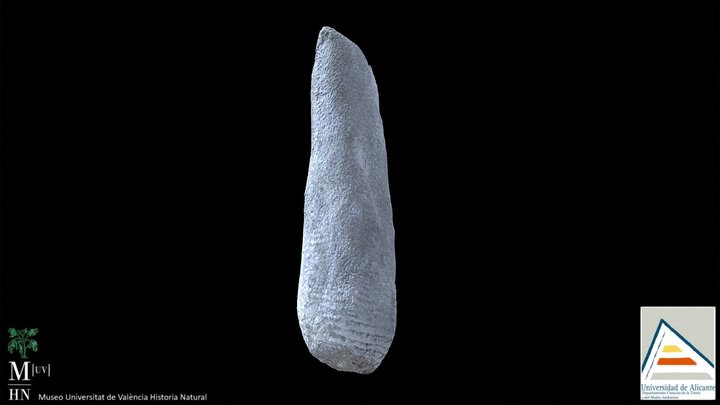
3D model
- Source
- Sketchfab
- Licence
- CC Attribution
- Commercial use
- cannot be read from the licence given — check the record
No picture of Gastrochaenolites ornatus was found. Wikipedia and Wikidata were searched and had none.
iDigBio and GBIF were not searched: the Paleobiology Database does not place Gastrochaenolites ornatus firmly enough to tell it from something else bearing the same name, and a search on the name alone returns whichever of them was photographed.
Smithsonian Open Access did not answer, so this is what the others held rather than everything there is.
Smithsonian Open Access and MorphoSource were not reached for this taxon, so this list is what the others held rather than everything there is.
This is what the site found, which is not the same as what exists.
Keep going
What may have been alongside itGastrochaenolites through timeFormations of the PaleoceneThe world it lived on
Occurrence data from the Paleobiology Database, CC BY 4.0. Kelly and Bromley 1984