Thalassinoides
Thalassinoides is an ichnogenus of trace fossil used to refer to "dichotomously or T-branched boxworks, mazes and shafts, unlined and unornamented". Facies of Thalassinoides increased suddenly in abundance at the beginning of the Mesozoic. Such burrows are made by a number of organisms, including the sea anemone Cerianthus, Balanoglossus and fishes, but are most closely associated with decapod crustaceans of the (former) infraorder Thalassinidea.

Mark A. Wilson (Department of Geology, The College of Wooster). [1] · Public Domain · via Wikipedia/Commons. May be a photograph of a specimen, or an artist’s reconstruction — an interpretation of a skeleton, since colour and soft tissue are almost never preserved.
On record
Recorded, not inferred- Sits inside
- IchnofossilsPBDB
Time the record covers
At least 520 million years on record.
The record covers at least 521 Mya to 11.7 ka. No occurrence read is dated outside 525.5 Mya to 0 Mya.
133 occurrences of Thalassinoides on record, most of them in the Late Jurassic. Bar height is expected occurrences, not a count: each fossil is spread across the span it is dated to, so a tall narrow bar means tight dating and a low wide one means loose.
When
133 occurrences- Cambrian2%
- Ordovician2%
- Silurianunder 1%
- Devonian3%
- Carboniferous2%
- Permianunder 1%
- Early Jurassic4%
- Middle Jurassic12%
- Late Jurassic22%
- Early Cretaceous10%
- Late Cretaceous17%
- Paleocene6%
- Eocene3%
- Oligocene2%
- Miocene7%
- Plioceneunder 1%
- Pleistocene7%
- Holoceneunder 1%
These are dates about fossils, not the animal: the record can only begin after it arose and end before it died out, so either end may reach further. Shares are expected occurrences: a fossil dated to a span is counted partly in each period it straddles. More on what this infers.
Found in
62 formations
- Kap Leslie Formation22
- Opalinuston Formation13
- Prairie Bluff Formation6
- Roca Formation · Malargüe Group4
- Chachao Formation · Mendoza Group4
- Assomada Formation4
Loading coastlines…
The named rock units Thalassinoides has been recovered from, largest first. Drawn where the rock is now, not where it formed. 38 further formations hold fewer occurrences each and are not listed. 15 occurrences have no formation on record, which is common for older literature.
Thalassinoides and its relatives
Late JurassicWhere Thalassinoides and its relatives were recorded in the Late Jurassic.
Found in the same rock
1,015 taxa- Chondrites23 sites
- Ammonoidea22 sites
- Entolium orbiculare19 sites
- Planolites19 sites
- Camptonectes16 sites
- Grammatodon16 sites
- Pinna16 sites
- Belemnitida15 sites
- Pleuromya15 sites
- Buchia mosquensis14 sites
- Isognomon14 sites
- Bryozoa13 sites
- Gastropoda13 sites
- Serpula13 sites
- Taimyrothyris13 sites
- Astarte12 sites
- Protocardia striatula12 sites
- Bivalvia11 sites
- Isocyprina11 sites
- Pleuromya uniformis11 sites
- Skolithos10 sites
- Thracia depressa10 sites
- Turritella10 sites
- Dentalium9 sites
The Paleobiology Database records 110 sites for Thalassinoides, and this reads all of them. The number is how many of those sites it was catalogued from too. The 24 sharing the most are listed.
This is not a list of everything alive at the time. It is only what has come out of the same ground as this animal and been written down.
Entered from
72 references- Genesis and environmental significance of Upper Cretaceous shell concentrations from the Cauvery Basin, southern India14
- Paläontologische Untersuchungen im unteren Opalinuston der Nordschweiz13
- Unpublished data8
- Stratigraphy and Paleobiology of the Upper Cretaceous - Lower Paleogene Sediments from the Trans-Saharan Seaway in Mali6
- Upper Cretaceous (Maestrichtian) Mollusca from the Haustator bilira Assemblage Zone in the East Gulf Coastal Plain6
- What Darwin did not see: Pleistocene fossil assemblages on a high energy coast at Ponta das Bicudas, Santiago, Cape Verde Islands4
- Shell Bed Stacking Patterns in the Chachao Formation (Early Valanginian) in Malargue Area, Mendoza Province, Neuquen Basin, Argintina4
- Litho- and biostratigraphical observations on the type sections of the Craie de Villedieu Formation (Upper Cretaceous, western France)4
- Oases of biodiversity: Early Devonian palaeoecology at Hamar Laghdad, Morocco3
- Fossil decapod crustaceans from the Jaguel and Roca Formations (Maastrichtian-Danian) of the Neuquen Basin, Argentina3
- Palaeoecology and taphonomy of spatangoid-dominated echinoid assemblages: A case study from the Early-Middle Miocene of Sardinia, Italy2
- Fossil associations from the middle and upper Eocene strata of the Pamplona Basin and surrounding areas (Navarre, western Pyrenees)2
Each of the 133 occurrences read was entered from one of these publications, ordered by how many each accounts for. This is not a search for papers mentioning the name. 60 further references are not listed. Entries link to doi.org where the Paleobiology Database holds an identifier, and to its own record where it does not. Relayed as the Paleobiology Database holds them, not checked against what they resolve to.
Media and terms
Media content2

Picture of Thalassinoides
- Source
- Wikipedia/Commons
- Credit
- Mark A. Wilson (Department of Geology, The College of Wooster). [1]
- Licence
- Public Domain
- Commercial use
- the licence allows it
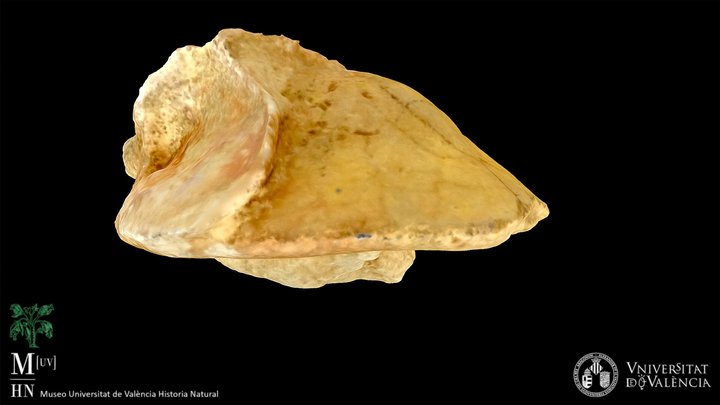
3D model
- Source
- Sketchfab
- Licence
- CC Attribution
- Commercial use
- cannot be read from the licence given — check the record
Smithsonian Open Access and MorphoSource were not reached for this taxon, so this list is what the others held rather than everything there is.
The description on this site
- Licence
- CC BY-SA 4.0
This is what the site found, which is not the same as what exists.
Keep going
What may have been alongside itIchnofossils through timeFormations of the Late JurassicThe world it lived on
Occurrence data from the Paleobiology Database, CC BY 4.0. Ehrenberg 1944