Gavialis gangeticus
The gharial, also known as gavial or fish-eating crocodile, is a crocodilian in the family Gavialidae and among the longest of all living crocodilians. Mature females are 2.6 to 4.5 m long, and males 3 to 6 m. Adult males have a distinct boss at the end of the snout, which resembles an earthenware pot known as a ghara, hence the name "gharial". The gharial is well adapted to catching fish because of its long, narrow snout and 110 sharp, interlocking teeth.

Charles J. Sharp · CC BY-SA 4.0 · via Wikipedia/Commons. May be a photograph of a specimen, or an artist’s reconstruction — an interpretation of a skeleton, since colour and soft tissue are almost never preserved.
On record
Recorded, not inferred- Also called
- GharialPBDB
- Sits inside
- GavialisPBDB
- Diet
- carnivorePBDB, for Crocodylia
- Motility
- actively mobilePBDB, for Osteichthyes
- Environment
- marinePBDB, for Mesoeucrocodylia
Time the record covers
At least 2.4 million years on record.
The record covers at least 2.58 Mya to 129 ka. No occurrence read is dated outside 3.6 Mya to 0 Mya.
11 occurrences of Gavialis gangeticus on record. The Paleobiology Database records this as a living group. Bar height is expected occurrences, not a count: each fossil is spread across the span it is dated to, so a tall narrow bar means tight dating and a low wide one means loose.
When
11 occurrences- Pliocene52%
- Pleistocene48%
These are dates about fossils, not the animal: the record can only begin after it arose and end before it died out, so either end may reach further. Shares are expected occurrences: a fossil dated to a span is counted partly in each period it straddles. More on what this infers.
Found in
3 formations
- Pinjor Formation · Siwalik Group4
- Pinjor Formation · Siwalik Group2
- Tatrot Formation1
Loading coastlines…
The named rock units Gavialis gangeticus has been recovered from, largest first. Drawn where the rock is now, not where it formed. 4 occurrences have no formation on record, which is common for older literature.
Found in the same rock
60 taxa- Gavialis browni2 sites
- Hardella thurjii2 sites
- Rhamphosuchus crassidens2 sites
- Acanthopotamon martensi1 site
- Anhinga1 site
- Antilope cervicapra1 site
- Axis axis1 site
- Axis porcinus1 site
- Batagur1 site
- Batagur baska1 site
- Batagur dhongoka1 site
- Batagur kachuga1 site
- Batagurinae1 site
- Bos gaurus1 site
- Bos indicus1 site
- Bos namadicus1 site
- Boselaphus tragocamelus1 site
- Bubalus1 site
- Cachuga tectum1 site
- Canis1 site
- Caprini1 site
- Cervus1 site
- Cervus duvauceli1 site
- Cervus unicolor1 site
The Paleobiology Database records 9 sites for Gavialis gangeticus, and this reads all of them. The number is how many of those sites it was catalogued from too. The 24 sharing the most are listed.
This is not a list of everything alive at the time. It is only what has come out of the same ground as this animal and been written down.
Entered from
3 references- Fossil turtles and crocodiles from the Caenozoic of S-Asia8
- The taxonomic content of the genus Gavialis from the Siwalik Hills of India and Pakistan2
- On the occurrence of reptilian remains in the peat bed of Barrackpore, 24-Parganas, West Bengal1
Each of the 11 occurrences read was entered from one of these publications, ordered by how many each accounts for. This is not a search for papers mentioning the name. Entries link to doi.org where the Paleobiology Database holds an identifier, and to its own record where it does not. Relayed as the Paleobiology Database holds them, not checked against what they resolve to.
Media and terms
Media content3
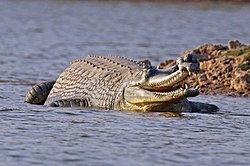
Picture of Gavialis gangeticus
- Source
- Wikipedia/Commons
- Credit
- Charles J. Sharp
- Licence
- CC BY-SA 4.0
- Commercial use
- the licence allows it
CT scan
- Source
- MorphoSource
- Licence
- not stated by the source
- Commercial use
- cannot be read from the licence given — check the record
- Specimen
- Gavialis gangeticus · UF:Herp:118998
3D model
- Source
- Sketchfab
- Credit
- Dr. Eugenia Gold
- Licence
- CC Attribution
- Commercial use
- cannot be read from the licence given — check the record
Smithsonian Open Access was not reached for this taxon, so this list is what the others held rather than everything there is.
The description on this site
- Source
- Wikipedia, “Gharial”
- Licence
- CC BY-SA 4.0
This is what the site found, which is not the same as what exists.
Keep going
What may have been alongside itGavialis through timeThe world it lived on
Occurrence data from the Paleobiology Database, CC BY 4.0. Gmelin 1789