Geospiza fortis
The medium ground finch is a species of bird in the family Thraupidae. It is endemic to the Galápagos Islands. Its primary natural habitat is tropical shrubland. One of Darwin's finches, the species was the first which scientists have observed evolving in real-time.

Uncredited · CC BY-SA 2.0 · via Wikipedia/Commons. May be a photograph of a specimen, or an artist’s reconstruction — an interpretation of a skeleton, since colour and soft tissue are almost never preserved.
On record
Recorded, not inferred- Also called
- medium ground-finchPBDB
- Sits inside
- GeospizaPBDB
- Diet
- carnivorePBDB, for Coelurosauria
- Life habit
- ground dwelling, solitaryPBDB, for Theropoda
- Motility
- actively mobilePBDB, for Theropoda
- Environment
- terrestrialPBDB, for Theropoda
- Mass
- 24 gWikidata
Time the record covers
At most 12 thousand years on record.
Every occurrence read is dated to somewhere between 11.7 ka and 0 Mya, and nothing in the dating separates them, so that window is what the record shows rather than a span.
3 occurrences of Geospiza fortis on record, most of them in the Holocene. The Paleobiology Database records this as a living group. Bar height is expected occurrences, not a count: each fossil is spread across the span it is dated to, so a tall narrow bar means tight dating and a low wide one means loose.
When
3 occurrences- Holocene100%
These are dates about fossils, not the animal: the record can only begin after it arose and end before it died out, so either end may reach further. Shares are expected occurrences: a fossil dated to a span is counted partly in each period it straddles. More on what this infers.
Geospiza fortis and its relatives
HoloceneWhere Geospiza fortis and its relatives were recorded in the Holocene.
Found in the same rock
30 taxa- Alsophis3 sites
- Aves3 sites
- Geochelone elephantopus3 sites
- Geospiza fuliginosa3 sites
- Geospiza magnirostris3 sites
- Mimus trifasciatus3 sites
- Passeriformes3 sites
- Phyllodactylus3 sites
- Rattus rattus3 sites
- Tropidurus3 sites
- Zenaida galapagoensis3 sites
- Camarhynchus pauper2 sites
- Lasiurus borealis2 sites
- Mus musculus2 sites
- Myiarchus magnirostris2 sites
- Ardeidae1 site
- Camarhynchus parvulus1 site
- Certhidea olivacea1 site
- Felis domesticus1 site
- Geospiza difficilis1 site
- Geospiza scandens1 site
- Mammalia1 site
- Nyctanassa violacea1 site
- Oceanodroma castro1 site
The Paleobiology Database records 3 sites for Geospiza fortis, and this reads all of them. The number is how many of those sites it was catalogued from too. The 24 sharing the most are listed.
This is not a list of everything alive at the time. It is only what has come out of the same ground as this animal and been written down.
Entered from
1 referenceEach of the 3 occurrences read was entered from one of these publications, ordered by how many each accounts for. This is not a search for papers mentioning the name. Each entry links to doi.org. Relayed as the Paleobiology Database holds them, not checked against what they resolve to.
Media and terms
Media content2

Picture of Geospiza fortis
- Source
- Wikipedia/Commons
- Credit
- nobody named on the record
- Licence
- CC BY-SA 2.0
- Commercial use
- the licence allows it
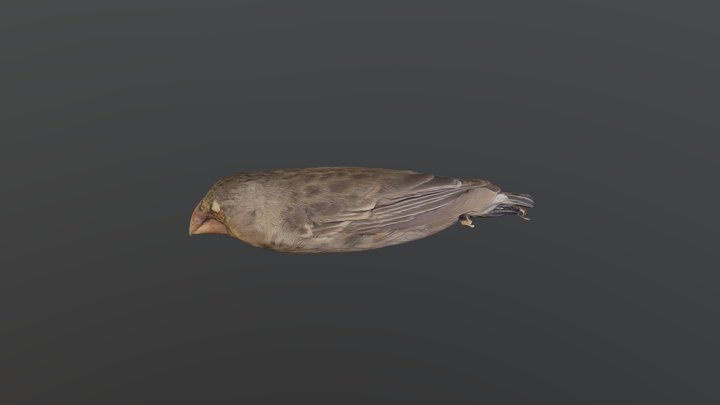
Smithsonian Open Access and MorphoSource were not reached for this taxon, so this list is what the others held rather than everything there is.
The description on this site
- Licence
- CC BY-SA 4.0
This is what the site found, which is not the same as what exists.
Keep going
What may have been alongside itGeospiza through timeFormations of the HoloceneThe world it lived on
Occurrence data from the Paleobiology Database, CC BY 4.0. Gould 1837