Nyctanassa violacea
The yellow-crowned night heron is one of two species of night heron in the genus Nyctanassa. Unlike the black-crowned night heron, which has a worldwide distribution, the yellow-crowned is restricted to the Americas. It is known as the bihoreau violacé in French and the pedrete corona clara or yaboa común in some Spanish-speaking countries.

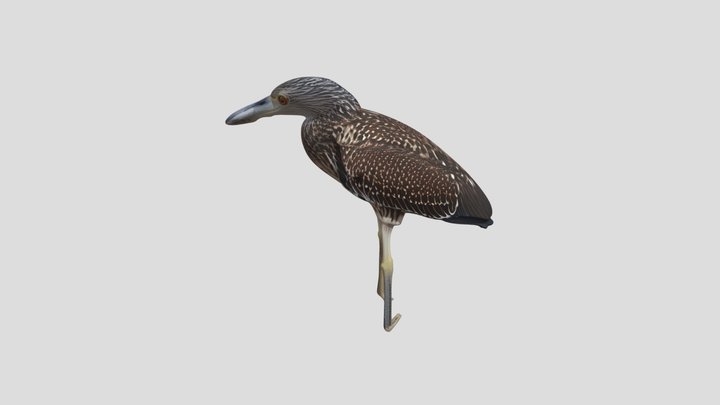
Chuck Homler (FocusOnWildlife.Me) · CC BY-SA 4.0 · via Wikipedia/Commons. May be a photograph of a specimen, or an artist’s reconstruction — an interpretation of a skeleton, since colour and soft tissue are almost never preserved.
On record
Recorded, not inferred- Also called
- yellow-crowned night heronPBDB
- Sits inside
- NyctanassaPBDB
- Diet
- piscivorePBDB, for Ardeidae
- Life habit
- volantPBDB, for Ardeidae
- Motility
- actively mobilePBDB, for Theropoda
- Environment
- terrestrialPBDB, for Ardeidae
Time the record covers
At least 1.3 million years on record.
The record covers at least 1.4 Mya to 11.7 ka. No occurrence read is dated outside 4.7 Mya to 0 Mya.
18 occurrences of Nyctanassa violacea on record. The Paleobiology Database records this as a living group. Bar height is expected occurrences, not a count: each fossil is spread across the span it is dated to, so a tall narrow bar means tight dating and a low wide one means loose.
When
18 occurrences- Pliocene4%
- Pleistocene45%
- Holocene51%
These are dates about fossils, not the animal: the record can only begin after it arose and end before it died out, so either end may reach further. Shares are expected occurrences: a fossil dated to a span is counted partly in each period it straddles. More on what this infers.
Found in
2 formations
Loading coastlines…
The named rock units Nyctanassa violacea has been recovered from, largest first. Drawn where the rock is now, not where it formed. 15 occurrences have no formation on record, which is common for older literature.
Found in the same rock
540 taxa- Puffinus lherminieri6 sites
- Ardea herodias5 sites
- Fulica americana5 sites
- Meleagris gallopavo5 sites
- Nesotrochis debooyi5 sites
- Passeriformes5 sites
- Phalacrocorax auritus5 sites
- Anas4 sites
- Buteo lineatus4 sites
- Cathartes aura4 sites
- Equus4 sites
- Eudocimus albus4 sites
- Mareca americana4 sites
- Patagioenas leucocephala4 sites
- Podilymbus podiceps4 sites
- Aenocyon dirus3 sites
- Alsophis3 sites
- Anolis sagrei3 sites
- Antigone canadensis3 sites
- Ardea alba3 sites
- Athene cunicularia3 sites
- Aves3 sites
- Aythya collaris3 sites
- Canis latrans3 sites
The Paleobiology Database records 18 sites for Nyctanassa violacea, and this reads all of them. The number is how many of those sites it was catalogued from too. The 24 sharing the most are listed.
This is not a list of everything alive at the time. It is only what has come out of the same ground as this animal and been written down.
Entered from
12 references- A middle Pleistocene bird community from Saint Lucie County, Florida2
- Exceptionally well preserved late Quaternary plant and vertebrate fossils from a blue hole on Abaco, The Bahamas2
- Holocene Vertebrate Fossils from Isla Floreana, Galapagos2
- Bird remains from pre-Columbian middens in the Virgin Islands2
- The avifauna of the Pleistocene in Florida2
- Bones of birds collected by Theodoor de Booy from kitchen midden deposits in the islands of St. Thomas and St. Croix2
- Prehistoric exploitation of birds on the Pacific coast of Chiapas, Mexico1
- Late Quaternary fossil vertebrates from the Cayman Islands1
- Two new late Blancan avifaunas from Florida and the extinction of wetland birds in the Plio-Pleistocene1
- Fossil and subfossil birds from the Bahamas1
- Ancient records of birds from the island of St. Croix with observations on extinct and living birds of Puerto Rico1
- Fossil birds found at Vero, Florida1
Each of the 18 occurrences read was entered from one of these publications, ordered by how many each accounts for. This is not a search for papers mentioning the name. Entries link to doi.org where the Paleobiology Database holds an identifier, and to its own record where it does not. Relayed as the Paleobiology Database holds them, not checked against what they resolve to.
Media and terms
Media content3

Picture of Nyctanassa violacea
- Source
- Wikipedia/Commons
- Credit
- Chuck Homler (FocusOnWildlife.Me)
- Licence
- CC BY-SA 4.0
- Commercial use
- the licence allows it
CT scan
- Source
- MorphoSource
- Licence
- In Copyright
- Commercial use
- cannot be read from the licence given — check the record
- Specimen
- Nyctanassa violacea · TxVP:M:16612
Smithsonian Open Access was not reached for this taxon, so this list is what the others held rather than everything there is.
The description on this site
- Licence
- CC BY-SA 4.0
This is what the site found, which is not the same as what exists.
Keep going
What may have been alongside itNyctanassa through timeThe world it lived on
Occurrence data from the Paleobiology Database, CC BY 4.0. (Linnaeus 1758)