Gerromorpha
The Gerromorpha comprise an infraorder of insects in the "true bug" order Hemiptera. These "typical" bugs are commonly called semiaquatic bugs or shore-inhabiting bugs. The Ochteroidea (infraorder Nepomorpha are also found in shore habitat, while the Gerromorpha are actually most often encountered running around on the water surface, being kept from sinking by surface tension and their water-repellent legs. Well-known members of the Gerromorpha are the namesake Gerridae.

James K. Lindsey · CC BY-SA 3.0 · via Wikipedia/Commons. May be a photograph of a specimen, or an artist’s reconstruction — an interpretation of a skeleton, since colour and soft tissue are almost never preserved.
On record
Recorded, not inferred- Also called
- semi-aquatic bugPBDB
- Sits inside
- HeteropteraPBDB
- Motility
- actively mobilePBDB, for Arthropoda
- Environment
- terrestrialPBDB, for Insecta
Time the record covers
At least 149 million years on record.
The record covers at least 149.2 Mya to 129 ka. No occurrence read is dated outside 154.8 Mya to 11.7 ka.
122 occurrences of Gerromorpha on record, most of them in the Eocene. The Paleobiology Database records this as a living group. Bar height is expected occurrences, not a count: each fossil is spread across the span it is dated to, so a tall narrow bar means tight dating and a low wide one means loose.
When
122 occurrences- Late Jurassic3%
- Early Cretaceous16%
- Late Cretaceous4%
- Paleocene2%
- Eocene57%
- Oligocene7%
- Miocene11%
- Pleistoceneunder 1%
These are dates about fossils, not the animal: the record can only begin after it arose and end before it died out, so either end may reach further. Shares are expected occurrences: a fossil dated to a span is counted partly in each period it straddles. More on what this infers.
Found in
26 formations
- Fur Formation12
- Ølst Formation11
- Crato Formation · Santana Group8
- Eifel Formation5
- Florissant Formation4
- Escucha Formation4
Loading coastlines…
The named rock units Gerromorpha has been recovered from, largest first. Drawn where the rock is now, not where it formed. 2 further formations hold fewer occurrences each and are not listed. 51 occurrences have no formation on record, which is common for older literature.
Gerromorpha and its relatives
EoceneWhere Gerromorpha and its relatives were recorded in the Eocene.
Found in the same rock
4,161 taxa- Palaeogerris furensis11 sites
- Palaeogerris grandis7 sites
- Araneae6 sites
- Lygaeidae6 sites
- Coleoptera5 sites
- Curculionidae5 sites
- Ephemeroptera5 sites
- Gerridae5 sites
- Gerris5 sites
- Gryllidae5 sites
- Metrocephala anderseni5 sites
- Pentatomidae5 sites
- Yantaromyrmex geinitzi5 sites
- Apioninae4 sites
- Archipseudophasma4 sites
- Balticoroma serafinorum4 sites
- Bibionidae4 sites
- Blattidae4 sites
- Buprestinae4 sites
- Buprestis4 sites
- Carabidae4 sites
- Cerambycidae4 sites
- Ceratopogon4 sites
- Cercopoidea4 sites
The Paleobiology Database records 84 sites for Gerromorpha, and this reads all of them. Of that, one read hit the database's own return limit, so every count below is a floor rather than a total. The number is how many of those sites it was catalogued from too. The 24 sharing the most are listed.
This is not a list of everything alive at the time. It is only what has come out of the same ground as this animal and been written down.
Entered from
57 references- Water striders from the Paleogene of Denmark and review of fossil record and evolution of semi aquatic bugs (Hemiptera Gerromorpha)29
- Fossil water striders in the Eocene Baltic amber (Hemiptera, Gerromorpha)8
- Fossil water striders in Cretaceous French amber (Heteroptera: Gerromorpha: Mesoveliidae and Veliidae)5
- Fossil water striders from the Middle Eocene fossil sites of Eckfeld and Messel, Germany (Hemiptera, Gerromorpha)4
- Fossil water striders in the Oligocene/Miocene Dominican amber (Hemiptera: Gerromorpha)4
- Water measurers from the Baltic amber (Heteroptera: Gerromorpha, Hydrometridae)4
- The semi-aquatic pondweed bugs of a Cretaceous swamp3
- Systematik, Phylogenie, Taphonomie und Paläoökologie der Insekten aus dem Mittel-Eozän des Eckfelder Maares, Vulkaneifel3
- A new genus of water measurer from the Lower Cretaceous Crato Formation in Brazil (Insecta: Heteroptera: Gerromorpha: Hydrometridae)3
- The oldest known fossil Hydrometridae from the Lower Cretaceous of Brazil (Heteroptera: Gerromorpha)3
- The Tertiary Insects of North America3
- A surprisingly derived hydrometrid (Hemiptera, Gerromorpha) from the Crato Formation, Early Cretaceous of Brazil2
Each of the 122 occurrences read was entered from one of these publications, ordered by how many each accounts for. This is not a search for papers mentioning the name. 45 further references are not listed. Entries link to doi.org where the Paleobiology Database holds an identifier, and to its own record where it does not. Relayed as the Paleobiology Database holds them, not checked against what they resolve to.
Media and terms
Media content1
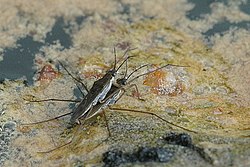
Picture of Gerromorpha
- Source
- Wikipedia/Commons
- Credit
- James K. Lindsey
- Licence
- CC BY-SA 3.0
- Commercial use
- the licence allows it
No 3D scan of Gerromorpha was found in MorphoSource and Sketchfab.
Smithsonian Open Access was not reached for this taxon, so this list is what the others held rather than everything there is.
The description on this site
- Source
- Wikipedia, “Gerromorpha”
- Licence
- CC BY-SA 4.0
This is what the site found, which is not the same as what exists.
Keep going
What may have been alongside itHeteroptera through timeFormations of the EoceneThe world it lived on
Occurrence data from the Paleobiology Database, CC BY 4.0. Popov 1971