Glossotherium
Glossotherium is an extinct genus of large mylodontid ground sloths of the subfamily Mylodontinae. It represents one of the best-known members of the family, along with Mylodon and Paramylodon. Reconstructed animals were between 3 and 4 metres long and possibly weighed up to 1,002.6–1,500 kg. The majority of finds of Glossotherium date from the Middle and Late Pleistocene, around 300,000 to 12,000 years ago, with a few dating older, as far back Pliocene, about 3.3-3 million years ago. The range included large parts of South America, east of the Andes roughly from latitude 20 to 40 degrees south, leaving out the Amazon Basin in the north. In western South America, finds are also documented north of the equator. The animals largely inhabited the open landscapes of the Pampas and northern savanna regions.

Rept0n1x · CC BY-SA 3.0 · via Wikipedia/Commons. May be a photograph of a specimen, or an artist’s reconstruction — an interpretation of a skeleton, since colour and soft tissue are almost never preserved.
On record
Recorded, not inferred- Sits inside
- MylodontinaePBDB
- Diet
- herbivorePBDB, for Mylodontidae
- Life habit
- ground dwellingPBDB, for Mylodontidae
- Motility
- actively mobilePBDB, for Osteichthyes
- Environment
- terrestrialPBDB, for Eutheria
Time the record covers
At least 4.5 million years on record.
The record covers at least 4.7 Mya to 129 ka. No occurrence read is dated outside 11.63 Mya to 0 Mya.
95 occurrences of Glossotherium on record, most of them in the Pleistocene. Bar height is expected occurrences, not a count: each fossil is spread across the span it is dated to, so a tall narrow bar means tight dating and a low wide one means loose.
When
95 occurrences- Miocene2%
- Pliocene13%
- Pleistocene85%
These are dates about fossils, not the animal: the record can only begin after it arose and end before it died out, so either end may reach further. Shares are expected occurrences: a fossil dated to a span is counted partly in each period it straddles. More on what this infers.
Found in
16 formations
- Lujan Formation5
- Rancho Viejo Beds Formation4
- Tamiami Formation4
- Salto Ander Egg Formation3
- Chapadmalal Formation3
- Sopas Formation2
Loading coastlines…
The named rock units Glossotherium has been recovered from, largest first. Drawn where the rock is now, not where it formed. 61 occurrences have no formation on record, which is common for older literature.
Glossotherium and its relatives
PleistoceneWhere Glossotherium and its relatives were recorded in the Pleistocene.
Found in the same rock
640 taxa- Equus17 sites
- Lestodon armatus17 sites
- Gomphotheriidae16 sites
- Toxodon platensis14 sites
- Megatherium americanum13 sites
- Notiomastodon platensis13 sites
- Panochthus13 sites
- Smilodon populator12 sites
- Hippidion principale11 sites
- Macrauchenia patagonica11 sites
- Glyptodon10 sites
- Glyptodon reticulatus10 sites
- Hemiauchenia paradoxa10 sites
- Platygonus10 sites
- Equus caballus9 sites
- Glyptodon clavipes9 sites
- Lama9 sites
- Nannippus peninsulatus9 sites
- Neochoerus9 sites
- Panochthus tuberculatus9 sites
- Eremotherium8 sites
- Hippidion8 sites
- Pampatherium8 sites
- Toxodon8 sites
The Paleobiology Database records 70 sites for Glossotherium, and this reads all of them. The number is how many of those sites it was catalogued from too. The 24 sharing the most are listed.
This is not a list of everything alive at the time. It is only what has come out of the same ground as this animal and been written down.
Entered from
51 references- Les Mammiferes Pleistocenes de la Republique de L´Equateur15
- Co-occurrence of mylodontid sloths and insights on their potential distributions during the late Pleistocene9
- Xenarthrans of the collection of Santiago Roth from the Pampean Region of Argentina (Pleistocene), in Zurich, Switzerland6
- The mylodontine ground sloth Glossotherium tropicorum from the late Pleistocene of Ecuador and Peru4
- New Postcranial Remains of Ground Sloths (Xenarthra, Folivora, Mylodontidae) from Southern Brazil3
- New well-preserved materials of Glossotherium chapadmalense (Xenarthra, Mylodontidae) from the Pliocene of Argentina shed light on the origin and evolution of the genus3
- Síntesis actualizada del registro paleontológico pleistoceno en el Noroeste argentino2
- Vertebrate continental assemblage from the Last Interglacial in southern South America (Entre Ríos, Argentina). Biostratigraphy and paleoenvironment2
- Pleistocene mammals from Uruguay: Biostratigraphic, biogeographic and environmental connotations2
- Late Cenozoic mammal bio-chronostratigraphy in southwestern Buenos Aires Province, Argentina2
- Geochronology of Hemphillian-Blancan aged strata, Guanajuato, Mexico, and implications for the timing of the Great American Biotic Interchange2
- Synonymies and reidentifications of North American fossil mammals2
Each of the 95 occurrences read was entered from one of these publications, ordered by how many each accounts for. This is not a search for papers mentioning the name. 39 further references are not listed. Entries link to doi.org where the Paleobiology Database holds an identifier, and to its own record where it does not. Relayed as the Paleobiology Database holds them, not checked against what they resolve to.
Media and terms
Media content3
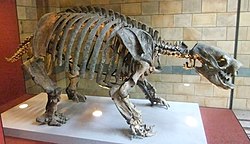
Picture of Glossotherium
- Source
- Wikipedia/Commons
- Credit
- Rept0n1x
- Licence
- CC BY-SA 3.0
- Commercial use
- the licence allows it
Structured light scan
- Source
- MorphoSource
- Credit
- Instituto de Investigaciones Arqueológicas y Paleontológicas del Cuaternario Pampeano (INCUAPA)
- Licence
- not stated by the source
- Commercial use
- cannot be read from the licence given — check the record
- Specimen
- Glossotherium robustum · FCS-P.160
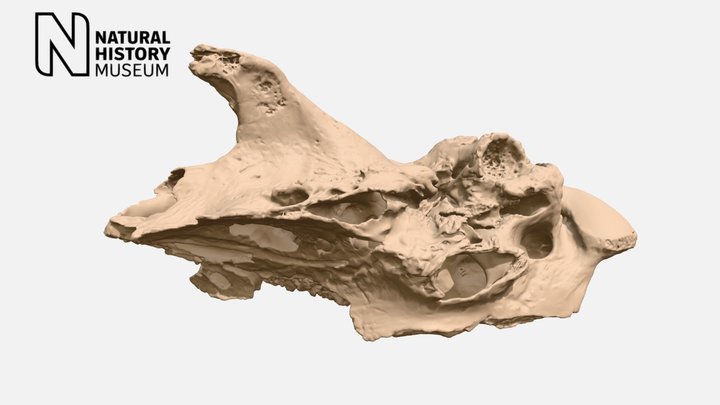
3D model
- Source
- Sketchfab
- Credit
- NHM_Imaging
- Licence
- CC Attribution-NonCommercial
- Commercial use
- the licence does not allow it
Smithsonian Open Access was not reached for this taxon, so this list is what the others held rather than everything there is.
The description on this site
- Licence
- CC BY-SA 4.0
This is what the site found, which is not the same as what exists.
Keep going
What may have been alongside itMylodontinae through timeFormations of the PleistoceneThe world it lived on
Occurrence data from the Paleobiology Database, CC BY 4.0. Owen 1840