Eremotherium
Eremotherium is an extinct genus of giant ground sloth in the family Megatheriidae. Eremotherium lived in southern North America, Central America, and northern South America. It was one of the largest sloths, with a body size comparable to elephants, weighing around 4.5 tonnes and measuring about 6 metres (20 ft) long, slightly larger than its close relative Megatherium.

Wikipedia Loves Art participant " Kamraman " · CC BY-SA 2.5 · via Wikipedia/Commons. May be a photograph of a specimen, or an artist’s reconstruction — an interpretation of a skeleton, since colour and soft tissue are almost never preserved.
On record
Recorded, not inferred- Sits inside
- MegatheriinaePBDB
- Diet
- herbivorePBDB, for Megatheriidae
- Life habit
- ground dwellingPBDB, for Megatheriidae
- Motility
- actively mobilePBDB, for Osteichthyes
- Environment
- terrestrialPBDB, for Eutheria
- Length
- 6 mWikidata
- Mass
- 3 tonneWikidata
Time the record covers
At least 4.9 million years on record.
The record covers at least 5 Mya to 11.7 ka. No occurrence read is dated outside 8 Mya to 0 Mya.
148 occurrences of Eremotherium on record, most of them in the Pleistocene. Bar height is expected occurrences, not a count: each fossil is spread across the span it is dated to, so a tall narrow bar means tight dating and a low wide one means loose.
When
148 occurrences- Mioceneunder 1%
- Pliocene3%
- Pleistocene96%
- Holoceneunder 1%
These are dates about fossils, not the animal: the record can only begin after it arose and end before it died out, so either end may reach further. Shares are expected occurrences: a fossil dated to a span is counted partly in each period it straddles. More on what this infers.
Found in
19 formations
- Tamiami Formation3
- Caloosahatchee Formation2
- Mesa Formation2
- Cuscatlán Formation1
- Bermont Formation1
- Solimões Formation1
Loading coastlines…
The named rock units Eremotherium has been recovered from, largest first. Drawn where the rock is now, not where it formed. 125 occurrences have no formation on record, which is common for older literature.
Eremotherium and its relatives
PleistoceneWhere Eremotherium and its relatives were recorded in the Pleistocene.
Found in the same rock
776 taxa- Equus42 sites
- Notiomastodon platensis22 sites
- Glyptotherium18 sites
- Odocoileus virginianus17 sites
- Mixotoxodon larensis14 sites
- Paramylodon harlani14 sites
- Mammuthus columbi13 sites
- Cuvieronius tropicus12 sites
- Dasypus bellus12 sites
- Toxodon12 sites
- Mazama11 sites
- Smilodon populator11 sites
- Glyptotherium cylindricum10 sites
- Holmesina floridanus10 sites
- Neochoerus10 sites
- Odocoileus10 sites
- Cuvieronius hyodon9 sites
- Equus conversidens9 sites
- Mammut americanum9 sites
- Tapirus9 sites
- Hemiauchenia macrocephala8 sites
- Notiomastodon8 sites
- Pampatherium8 sites
- Smilodon8 sites
The Paleobiology Database records 125 sites for Eremotherium, and this reads all of them. The number is how many of those sites it was catalogued from too. The 24 sharing the most are listed.
This is not a list of everything alive at the time. It is only what has come out of the same ground as this animal and been written down.
Entered from
78 references- A new specimen of Eremotherium laurillardi (Xenarthra, Megatheriidae) from the Late Pleistocene of Chiapas, southern of Mexico, and comments about the distribution of the species in Mexico29
- A new giant megatheriine ground sloth (Mammalia: Xenarthra: Megatheriidae) from the late Blancan to early Irvingtonian of Florida10
- Fossil Pleistocene to Sub-Recent Mammals from Northeastern Brazil. I - Edentata Megalonychidae7
- Guatemala's Late Pleistocene (Rancholabrean) fauna: Revision and interpretation6
- A systematic reassessment and paleogeographic review of fossil Xenarthra from Peru6
- Overview of the geology and vertebrate biochronology of the Leisey Shell Pit Local Fauna, Hillsborough County, Florida5
- Additions to the Pleistocene Mammal Faunas of South Carolina, North Carolina, and Georgia3
- La faune de vertébrés du Pléistocéne supérieur de l’aire archéologique de São Raimundo Nonato (Piauí, Brésil)3
- Late Cenozoic Vertebrates from Honduras and El Salvador3
- Recent archaeo-palaeontogical findings from Barranca del Muerto site, Santiago Chazumba, Oaxaca, Mexico2
- Tanque Loma, a new late-Pleistocene megafaunal tar seep locality from southwest Ecuador2
- The fossil mammals of Nicaragua2
Each of the 148 occurrences read was entered from one of these publications, ordered by how many each accounts for. This is not a search for papers mentioning the name. 66 further references are not listed. Entries link to doi.org where the Paleobiology Database holds an identifier, and to its own record where it does not. Relayed as the Paleobiology Database holds them, not checked against what they resolve to.
Media and terms
Media content3
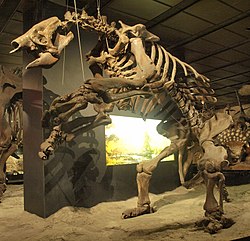
Picture of Eremotherium
- Source
- Wikipedia/Commons
- Credit
- Wikipedia Loves Art participant " Kamraman "
- Licence
- CC BY-SA 2.5
- Commercial use
- the licence allows it
Laser scan
- Source
- MorphoSource
- Licence
- not stated by the source
- Commercial use
- cannot be read from the licence given — check the record
- Specimen
- Eremotherium eomigrans · UF:VP:206880
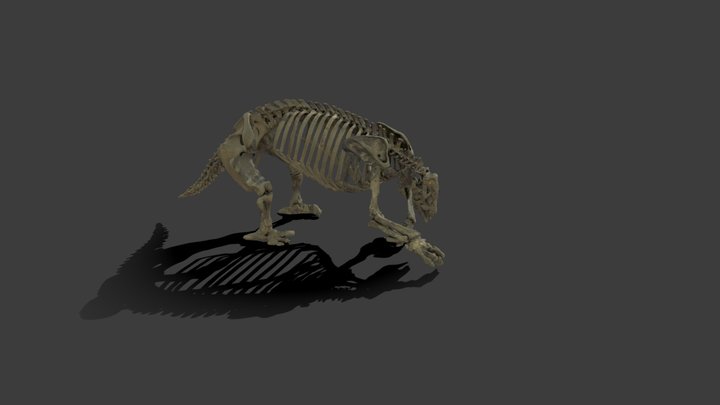
3D model
- Source
- Sketchfab
- Licence
- CC0 Public Domain
- Commercial use
- the licence allows it
The description on this site
- Licence
- CC BY-SA 4.0
This is what the site found, which is not the same as what exists.
Keep going
What may have been alongside itMegatheriinae through timeFormations of the PleistoceneThe world it lived on
Occurrence data from the Paleobiology Database, CC BY 4.0. Spillmann 1948