Gomphonchus
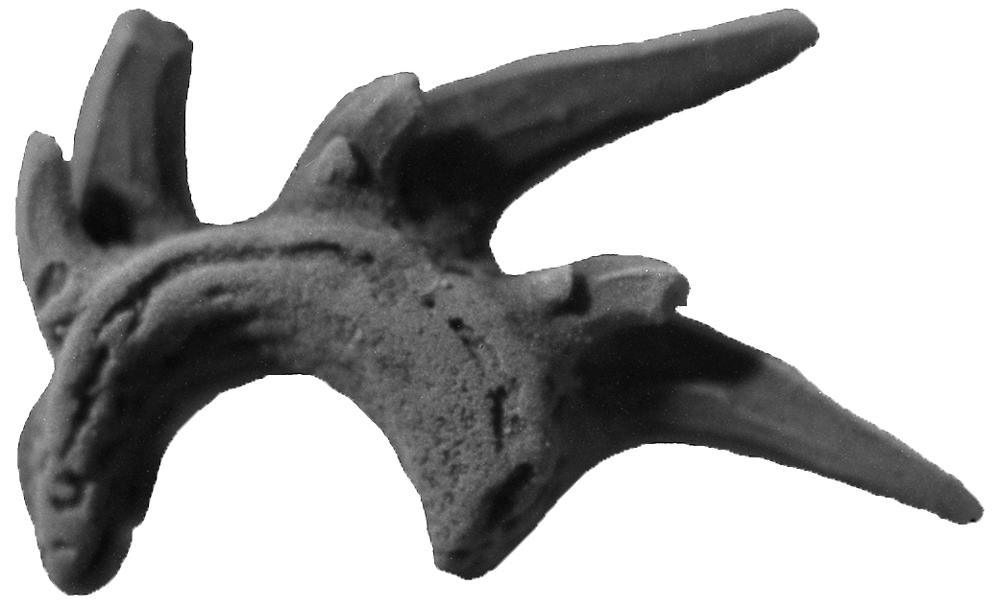
Märss · CC BY-NC 4.0 · via GBIF. May be a photograph of a specimen, or an artist’s reconstruction — an interpretation of a skeleton, since colour and soft tissue are almost never preserved.
On record
Recorded, not inferred- Sits inside
- IschnacanthidaePBDB
- Diet
- carnivorePBDB, for Acanthodii
- Life habit
- nektonicPBDB, for Acanthodii
- Motility
- actively mobilePBDB, for Acanthodii
Time the record covers
At least 29 million years on record.
The record covers at least 422.7 Mya to 393.47 Mya. No occurrence read is dated outside 432.9 Mya to 387.95 Mya.
18 occurrences of Gomphonchus on record, most of them in the Silurian. Bar height is expected occurrences, not a count: each fossil is spread across the span it is dated to, so a tall narrow bar means tight dating and a low wide one means loose.
When
18 occurrencesThese are dates about fossils, not the animal: the record can only begin after it arose and end before it died out, so either end may reach further. Shares are expected occurrences: a fossil dated to a span is counted partly in each period it straddles. More on what this infers.
Found in
12 formations
- Yanglugou Formation2
- Ohesaare Formation2
- Windmill Limestone Formation2
- Drake Bay Formation2
- Chester Bjerg Formation2
- Catavi Formation1
Loading coastlines…
The named rock units Gomphonchus has been recovered from, largest first. Drawn where the rock is now, not where it formed. 1 occurrence has no formation on record, which is common for older literature.
Gomphonchus and its relatives
SilurianWhere Gomphonchus and its relatives were recorded in the Silurian.
Found in the same rock
154 taxa- Canonia grossi3 sites
- Nostolepis3 sites
- Nostolepis gracilis3 sites
- Nostolepis striata3 sites
- Actinopteria2 sites
- Anaspida2 sites
- Buchanosteid indet.2 sites
- Calymene2 sites
- Fistulipora2 sites
- Heterostraci2 sites
- Lophosteus superbus2 sites
- Onchus2 sites
- Osteostraci2 sites
- Placodermi indet.2 sites
- Poracanthodes2 sites
- Poracanthodes cf. porosus2 sites
- Poracanthodes cf. punctatus2 sites
- Praetrilogania grabion2 sites
- Thelodus parvidens2 sites
- Acanthodii1 site
- Acaste1 site
- Actinopterygii1 site
- Aesopomum delicatum1 site
- Ancoradella ploeckensis1 site
The Paleobiology Database records 13 sites for Gomphonchus, and this reads all of them. The number is how many of those sites it was catalogued from too. The 24 sharing the most are listed.
This is not a list of everything alive at the time. It is only what has come out of the same ground as this animal and been written down.
Entered from
12 references- Silurian vertebrate assemblages of China3
- A new pteraspid (Agnatha, Heterostraci) from the Lower Devonian Drake Bay Formation, Prince of Wales Island, Nunavut, Arctic Canada, and comments on environmental preferences of pteraspids2
- Vertebrate remains from Upper Silurian – Lower Devonian beds of Hall Land, North Greenland2
- Locality 7:4 Ohesaare Cliff2
- Early Devonian vertebrate microfossils from the Simpson Park Range, Eureka County, Nevada2
- The Xiaoxiang Fauna (Ludlow, Silurian) - a window to explore the early diversification of jawed vertebrates1
- A new ischnacanthid acanthodian from the Late Silurian (Ludlow, ploeckensis Zone) Jack Formation, north Queensland1
- Locality 7:3 Kaugatuma Cliff1
- New studies on the Devonian of New Zealand1
- The Devonian vertebrate and mollusc fauna from Seripona (Dept. of Chiquisaca, Bolivia)1
- A Devonian fish fauna from subsurface sediments in the eastern Officer Basin, South Australia1
- The vertebrate stratigraphy of the Lower Devonian (Red Bay Group and Wood Bay Formation) of Spitsbergen1
Each of the 18 occurrences read was entered from one of these publications, ordered by how many each accounts for. This is not a search for papers mentioning the name. Entries link to doi.org where the Paleobiology Database holds an identifier, and to its own record where it does not. Relayed as the Paleobiology Database holds them, not checked against what they resolve to.
Media and terms
Media content1
Picture of Gomphonchus
- Source
- GBIF
- Credit
- Märss
- Licence
- CC BY-NC 4.0
- Commercial use
- the licence does not allow it
No 3D scan was found. Smithsonian Open Access, MorphoSource and Sketchfab were all searched.
This is what the site found, which is not the same as what exists.
Keep going
What may have been alongside itIschnacanthidae through timeFormations of the SilurianThe world it lived on
Occurrence data from the Paleobiology Database, CC BY 4.0. Gross 1971