Haematopus palliatus
The American oystercatcher, occasionally called the American pied oystercatcher, is a member of family Haematopodidae. Originally called the "sea pie", it was renamed in 1731 when naturalist Mark Catesby claimed that he had observed the bird eating oysters. The current population of American oystercatchers is estimated to be 50,000 – 99,999 mature individuals. There are estimated to be 1,500 breeding pairs along the Atlantic and Gulf Coasts of the US. The bird is marked by its black and white body and a long, thick orange beak.

Rhododendrites · CC BY-SA 4.0 · via Wikipedia/Commons. May be a photograph of a specimen, or an artist’s reconstruction — an interpretation of a skeleton, since colour and soft tissue are almost never preserved.
On record
Recorded, not inferred- Also called
- American oystercatcherPBDB
- Sits inside
- HaematopusPBDB
- Diet
- carnivorePBDB, for Coelurosauria
- Life habit
- ground dwelling, solitaryPBDB, for Theropoda
- Motility
- actively mobilePBDB, for Theropoda
- Environment
- marinePBDB, for Charadriiformes
Time the record covers
At least 1.9 million years on record.
The record covers at least 7.246 Mya to 5.333 Mya. No occurrence read is dated outside 11.63 Mya to 3.6 Mya.
2 occurrences of Haematopus palliatus on record, most of them in the Miocene. The Paleobiology Database records this as a living group, and the chart stops with its fossils rather than at the present. Bar height is expected occurrences, not a count: each fossil is spread across the span it is dated to, so a tall narrow bar means tight dating and a low wide one means loose.
When
2 occurrencesThese are dates about fossils, not the animal: the record can only begin after it arose and end before it died out, so either end may reach further. Shares are expected occurrences: a fossil dated to a span is counted partly in each period it straddles. More on what this infers.
Found in
2 formations
- Yorktown Formation · Chesapeake Group1
- Peace River Formation · Hawthorn Group1
Loading coastlines…
The named rock units Haematopus palliatus has been recovered from, largest first. Drawn where the rock is now, not where it formed.
Haematopus palliatus and its relatives
MioceneWhere Haematopus palliatus and its relatives were recorded in the Miocene.
Found in the same rock
436 taxa- Gavia concinna2 sites
- Larus2 sites
- Phalacrocorax wetmorei2 sites
- Phoebastria anglica2 sites
- <Brotulid>1 site
- Acanthocybium solandri1 site
- Accipitridae1 site
- Acipenser oxyrhynchus1 site
- Actinocythereis1 site
- Actinocythereis captionis1 site
- Acuticythereis1 site
- Aethiinae1 site
- Aetobatus1 site
- Agonidae1 site
- Alca1 site
- Alca ausonia1 site
- Alca carolinensis1 site
- Alca minor1 site
- Alca olsoni1 site
- Alca torda1 site
- Alopias vulpinus1 site
- Alosa sapidissima1 site
- Aluterus1 site
- Ammodytes hexapterus1 site
The Paleobiology Database records 2 sites for Haematopus palliatus, and this reads all of them. The number is how many of those sites it was catalogued from too. The 24 sharing the most are listed.
This is not a list of everything alive at the time. It is only what has come out of the same ground as this animal and been written down.
Entered from
2 references- Miocene and Pliocene birds from the Lee Creek Mine, North Carolina1
- The avifauna of the Bone Valley Formation1
Each of the 2 occurrences read was entered from one of these publications, ordered by how many each accounts for. This is not a search for papers mentioning the name. Entries link to doi.org where the Paleobiology Database holds an identifier, and to its own record where it does not. Relayed as the Paleobiology Database holds them, not checked against what they resolve to.
Media and terms
Media content3

Picture of Haematopus palliatus
- Source
- Wikipedia/Commons
- Credit
- Rhododendrites
- Licence
- CC BY-SA 4.0
- Commercial use
- the licence allows it
Structured light scan
- Source
- MorphoSource
- Licence
- not stated by the source
- Commercial use
- cannot be read from the licence given — check the record
- Specimen
- Haematopus palliatus palliatus · ROM:Birds:123861
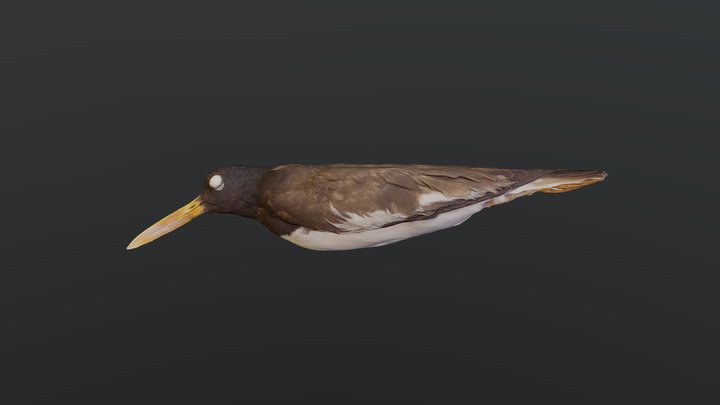
Smithsonian Open Access was not reached for this taxon, so this list is what the others held rather than everything there is.
The description on this site
- Licence
- CC BY-SA 4.0
This is what the site found, which is not the same as what exists.
Keep going
What may have been alongside itHaematopus through timeFormations of the MioceneThe world it lived on
Occurrence data from the Paleobiology Database, CC BY 4.0. Temminick 1820