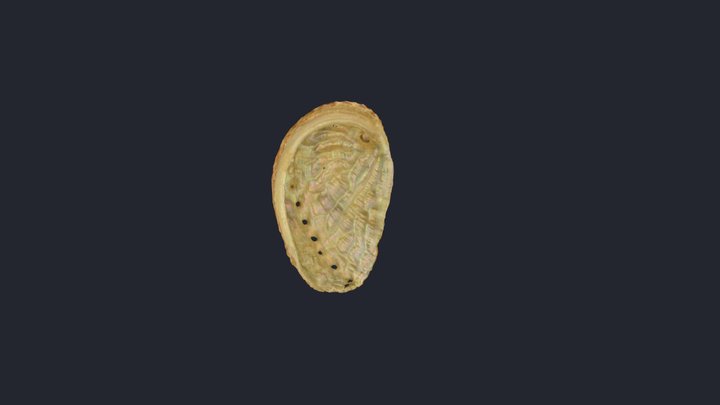
Haliotis tuberculata
The green ormer is a northeast Atlantic and Mediterranean species of sea snail, a coastal marine gastropod mollusc in the family Haliotidae, the abalone or ormer snails.

Philippe Guillaume · CC BY 2.0 · via Wikipedia/Commons. May be a photograph of a specimen, or an artist’s reconstruction — an interpretation of a skeleton, since colour and soft tissue are almost never preserved.
On record
Recorded, not inferred- Sits inside
- HaliotisPBDB
- Diet
- grazerPBDB, for Vetigastropoda
- Life habit
- epifaunalPBDB, for Vetigastropoda
- Motility
- actively mobilePBDB, for Vetigastropoda
- Vision
- limitedPBDB, for Gastropoda
Time the record covers
At least 13 million years on record.
The record covers at least 13.82 Mya to 129 ka. No occurrence read is dated outside 15.98 Mya to 11.7 ka.
31 occurrences of Haliotis tuberculata on record, most of them in the Miocene. The Paleobiology Database records this as a living group. Bar height is expected occurrences, not a count: each fossil is spread across the span it is dated to, so a tall narrow bar means tight dating and a low wide one means loose.
When
31 occurrences- Miocene55%
- Pliocene10%
- Pleistocene35%
These are dates about fossils, not the animal: the record can only begin after it arose and end before it died out, so either end may reach further. Shares are expected occurrences: a fossil dated to a span is counted partly in each period it straddles. More on what this infers.
Found in
3 formations
Loading coastlines…
The named rock units Haliotis tuberculata has been recovered from, largest first. Drawn where the rock is now, not where it formed. 27 occurrences have no formation on record, which is common for older literature.
Haliotis tuberculata and its relatives
MioceneWhere Haliotis tuberculata and its relatives were recorded in the Miocene.
Found in the same rock
351 taxa- Conus13 sites
- Lithophaga lithophaga13 sites
- Chlamys12 sites
- Creusia11 sites
- Cypraea11 sites
- Lima lima11 sites
- Serpulidae11 sites
- Talochlamys pusio11 sites
- Anadara9 sites
- Barbatia (Barbatia) barbata9 sites
- Bryozoa9 sites
- Venus (Ventricoloidea) multilamella9 sites
- Chama gryphoides8 sites
- Gastrana fragilis8 sites
- Porites8 sites
- Vermetus8 sites
- Acar7 sites
- Arca noae7 sites
- Botula fusca7 sites
- Cerithium (Thericium) vulgatum7 sites
- Diplodonta (Diplodonta) rotundata7 sites
- Glycymeris7 sites
- Jouannetia (Jouannetia) tournoueri7 sites
- Porites calabricae7 sites
The Paleobiology Database records 17 sites for Haliotis tuberculata, and this reads all of them. The number is how many of those sites it was catalogued from too. The 24 sharing the most are listed.
This is not a list of everything alive at the time. It is only what has come out of the same ground as this animal and been written down.
Entered from
15 references- Les formations recifales coralliennes du Miocene superieur d'Algerie et du Maroc [Upper Miocene coral reef formations from Algeria and Morocco]10
- Palaeoecology of the Pleistocene (MIS 5) outcrops of Santa Maria Island (Azores) in a complex oceanic tectonic setting3
- The Early Pliocene Gastropoda (Mollusca) of Estepona, Southern Spain. Part 1: Vetigastropoda3
- Checklist of the Pleistocene marine molluscs of Prainha and Lagoinhas (Santa Maria Island, Azores)2
- The marine Quaternary of the Canary Islands2
- Recherches sur le Neogene et le Quaternaire marins de la cote Atlantique du Maroc2
- A new coral-associated decapod assemblage from the Upper Miocene (Messinian) Upper Coralline Limestone of Malta (central Mediterranean)1
- Les constructions coralliennes du Badenien (Miocene moyen) de la bordure occidentale de la depression de Transylvanie (Roumanie) [Badenian (Middle Miocene) coral build-ups of the western border of the Transylvanian Basin (Romania)]1
- Pleistocene coralline algal build-ups (corallige`ne de plateau) and associated bioclastic deposits in the sedimentary cover of Cutro marine terrace (Calabria, southern Italy)1
- Late Quaternary warm marine mollusks from Santa Maria (Azores) paleoecologic and paleobiogeographic considerations1
- Coral microbialite environment in a Middle Miocene reef of Hungary1
- Paleoecology of a Pliocene coral reef in Cyprus: recovery of a marine community from the Messinian Salinity Crisis1
Each of the 31 occurrences read was entered from one of these publications, ordered by how many each accounts for. This is not a search for papers mentioning the name. 3 further references are not listed. Entries link to doi.org where the Paleobiology Database holds an identifier, and to its own record where it does not. Relayed as the Paleobiology Database holds them, not checked against what they resolve to.
Media and terms
Media content2

Picture of Haliotis tuberculata
- Source
- Wikipedia/Commons
- Credit
- Philippe Guillaume
- Licence
- CC BY 2.0
- Commercial use
- the licence allows it
Smithsonian Open Access was not reached for this taxon, so this list is what the others held rather than everything there is.
The description on this site
- Source
- Wikipedia, “Green ormer”
- Licence
- CC BY-SA 4.0
This is what the site found, which is not the same as what exists.
Keep going
What may have been alongside itHaliotis through timeFormations of the MioceneThe world it lived on
Occurrence data from the Paleobiology Database, CC BY 4.0. Linnaeus 1758