Hecticoceras
Hecticoceras is an ammonite genus belonging to the haploceratoid family Oppeliidae, that lived during the Middle and Late Jurassic, from the Callovian. Hecticoceras may be seen as a series of some nine subgenera, beginning with the lower Callovian H. (Hecticoceras) and H. (Hecticoceratoides) and ending with the lower Oxfordian H. (Pseudobrightia) and H. (Eochetoceras). Hecticoceras sensu lato and Prohecticoceras from the underlying Bathonian form the oppeliid subfamily, Hecticoceratinae.

Ghedoghedo · CC BY-SA 4.0 · via Wikipedia/Commons. May be a photograph of a specimen, or an artist’s reconstruction — an interpretation of a skeleton, since colour and soft tissue are almost never preserved.
On record
Recorded, not inferred- Sits inside
- HecticoceratinaePBDB
- Diet
- carnivorePBDB, for Ammonoidea
- Life habit
- nektonicPBDB, for Ammonoidea
- Motility
- fast-movingPBDB, for Ammonoidea
- Vision
- well-developedPBDB, for Cephalopoda
- Environment
- marinePBDB, for Cephalopoda
Time the record covers
At most 26 million years on record.
Every occurrence read is dated to somewhere between 168.2 Mya and 143.1 Mya, and nothing in the dating separates them, so that window is what the record shows rather than a span.
124 occurrences of Hecticoceras on record, most of them in the Middle Jurassic. Bar height is expected occurrences, not a count: each fossil is spread across the span it is dated to, so a tall narrow bar means tight dating and a low wide one means loose.
When
124 occurrencesThese are dates about fossils, not the animal: the record can only begin after it arose and end before it died out, so either end may reach further. Shares are expected occurrences: a fossil dated to a span is counted partly in each period it straddles. More on what this infers.
Found in
15 formations
- Habo beds Formation19
- "Sengenthal" Formation16
- Lotena Formation11
- "Berching" Formation3
- Gerpigem Formation3
- Croûte ferrugineuse Formation2
Loading coastlines…
The named rock units Hecticoceras has been recovered from, largest first. Drawn where the rock is now, not where it formed. 59 occurrences have no formation on record, which is common for older literature.
Hecticoceras and its relatives
Middle JurassicWhere Hecticoceras and its relatives were recorded in the Middle Jurassic.
Found in the same rock
445 taxa- Choffatia24 sites
- Kosmoceras12 sites
- Sublunuloceras nodosulcatum10 sites
- Indosphinctes9 sites
- Macrocephalites8 sites
- Reineckeia8 sites
- Lunuloceras lunuloides7 sites
- Orbignyceras pseudopunctatum7 sites
- Alligaticeras6 sites
- Grammatodon (Indogrammatodon)6 sites
- Perisphinctes6 sites
- Phlycticeras pustulatum6 sites
- Collotia5 sites
- Kamptokephalites5 sites
- Kellawaysites5 sites
- Kinkeliniceras angygaster5 sites
- Kosmoceras spinosum5 sites
- Lunuloceras5 sites
- Obtusicostites5 sites
- Peltoceras5 sites
- Pleurocephalites5 sites
- Sublunuloceras discoides5 sites
- Actinostreon gregarea4 sites
- Alcidia4 sites
The Paleobiology Database records 80 sites for Hecticoceras, and this reads all of them. The number is how many of those sites it was catalogued from too. The 24 sharing the most are listed.
This is not a list of everything alive at the time. It is only what has come out of the same ground as this animal and been written down.
Entered from
21 references- Zur Stratigraphie des Mittel- und unteren Oberjuras in Sengenthal bei Neumarkt /Opf. (Fränkische Alb) [On the stratigraphy of the Middle and early Upper Jurassic at Sengenthal, near Neumarkt/Opf. (Franconian Alb)]19
- Habo Beds near Ler (Kutch): Pt. 3 - Biostratigraphy of the beds on the east of Ler19
- Geologie de Madagascar I. Les Terrains Sedimentaires15
- Stratigraphie und Palaeontologie des oolithischen Eisenerzlagers von Herznach und seiner Umgebung15
- Oxfordian and late Callovian ammonite faunas and biostratigraphy of the Neuquen-Mendoza and Tarapaca Basins (Jurassic, Ammonoidea, Western South-America)14
- La série callovienne du Nord-Ouest du bassin d'Aquitaine9
- La succession des faunes dans le Callovien Francais, essais de corrélation à l'échelle de la zone8
- Atlas des fossiles caractéristiques de Madagascar (Ammonites). Fascicule II (Bathonien, Callovien). Pl. VI-XXXIII6
- Upper Jurassic Reefs from the Russian Western Caucasus: Implications for the Eastern Black Sea4
- Les terebratulidae du Dogger dans le Mâconnais, le mont d'Or lyonnais et le Jura méridional: Étude systématique et biostratigraphique. Rapports avec la paléoécologie3
- Unpublished data from Kachchh2
- The ammonite fauna of the La Manga Formation (Late Callovian-Early Oxfordian) of Vega de la Veranada, Neuquén Basin, Argentina1
Each of the 124 occurrences read was entered from one of these publications, ordered by how many each accounts for. This is not a search for papers mentioning the name. 9 further references are not listed. Entries link to doi.org where the Paleobiology Database holds an identifier, and to its own record where it does not. Relayed as the Paleobiology Database holds them, not checked against what they resolve to.
Media and terms
Media content2

Picture of Hecticoceras
- Source
- Wikipedia/Commons
- Credit
- Ghedoghedo
- Licence
- CC BY-SA 4.0
- Commercial use
- the licence allows it
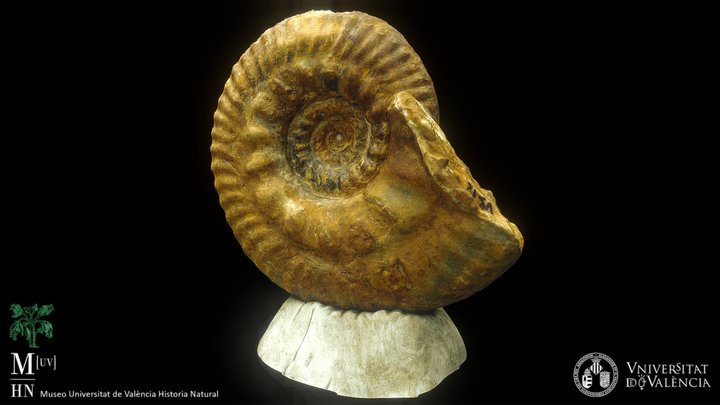
3D model
- Source
- Sketchfab
- Licence
- CC Attribution
- Commercial use
- cannot be read from the licence given — check the record
The description on this site
- Licence
- CC BY-SA 4.0
This is what the site found, which is not the same as what exists.
Keep going
What may have been alongside itHecticoceratinae through timeFormations of the Middle JurassicThe world it lived on
Occurrence data from the Paleobiology Database, CC BY 4.0. Bonarelli 1893