Heterodontosauridae
Heterodontosauridae is a family of ornithischian dinosaurs that were likely among the most basal (primitive) members of the group. Their phylogenetic placement is uncertain but they are most commonly found outside of the group Genasauria. Although their fossils are relatively rare and their group small in numbers, they have been found on all continents except Australia and Antarctica, with a range spanning the Early Jurassic to the Early Cretaceous.

Daderot · CC0 · via Wikipedia/Commons. May be a photograph of a specimen, or an artist’s reconstruction — an interpretation of a skeleton, since colour and soft tissue are almost never preserved.
On record
Recorded, not inferred- Also called
- heterodontosauridPBDB
- Sits inside
- PrionodontiaPBDB
- Diet
- herbivorePBDB, for Ornithischia
- Life habit
- ground dwelling, gregariousPBDB, for Ornithischia
- Motility
- actively mobilePBDB, for Ornithischia
- Environment
- terrestrialPBDB, for Ornithischia
Time the record covers
At least 79 million years on record.
The record covers at least 205.7 Mya to 125.77 Mya. No occurrence read is dated outside 227.3 Mya to 121.4 Mya.
39 occurrences of Heterodontosauridae on record, most of them in the Early Jurassic. Bar height is expected occurrences, not a count: each fossil is spread across the span it is dated to, so a tall narrow bar means tight dating and a low wide one means loose.
When
39 occurrencesThese are dates about fossils, not the animal: the record can only begin after it arose and end before it died out, so either end may reach further. Shares are expected occurrences: a fossil dated to a span is counted partly in each period it straddles. More on what this infers.
Found in
14 formations
- Elliot Formation · Stormberg Group8
- Morrison Formation5
- Lulworth Formation · Purbeck Group4
- Clarens Formation · Stormberg Group4
- Cañadón Asfalto Formation · Sierra de Olte Group3
- El Castellar Formation1
Loading coastlines…
The named rock units Heterodontosauridae has been recovered from, largest first. Drawn where the rock is now, not where it formed. 6 occurrences have no formation on record, which is common for older literature.
Heterodontosauridae and its relatives
Early JurassicWhere Heterodontosauridae and its relatives were recorded in the Early Jurassic.
Found in the same rock
302 taxa- Goniopholis5 sites
- Mammalia5 sites
- Paramacellodus5 sites
- Squamata5 sites
- Testudines5 sites
- Dorsetisaurus4 sites
- Dryolestidae4 sites
- Heterodontosaurus tucki4 sites
- Lycorhinus angustidens4 sites
- Pterosauria4 sites
- Albanerpetontidae3 sites
- Atoposauridae3 sites
- Coelurosauria3 sites
- Echinodon3 sites
- Echinodon becklesii3 sites
- Fruitadens haagarorum3 sites
- Glirodon grandis3 sites
- Heterodontosaurus3 sites
- Multituberculata3 sites
- Opisthias3 sites
- Paurodontidae3 sites
- Sauropoda3 sites
- Spalacotherium evansae3 sites
- Stegosauria3 sites
The Paleobiology Database records 33 sites for Heterodontosauridae, and this reads all of them. The number is how many of those sites it was catalogued from too. The 24 sharing the most are listed.
This is not a list of everything alive at the time. It is only what has come out of the same ground as this animal and been written down.
Entered from
29 references- New heterodontosaurid specimens from the Lower Jurassic of southern Africa and the early ornithischian dinosaur radiation4
- Taxonomy, morphology, masticatory function and phylogeny of heterodontosaurid dinosaurs3
- A new Upper Jurassic heterodontosaurid from North America: lower limits of ornithischian dinosaur body size inferred from North America3
- Fossils from the Elliot and Clarens Formations (Karoo Sequence) of the northeastern Cape, Orange Free State and Lesotho, and a suggested biozonation based on tetrapods3
- Ornithischian dinosaurs from the Lower Cretaceous (Berriasian) of England2
- A new phylogeny of cerapodan dinosaurs1
- A preliminary report of the fossil mammals from a new microvertebrate locality in the Upper Jurassic Morrison Formation, Grand County, Utah1
- New heterodontosaurid remains from the Cañadón Asfalto Formation: cursoriality and the functional importance of the pes in small heterodontosaurids1
- A Middle Jurassic heterodontosaurid dinosaur from Patagonia and the evolution of heterodontosaurids1
- An Early Cretaceous heterodontosaurid dinosaur with filamentous integumentary structures1
- Dinosaurs and other fossil vertebrates from the Late Jurassic and Early Cretaceous of the Galve area, NE Spain1
- The Purbeckian site of Cherves-de-Cognac (Berriasian, Early Cretaceous, southwest France): a continental ecosystem accumulated in an evaporitic littoral depositional environment1
Each of the 39 occurrences read was entered from one of these publications, ordered by how many each accounts for. This is not a search for papers mentioning the name. 17 further references are not listed. Entries link to doi.org where the Paleobiology Database holds an identifier, and to its own record where it does not. Relayed as the Paleobiology Database holds them, not checked against what they resolve to.
Media and terms
Media content1
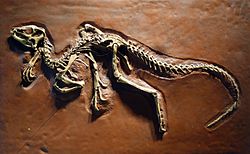
Picture of Heterodontosauridae
- Source
- Wikipedia/Commons
- Credit
- Daderot
- Licence
- CC0
- Commercial use
- the licence allows it
No 3D scan was found. Smithsonian Open Access, MorphoSource and Sketchfab were all searched.
The description on this site
- Licence
- CC BY-SA 4.0
This is what the site found, which is not the same as what exists.
Keep going
What may have been alongside itPrionodontia through timeFormations of the Early JurassicThe world it lived on
Occurrence data from the Paleobiology Database, CC BY 4.0. Romer 1966